

Every project begins with optimism.
The proposal is approved. Resources are allocated. Timelines are defined. Revenue projections look promising.
Yet somewhere between winning the deal and delivering the outcome, things start to break.
Project managers work in one system. Finance teams rely on another. Resource managers maintain separate spreadsheets. Leadership teams receive reports weeks after critical decisions should have been made.
The result?
Projects exceed budgets. Resource utilization drops. Billing cycles slow down. Forecasts become unreliable. Teams spend more time searching for information than delivering value.
For project-based businesses, these challenges are no longer operational inconveniences—they are direct threats to profitability.
As organizations scale, disconnected systems create data silos that prevent teams from making informed decisions in real time. A missed resource allocation can delay delivery. Inaccurate project forecasting can impact cash flow. Poor visibility into project health can turn profitable engagements into costly liabilities.
This challenge has become even more significant in today's AI-driven business environment.
Organizations are rapidly investing in artificial intelligence, automation, and intelligent business applications to improve efficiency. However, AI is only as effective as the data and processes behind it. When project information is scattered across multiple tools, AI cannot deliver meaningful insights, accurate forecasts, or intelligent recommendations.
Modern enterprises need more than project management software.
They need a connected operational framework that unifies sales, project delivery, resource management, finance, and business intelligence into a single ecosystem.
This is where Microsoft Dynamics 365 Project Operations is changing the way project-centric organizations operate.
Built as an AI-powered platform, Dynamics 365 Project Operations connects the entire project lifecycle—from opportunity management and resource planning to project execution, billing, and profitability analysis—within a single environment. This unified approach enables businesses to improve visibility, optimize resources, automate processes, and make faster decisions with confidence.
As a trusted Microsoft Solutions Partner, Proso AI helps organizations unlock the full value of Dynamics 365 Project Operations by combining Microsoft's AI capabilities, business applications expertise, and implementation best practices to build project delivery models that are scalable, data-driven, and future-ready.
In this guide, we'll explore why traditional project management approaches are struggling to keep pace with modern business demands—and how AI-powered project operations are helping organizations move from reactive project management to proactive business transformation.
Project-based businesses are under increasing pressure to deliver projects faster, improve resource utilization, maintain profitability, and provide exceptional customer experiences—all while managing growing operational complexity.
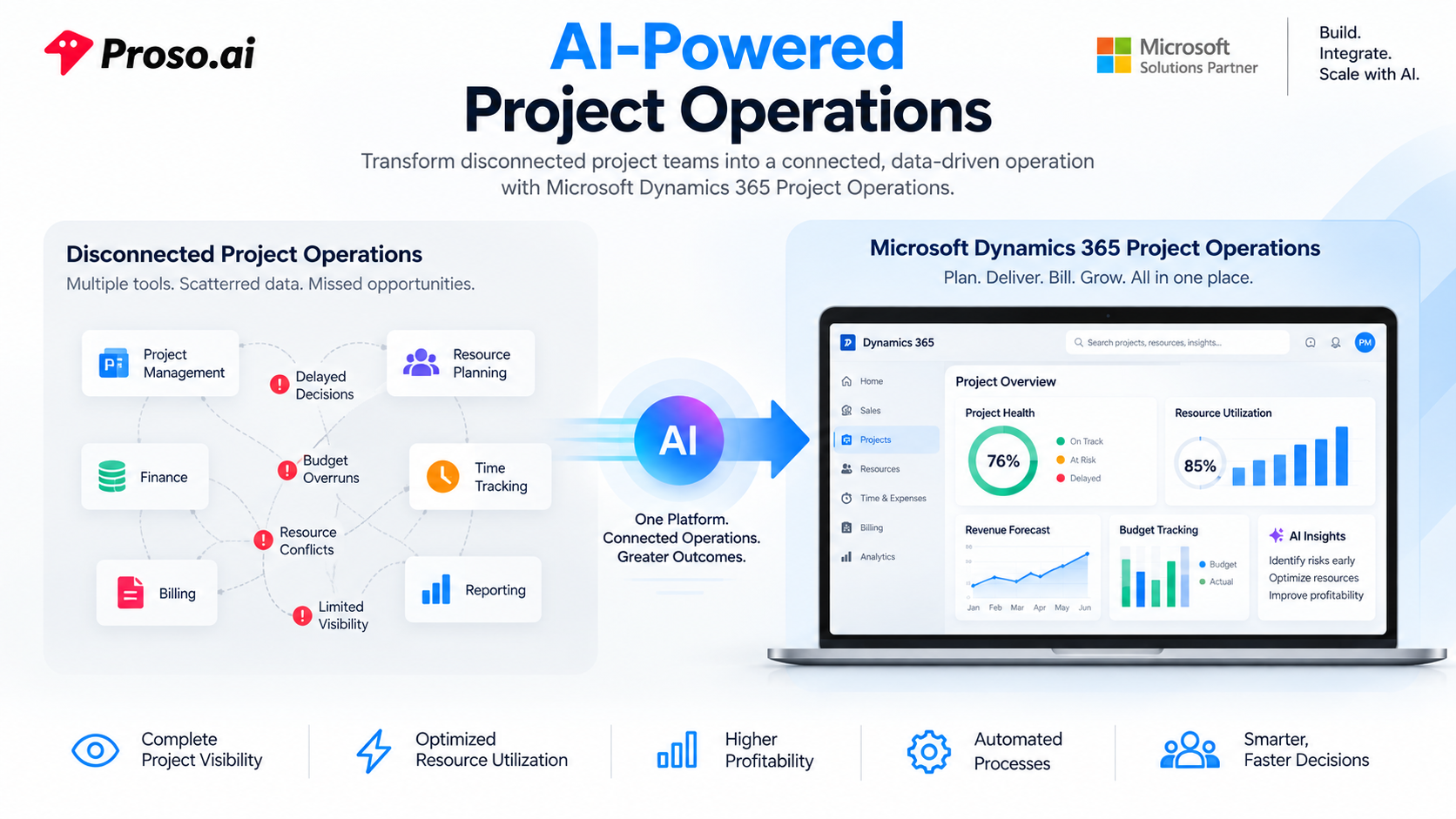
Unfortunately, many organizations still rely on disconnected tools for project planning, resource management, financial tracking, time entry, reporting, and customer engagement.
The result is a fragmented project delivery ecosystem where critical information is spread across multiple systems, making it difficult to gain real-time visibility into project performance.
This is exactly the challenge that Microsoft Dynamics 365 Project Operations was designed to solve.
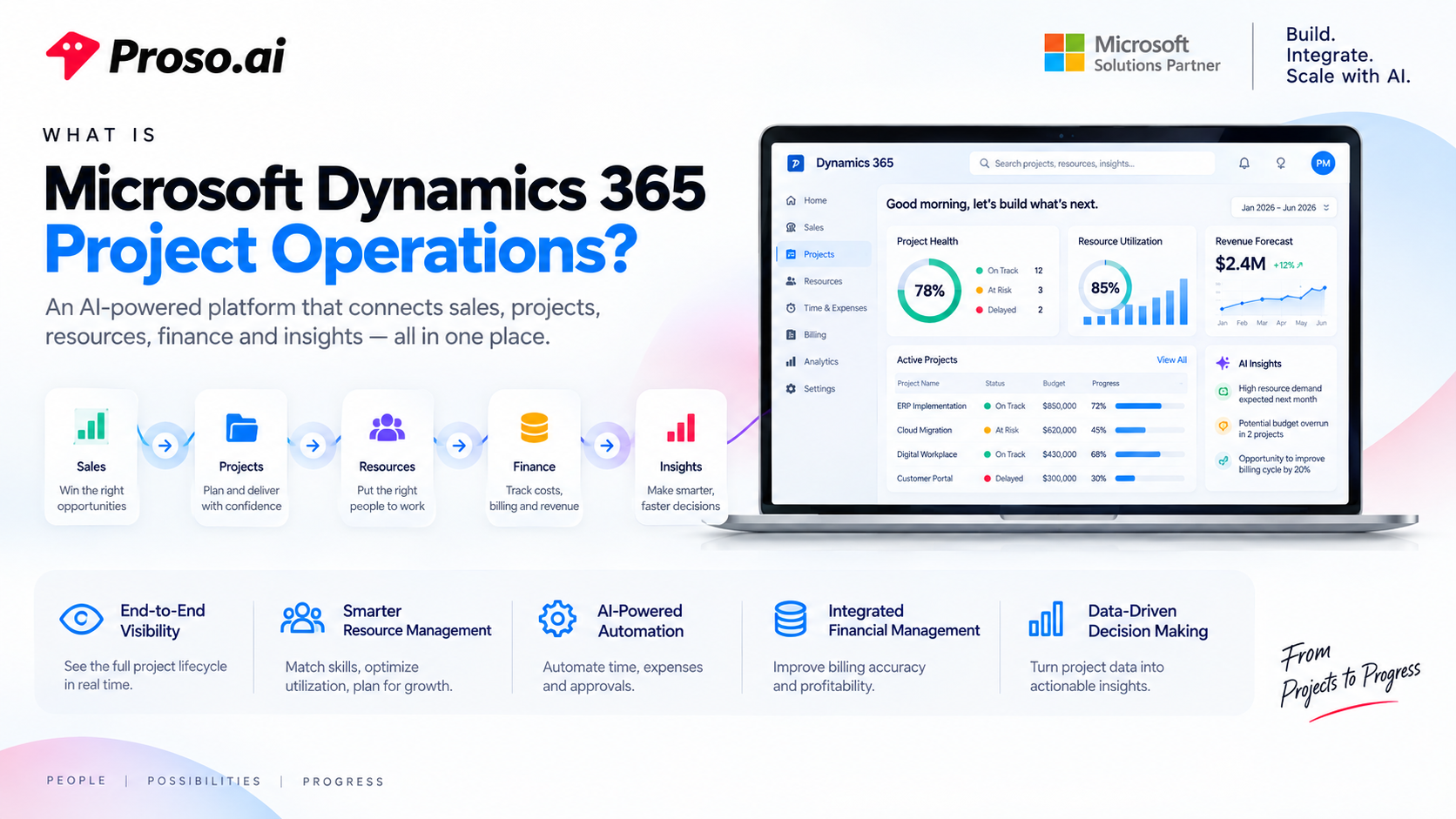
Microsoft Dynamics 365 Project Operations is an AI-powered project management and professional services automation platform that connects the entire project lifecycle—from opportunity management and project planning to resource allocation, execution, billing, and financial reporting—within a single unified solution.
Instead of managing projects across multiple disconnected applications, organizations can bring sales, project delivery, resource management, finance, and leadership teams together through a shared source of truth.
This unified approach enables businesses to make faster decisions, improve collaboration, reduce operational inefficiencies, and deliver projects with greater predictability.
At its core, Dynamics 365 Project Operations helps organizations answer five critical business questions:
When these questions can be answered in real time, organizations move from reactive project management to proactive project leadership.
Most project-centric organizations have grown their technology stack over time.
One tool manages project plans.
Another tracks timesheets.
Finance operates in a separate ERP.
Resource managers maintain spreadsheets.
Executives rely on manually generated reports.
While each tool may perform its individual function effectively, the lack of integration creates operational blind spots.
Project managers struggle to understand actual project costs.
Finance teams lack visibility into delivery progress.
Leadership teams receive outdated reports.
Resource managers cannot accurately forecast future demand.
As organizations scale, these challenges become more expensive and difficult to manage.
Microsoft refers to this as a disconnected project delivery lifecycle—a situation where teams lack visibility across projects, resulting in inefficiencies, forecasting challenges, underutilized resources, delayed billing, and reduced operational agility.
Modern project delivery requires connected systems, connected data, and connected teams.
Dynamics 365 Project Operations is built around five critical operational pillars that drive successful project delivery.
Project leaders gain a comprehensive view of project performance through real-time dashboards and analytics.
Instead of waiting for weekly status updates, stakeholders can instantly monitor:
This level of visibility allows organizations to identify risks before they impact delivery outcomes.
One of the biggest challenges in project-based organizations is ensuring the right people are assigned to the right projects at the right time.
Dynamics 365 Project Operations helps organizations:
This creates a more agile delivery model while reducing bench time and resource conflicts.
Artificial Intelligence is rapidly becoming a competitive advantage for project-centric organizations.
Dynamics 365 Project Operations incorporates AI capabilities that help automate routine project activities, improve forecasting accuracy, and reduce administrative overhead.
Microsoft's latest AI-powered agents can assist with:
These capabilities help teams spend less time on administrative work and more time delivering customer value.
Successful projects are not measured solely by delivery—they are measured by profitability.
Dynamics 365 Project Operations connects project execution with financial performance, enabling organizations to:
By connecting project operations and finance, businesses gain a clearer understanding of project profitability throughout the delivery lifecycle.
Organizations generate enormous amounts of project data every day.
The challenge is transforming that data into actionable insights.
Dynamics 365 Project Operations provides business intelligence and reporting capabilities that help leaders:
When leaders have access to real-time data, decisions become faster, more accurate, and more strategic.
For years, project management has been driven by historical data and human judgment.
Project managers reviewed reports manually.
Resource planners relied on spreadsheets.
Finance teams created forecasts using past performance.
Executives made strategic decisions based on weekly or monthly reports.
While these approaches have worked in the past, today's project environments move too quickly for reactive decision-making.
Modern businesses need the ability to identify risks earlier, forecast outcomes more accurately, optimize resources continuously, and make decisions based on real-time intelligence.
This is where Artificial Intelligence is fundamentally changing project operations.
AI is no longer simply a productivity tool.
It is becoming a strategic business capability that helps organizations predict, automate, optimize, and scale project delivery with greater confidence.
For project-based organizations, the question is no longer whether to adopt AI.
The question is how quickly they can integrate AI into their project operations before competitors gain a significant advantage.
Traditional project management focuses on reporting what has already happened.
AI-powered project operations focus on predicting what is likely to happen next.
Consider a typical project scenario.
A resource shortage emerges.
A project milestone begins slipping.
Costs start exceeding the original budget.
In traditional environments, teams often discover these issues after they have already impacted delivery.
With AI-powered project operations, organizations can identify potential risks much earlier and take corrective action before they become business problems.
This shift transforms project management from a reactive process into a predictive operational model.
Instead of asking:
"What went wrong?"
Organizations can begin asking:
"What is likely to go wrong, and how do we prevent it?"
This proactive approach improves project outcomes while reducing operational uncertainty.
Microsoft has made AI a foundational component across the Dynamics 365 ecosystem.
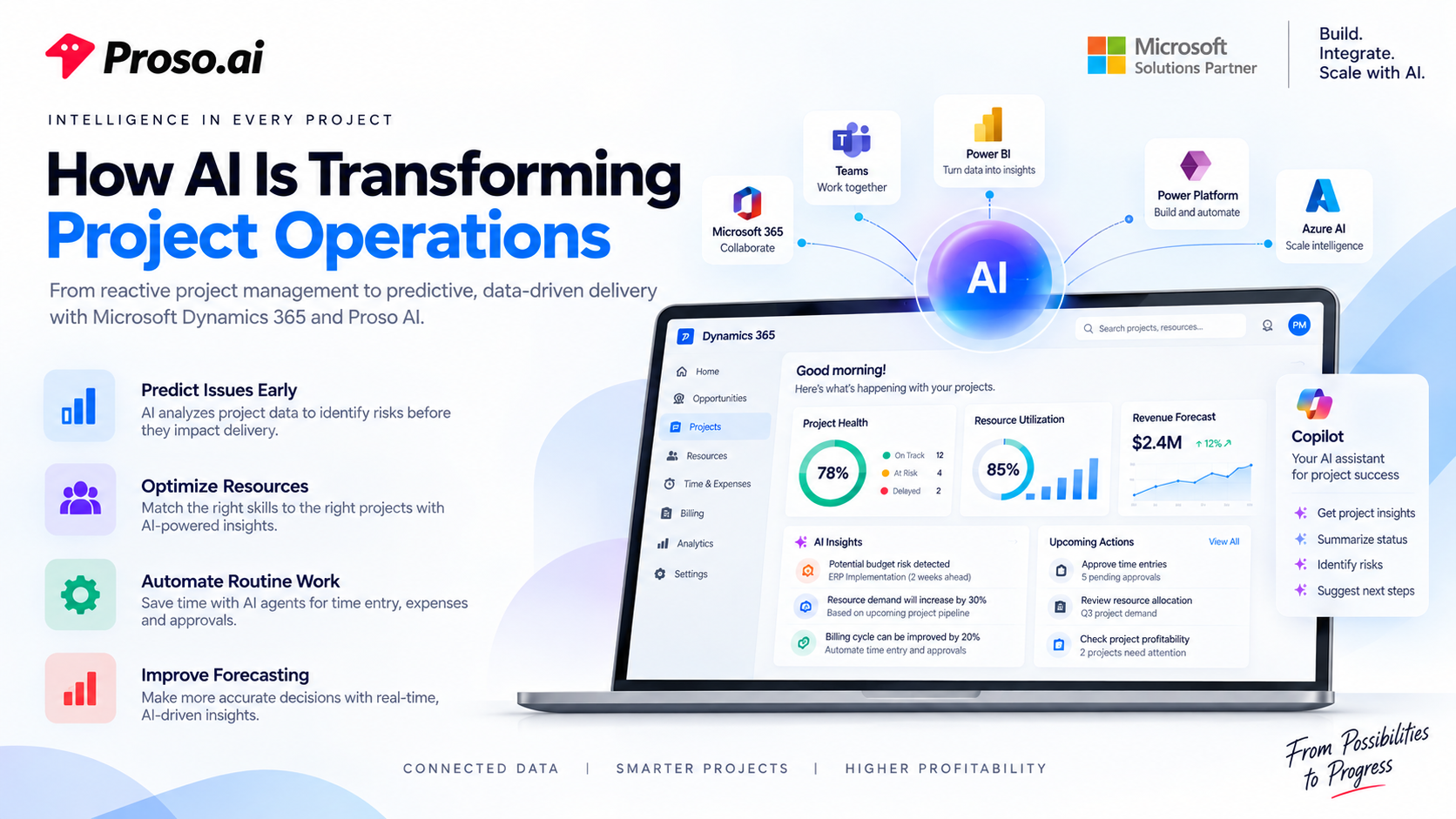
Within Dynamics 365 Project Operations, AI helps organizations automate routine tasks, improve planning accuracy, accelerate decision-making, and gain deeper operational insights.
Rather than requiring users to search through reports and dashboards manually, AI helps surface relevant information automatically.
Project managers can quickly identify risks.
Resource managers can improve workforce planning.
Finance leaders can gain better forecasting visibility.
Executives can make decisions using real-time business intelligence.
This enables organizations to spend less time gathering information and more time acting on it.
One of the biggest challenges in project delivery is identifying issues before they impact profitability or customer satisfaction.
AI continuously analyzes project performance data to uncover patterns that may not be immediately visible.
Organizations can gain insights into:
These insights help project leaders make informed decisions faster and with greater confidence.
Resource utilization remains one of the most important profitability drivers for project-based businesses.
Assigning the wrong resource can lead to delays, reduced productivity, and increased project costs.
AI helps organizations optimize resource allocation by analyzing:
This ensures that the right people are assigned to the right projects at the right time.
The result is improved utilization, reduced bench time, and higher project profitability.
Many project teams spend a significant amount of time on administrative activities rather than project execution.
Examples include:
AI-powered automation reduces the effort required to complete these routine tasks.
This enables teams to focus on higher-value work while improving operational efficiency.
Forecasting is often challenging because project environments are constantly changing.
Resource availability shifts.
Project scopes evolve.
Customer requirements change.
AI improves forecasting accuracy by continuously analyzing operational data and identifying emerging trends.
Organizations can better predict:
This creates a more predictable business environment and enables better strategic planning.
Many organizations are experimenting with standalone AI tools.
However, AI becomes significantly more powerful when it has access to connected business data.
This is one of Microsoft's greatest advantages.
Dynamics 365 Project Operations integrates seamlessly with the broader Microsoft ecosystem, including:
When project, financial, operational, and collaboration data are connected, AI can generate more accurate recommendations and more meaningful business insights.
Instead of operating in isolated systems, organizations gain a unified intelligence layer across their entire project delivery process.
Technology alone does not drive transformation.
Successful outcomes depend on implementation expertise, governance, adoption, and alignment with business objectives.
As a Microsoft Solutions Partner, Proso AI helps organizations move beyond software deployment and build intelligent project delivery ecosystems that support long-term growth.
Our approach focuses on:
By combining Microsoft's AI-powered business applications with deep implementation expertise, Proso AI helps organizations accelerate digital transformation while maximizing the value of their technology investments.
Investing in technology is rarely about acquiring new features.
Business leaders invest in solutions because they want measurable outcomes.
They want projects delivered on time.
They want higher resource utilization.
They want better profitability.
They want predictable revenue.
And they want the visibility needed to make confident business decisions.
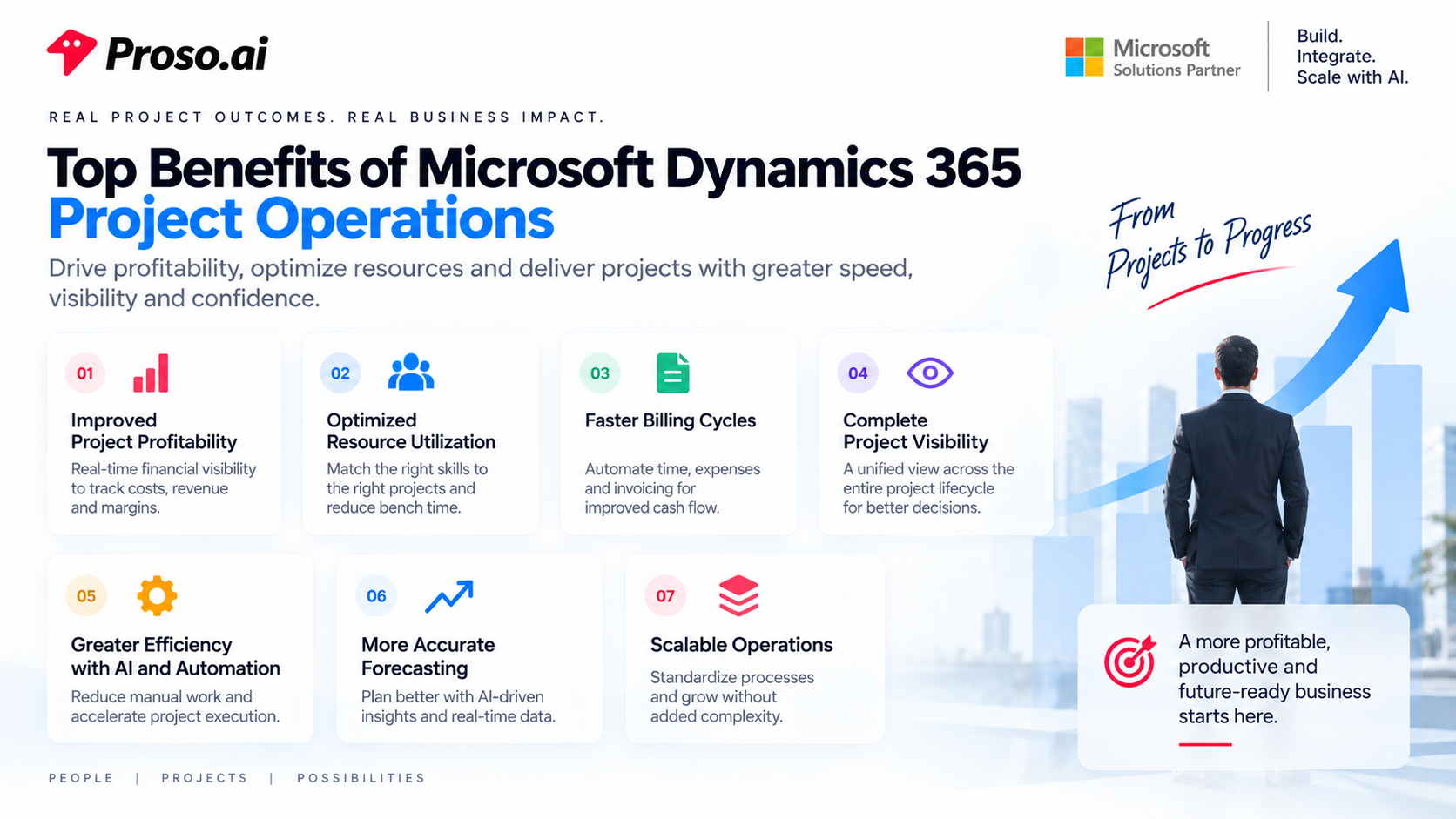
This is why organizations across professional services, consulting, engineering, IT services, construction, and project-based industries are adopting Microsoft Dynamics 365 Project Operations.
By combining project management, resource planning, finance, and AI-powered insights into a unified platform, organizations can unlock significant operational and financial benefits.
Let's explore the most impactful advantages.
One of the biggest challenges project-based businesses face is understanding profitability before a project is completed.
Many organizations only discover budget overruns after they have already impacted margins.
Dynamics 365 Project Operations provides real-time visibility into:
This enables project leaders to identify risks early and make adjustments before profitability is affected.
Instead of managing projects based on assumptions, organizations can manage them based on actual financial data.
✓ Better margin protection
✓ Reduced budget overruns
✓ Improved project forecasting
✓ Increased project profitability
For professional services organizations, people are the most valuable asset.
However, many businesses struggle with:
Dynamics 365 Project Operations helps organizations match project demand with workforce capacity more effectively.
By providing visibility into skills, availability, utilization, and future demand, organizations can ensure the right people are assigned to the right projects.
The result is higher productivity, improved employee engagement, and better business performance.
✓ Higher billable utilization
✓ Reduced bench costs
✓ Better workforce planning
✓ Increased project efficiency
Delayed billing often leads to delayed revenue.
In many organizations, project data, time entries, expense reports, and invoicing processes are disconnected.
This creates administrative bottlenecks that slow revenue recognition and impact cash flow.
Dynamics 365 Project Operations connects project delivery with financial operations, enabling organizations to streamline billing processes and improve invoicing accuracy.
Teams can track billable activities more effectively, reduce manual effort, and ensure invoices are generated faster.
✓ Faster invoicing
✓ Improved cash flow
✓ Reduced revenue leakage
✓ Higher billing accuracy
Many business leaders struggle to answer simple questions:
Without centralized visibility, decision-making becomes slower and less accurate.
Dynamics 365 Project Operations provides a unified view of the entire project lifecycle, allowing leaders to monitor performance in real time.
This visibility helps organizations identify risks earlier and make more informed decisions.
✓ Faster decision-making
✓ Improved project governance
✓ Better executive reporting
✓ Reduced operational blind spots
Project teams often spend valuable time on repetitive administrative activities rather than delivering outcomes.
Examples include:
AI-powered automation reduces administrative burden while improving operational consistency.
Instead of spending hours updating spreadsheets and chasing approvals, teams can focus on delivering customer value.
✓ Reduced manual work
✓ Faster project execution
✓ Higher team productivity
✓ Improved employee experience
Growth requires predictability.
Unfortunately, forecasting remains a challenge for many project-based businesses because project environments are constantly changing.
Dynamics 365 Project Operations enables organizations to improve forecasting accuracy by combining operational, financial, and resource data within a single platform.
Leaders gain better visibility into:
This helps organizations make strategic decisions with greater confidence.
✓ More accurate forecasts
✓ Better capacity planning
✓ Improved strategic alignment
✓ Reduced business uncertainty
As organizations grow, operational complexity often grows with them.
More projects.
More resources.
More customers.
More reporting requirements.
More systems.
Dynamics 365 Project Operations provides a scalable operational foundation that grows alongside the business.
Organizations can standardize processes, improve governance, and maintain visibility across an expanding portfolio of projects.
This enables sustainable growth without introducing additional operational friction.
✓ Easier business scaling
✓ Standardized project delivery
✓ Improved operational consistency
✓ Reduced management overhead
The organizations leading their industries today are not necessarily the ones with the largest teams.
They are the ones making faster decisions, utilizing resources more effectively, and leveraging AI to improve operational efficiency.
Project operations are no longer simply about project delivery.
They have become a strategic driver of growth, profitability, customer satisfaction, and competitive advantage.
Organizations that modernize their project operations today will be better positioned to adapt, scale, and compete in the years ahead.
Implementing Microsoft Dynamics 365 Project Operations is about much more than deploying software.
It requires aligning people, processes, data, and technology to create a connected project delivery ecosystem that drives measurable business outcomes.
Without the right implementation strategy, organizations often struggle with low user adoption, disconnected workflows, poor data quality, and underutilized technology investments.
That's why choosing the right implementation partner is just as important as choosing the right platform.
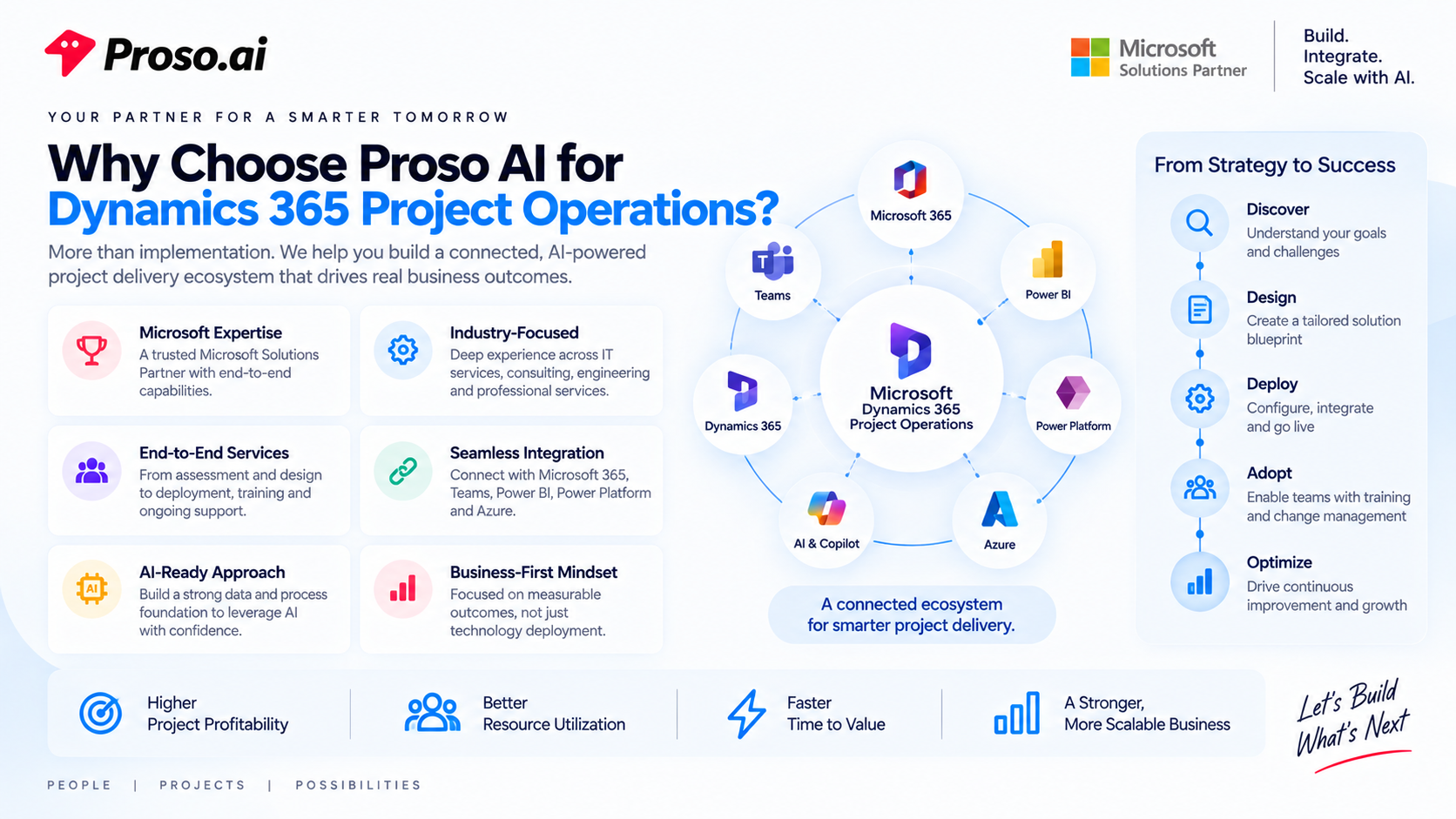
At Proso AI, we help organizations transform project operations by combining deep Microsoft expertise, AI-driven innovation, and a business-first implementation approach.
As a Microsoft Solutions Partner, Proso AI helps organizations unlock the full value of Microsoft's business applications ecosystem.
Our expertise extends beyond Dynamics 365 Project Operations to include:
This allows us to design connected solutions that eliminate operational silos and create a unified digital ecosystem.
Rather than implementing standalone tools, we help organizations build intelligent business environments where data, processes, and teams work together seamlessly.
Every industry delivers projects differently.
An IT services organization faces different challenges than a consulting firm.
An engineering company has different operational requirements than a professional services business.
A one-size-fits-all implementation approach rarely succeeds.
Proso AI works closely with organizations to understand:
This ensures that Dynamics 365 Project Operations is configured to support the unique needs of the business rather than forcing teams to adapt to generic processes.
Successful digital transformation requires more than system deployment.
Our implementation methodology covers every stage of the project lifecycle.
We begin by evaluating current project management processes, technology environments, reporting structures, and operational challenges.
This helps identify opportunities for optimization before implementation begins.
Our consultants design a solution architecture that aligns with business goals while leveraging Microsoft best practices.
We configure Dynamics 365 Project Operations to support project planning, resource management, financial operations, reporting, and workflow automation.
We connect Dynamics 365 Project Operations with existing business systems, ensuring data flows seamlessly across the organization.
Technology delivers value only when people use it effectively.
We provide training, documentation, and adoption strategies that help teams embrace new ways of working.
Business requirements evolve.
Our team continues to support organizations through optimization, enhancements, and long-term growth initiatives.
One of the biggest advantages of Dynamics 365 Project Operations is its ability to integrate with Microsoft's broader technology stack.
Proso AI helps organizations create connected experiences across:
Enable collaboration directly within project workflows.
Transform project and financial data into actionable business intelligence.
Automate repetitive processes and accelerate operational efficiency.
Connect productivity tools with project delivery processes.
Extend intelligence and automation capabilities across business operations.
The result is a unified digital workplace where teams can collaborate, analyze, automate, and execute more effectively.
Artificial Intelligence is rapidly becoming a competitive differentiator.
However, AI success depends on having the right foundation.
Disconnected systems, inconsistent data, and manual processes limit the effectiveness of AI initiatives.
Proso AI helps organizations establish the operational readiness required to scale AI successfully.
Our approach focuses on:
This ensures organizations can confidently leverage Microsoft's AI innovations while maintaining operational control and governance.
Technology projects should not be measured by implementation milestones.
They should be measured by business outcomes.
At Proso AI, our objective is simple:
Help organizations improve project delivery, increase profitability, optimize resources, accelerate decision-making, and create a foundation for long-term growth.
By combining Microsoft technology expertise with practical business consulting, we help organizations move beyond digital transformation initiatives and achieve meaningful operational transformation.
Organizations choose Proso AI because they need more than a technology provider.
They need a strategic partner that understands both business operations and Microsoft technologies.
Our clients benefit from:
✓ Deep Microsoft ecosystem expertise
✓ Proven implementation methodology
✓ AI-driven innovation capabilities
✓ Industry-specific consulting experience
✓ End-to-end project support
✓ Long-term optimization and growth strategies
✓ Focus on measurable business outcomes
When technology, processes, and people work together effectively, project operations become a competitive advantage rather than an operational challenge.
Every project-centric organization faces a common challenge:
How do you deliver projects efficiently while maintaining profitability, resource utilization, customer satisfaction, and operational control?
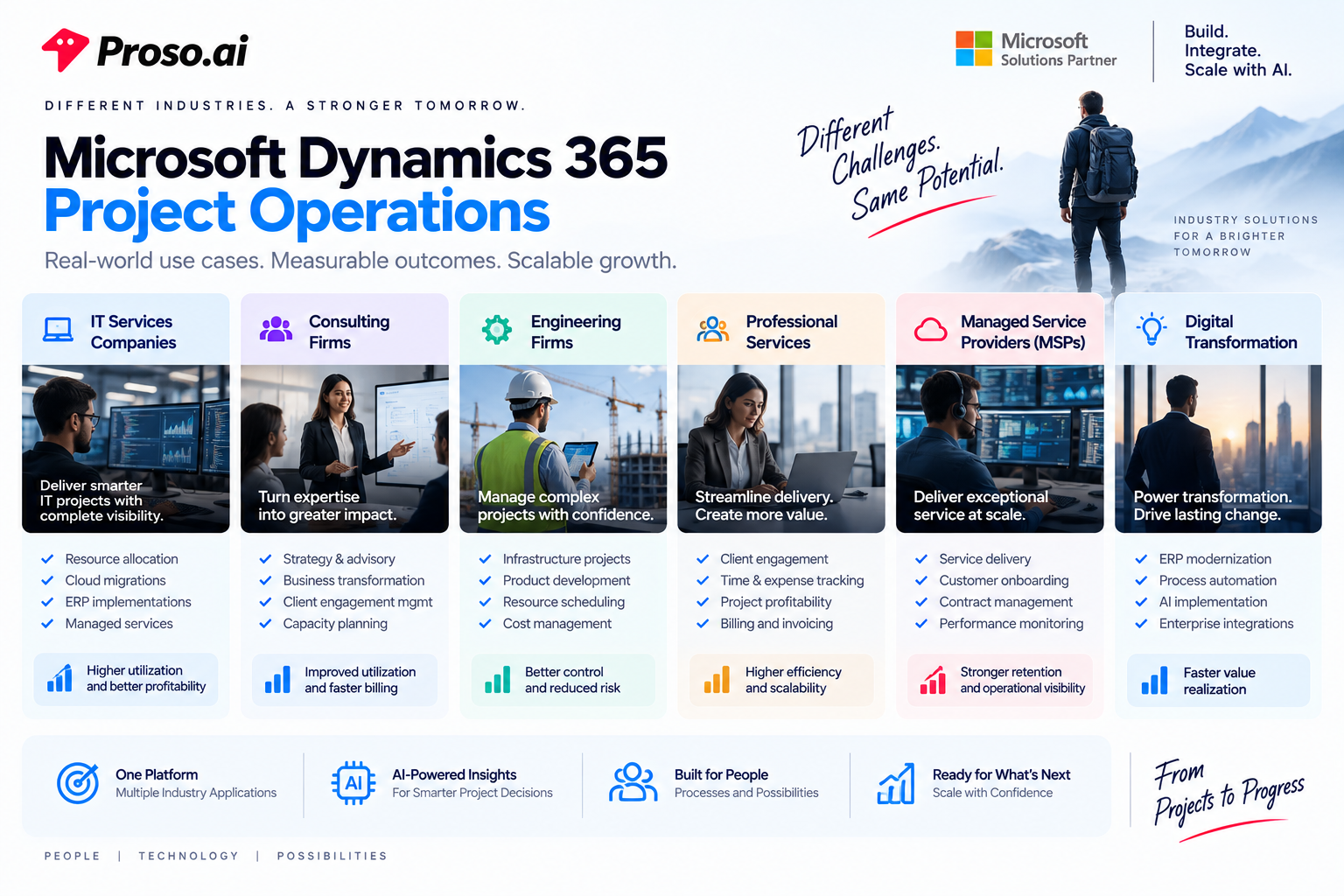
While the core objectives remain similar, each industry faces unique project delivery challenges.
This is why Microsoft Dynamics 365 Project Operations is designed to provide the flexibility needed to support diverse business models while maintaining a unified approach to project management, resource planning, financial oversight, and operational intelligence.
Let's explore how organizations across different industries are using Dynamics 365 Project Operations to transform project delivery.
IT services organizations operate in fast-moving environments where project success depends on effective resource management, delivery predictability, and client satisfaction.
However, many IT service providers struggle with:
Dynamics 365 Project Operations helps IT services organizations connect sales, delivery, finance, and resource management into a single platform.
✓ Resource allocation and workforce planning
✓ Software implementation projects
✓ Managed service delivery
✓ Cloud migration initiatives
✓ ERP implementation projects
✓ Digital transformation engagements
Consulting organizations rely heavily on people, expertise, and time.
Success depends on effectively matching consultants with client engagements while maintaining utilization and profitability.
Many consulting firms struggle with:
Dynamics 365 Project Operations provides consulting firms with a centralized platform to manage engagements from opportunity creation through project completion and invoicing.
✓ Strategy consulting projects
✓ Business transformation initiatives
✓ Advisory engagements
✓ Technology consulting services
✓ Change management programs
✓ Client success management
Engineering projects often involve complex timelines, specialized resources, regulatory requirements, and extensive collaboration.
Without connected systems, project teams can struggle with visibility into project costs, timelines, and resource availability.
Dynamics 365 Project Operations enables engineering firms to manage complex projects with greater control and transparency.
✓ Infrastructure projects
✓ Product development initiatives
✓ Engineering consulting
✓ Construction planning
✓ Resource scheduling
✓ Cost management and forecasting
Professional services firms depend on efficient project execution and effective workforce management.
Whether delivering legal services, accounting engagements, design services, or specialized consulting, organizations need visibility into project performance and profitability.
Dynamics 365 Project Operations helps professional services organizations standardize project delivery processes while maintaining flexibility.
✓ Client engagement management
✓ Time and expense tracking
✓ Resource scheduling
✓ Project profitability analysis
✓ Billing and invoicing
✓ Capacity planning
Managed Service Providers must balance recurring service delivery, customer expectations, workforce utilization, and profitability.
Managing multiple customer engagements across different service levels can quickly become complex.
Dynamics 365 Project Operations helps MSPs gain visibility across projects, resources, contracts, and financial performance.
✓ Service delivery management
✓ Customer onboarding projects
✓ Technical resource scheduling
✓ Support operations
✓ Service contract management
✓ Performance monitoring
Digital transformation projects often involve multiple stakeholders, technologies, vendors, and workstreams.
Without connected project management capabilities, organizations risk delays, budget overruns, and reduced business value.
Dynamics 365 Project Operations provides the visibility and control required to manage complex transformation initiatives successfully.
✓ ERP modernization
✓ Microsoft ecosystem adoption
✓ Cloud transformation
✓ Process automation initiatives
✓ AI implementation programs
✓ Enterprise application integration
Regardless of industry, project-centric organizations share a common need:
Microsoft Dynamics 365 Project Operations provides a flexible foundation that can be tailored to support the unique requirements of different industries while maintaining a consistent framework for project success.
By bringing together sales, project delivery, resources, finance, and AI-powered intelligence, organizations gain the visibility and control needed to scale with confidence.
While the platform is powerful, successful outcomes depend on understanding how project operations work within specific industries.
A consulting firm operates differently from an engineering company.
An MSP has different requirements than a professional services organization.
This is why organizations often seek implementation partners that understand both the technology and the industry context.
At Proso AI, we help organizations align Microsoft Dynamics 365 Project Operations with their unique business processes, industry requirements, and growth objectives to maximize adoption and business value.
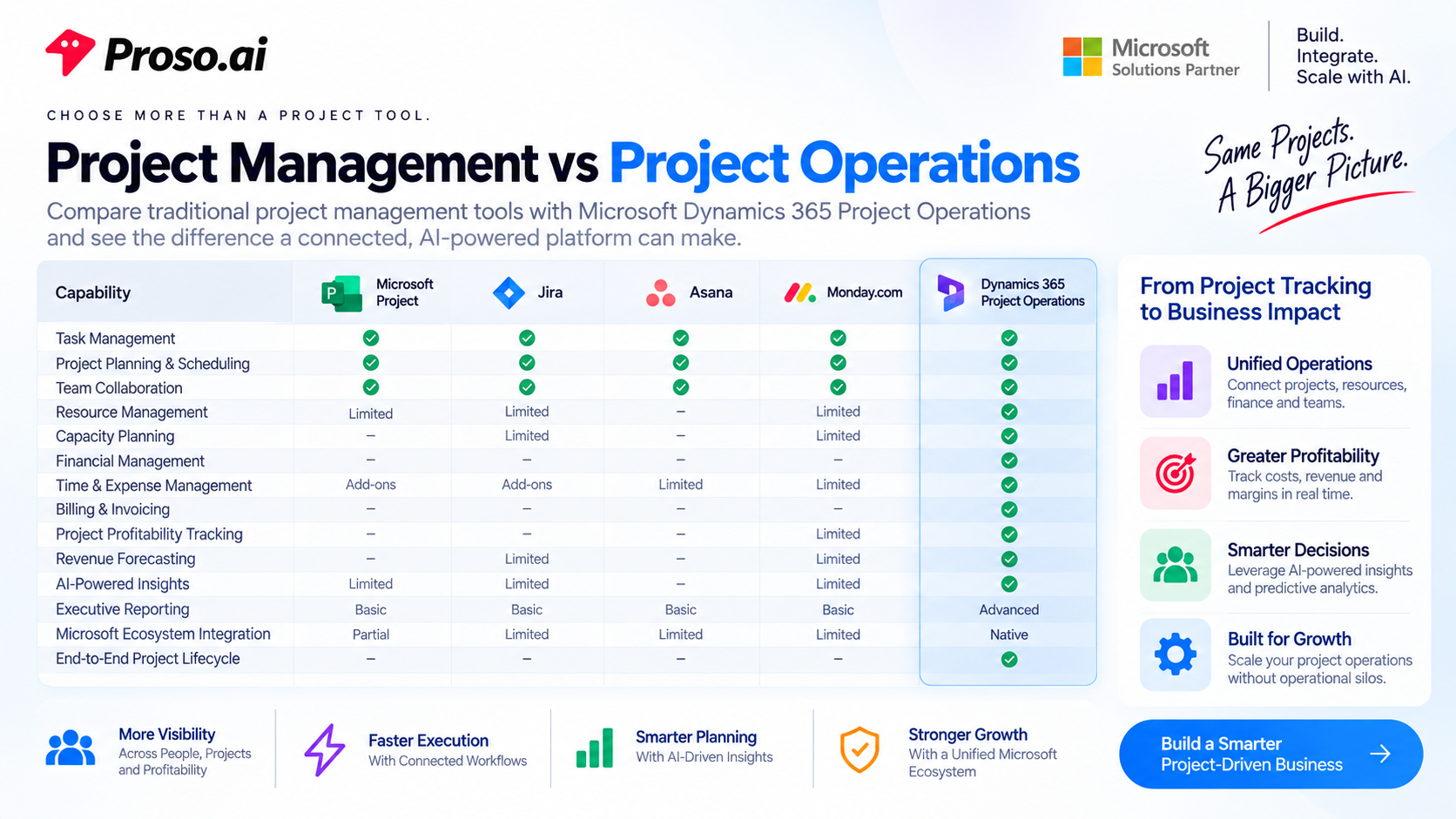
Many organizations already use project management tools.
They may have invested in Microsoft Project, Jira, Asana, Monday.com, Trello, or other project planning platforms.
These tools often help teams manage tasks, track project progress, and improve collaboration.
However, as organizations grow, many discover a significant limitation:
Most traditional project management tools were designed to manage projects—not entire project-based businesses.
Modern organizations need more than task tracking.
They need visibility into resources, profitability, forecasting, billing, utilization, financial performance, and business operations.
This is where Microsoft Dynamics 365 Project Operations takes a fundamentally different approach.
Before comparing platforms, it's important to understand the difference between project management and project operations.
In simple terms:
Project management helps you complete projects.
Project operations helps you run a profitable project-based business.
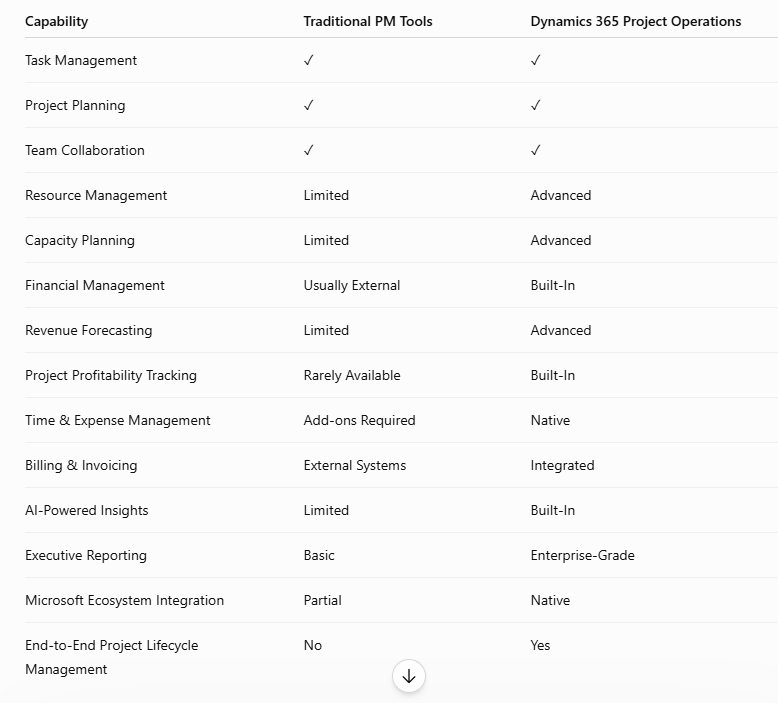
This difference becomes increasingly important as organizations scale operations.
Microsoft Project is an excellent project scheduling and planning tool.
It helps project managers:
However, Microsoft Project was not designed to manage:
Dynamics 365 Project Operations extends beyond planning and provides operational visibility across the entire business.
Jira is widely used by software development and agile teams.
It excels at:
However, Jira primarily focuses on development execution rather than project business management.
Organizations often require additional tools to manage:
Dynamics 365 Project Operations provides broader business visibility beyond software delivery activities.
Asana and Monday.com are popular because they are easy to deploy and highly user-friendly.
They provide:
For small teams, these platforms can be highly effective.
However, growing organizations often encounter limitations when they need:
Dynamics 365 Project Operations addresses these enterprise requirements while maintaining collaboration capabilities.
Traditional project management tools primarily help teams organize work.
Dynamics 365 Project Operations helps organizations make smarter business decisions.
With Microsoft's AI capabilities, organizations can:
This shift moves organizations from simply managing work to optimizing business performance.
As AI adoption accelerates, this distinction becomes increasingly important.
Organizations often outgrow traditional project management platforms when they begin asking questions such as:
If answering these questions requires multiple spreadsheets, disconnected reports, or manual analysis, it may be time to consider a more comprehensive project operations platform.
Traditional project management platforms help teams manage work.
Microsoft Dynamics 365 Project Operations helps leadership teams manage project-driven businesses.
By connecting project delivery, resource planning, finance, AI, and operational intelligence, organizations gain a complete view of performance across the entire project lifecycle.
This visibility enables faster decisions, stronger governance, improved profitability, and greater confidence in future growth.
Project management has undergone significant transformation over the last decade.
Organizations moved from spreadsheets to cloud-based project management platforms.
Teams adopted collaboration tools to improve communication.
Businesses invested in digital transformation initiatives to streamline operations.
Today, another shift is underway.
Artificial Intelligence is fundamentally changing how projects are planned, managed, executed, and optimized.
The future of project operations will not be defined by better task tracking.
It will be defined by intelligent systems that help organizations predict outcomes, automate routine work, optimize resources, and make smarter business decisions.
For project-centric organizations, this transformation presents both an opportunity and a challenge.
The opportunity is greater efficiency, profitability, and agility.
The challenge is adapting quickly enough to remain competitive.
Historically, project management systems focused on recording information.
Project managers manually tracked tasks.
Resource planners managed spreadsheets.
Finance teams generated reports.
Leadership teams reviewed historical data.
While these processes provided visibility, they were often reactive.
Organizations learned what happened after events had already occurred.
The next generation of project operations is different.
AI-powered systems continuously analyze project, financial, and operational data to generate insights in real time.
Rather than simply reporting outcomes, intelligent systems help organizations anticipate outcomes.
This shift transforms project delivery from a reactive discipline into a predictive business capability.
Project complexity continues to increase.
Organizations are managing:
Human decision-making alone cannot keep pace with the volume of data generated across modern project environments.
AI helps bridge this gap by identifying patterns, risks, and opportunities that would otherwise remain hidden.
Future project leaders will increasingly rely on AI to:
AI models can analyze historical and real-time data to identify early warning signs before projects fall behind schedule or exceed budgets.
Intelligent systems can recommend optimal resource assignments based on skills, availability, utilization, and project requirements.
AI can continuously evaluate operational trends and improve revenue, capacity, and profitability forecasts.
Routine activities such as approvals, reporting, scheduling, and data entry can increasingly be automated.
This allows teams to focus on strategic and customer-facing activities rather than manual administration.
One of the most significant developments in enterprise software is the emergence of AI copilots and intelligent agents.
Traditional software requires users to search for information.
AI copilots bring information directly to users when they need it.
Instead of navigating dashboards and reports, project managers can ask natural language questions such as:
AI-powered assistants can analyze business data and provide actionable recommendations in seconds.
The next evolution goes even further.
Intelligent agents will increasingly perform tasks autonomously, including:
Organizations that embrace these capabilities will gain significant operational advantages.
AI is most effective when it has access to connected business data.
Unfortunately, many organizations still operate with disconnected systems.
Project information exists in one platform.
Financial data lives in another.
Collaboration occurs elsewhere.
Reporting often requires manual consolidation.
This fragmentation limits visibility and reduces the effectiveness of AI initiatives.
Future-ready organizations are moving toward connected business ecosystems where project delivery, finance, collaboration, analytics, and automation operate as part of a unified environment.
This is why platforms such as Microsoft Dynamics 365 Project Operations are becoming increasingly important.
By connecting project operations with Microsoft 365, Power Platform, Power BI, Azure, and AI services, organizations can create a continuous flow of information across the business.
The result is faster decision-making, improved efficiency, and stronger business outcomes.
Many software providers are adding AI features to existing products.
Microsoft is taking a broader approach.
AI is being embedded across the entire Microsoft ecosystem.
Organizations can leverage AI across:
This creates a connected intelligence layer that spans project delivery, business operations, collaboration, analytics, and automation.
Instead of isolated AI tools, organizations gain an integrated platform for intelligent decision-making.
For project-based businesses, this unified approach creates significant long-term advantages.
Many organizations focus on AI adoption before addressing operational readiness.
However, AI effectiveness depends on:
Without these foundations, AI initiatives often struggle to deliver meaningful value.
Successful organizations begin by modernizing operations, connecting systems, and creating a reliable data environment.
Only then can AI reach its full potential.
This is one of the reasons organizations invest in platforms such as Dynamics 365 Project Operations—to create a scalable foundation for future innovation.
The future of project operations will belong to organizations that combine people, processes, and technology effectively.
The most successful businesses will not simply manage projects better.
They will leverage AI, automation, and connected workflows to make smarter decisions, optimize resources, improve profitability, and respond more quickly to change.
Project operations is no longer just an operational function.
It is becoming a strategic driver of growth, innovation, and competitive advantage.
Organizations that begin building this foundation today will be better prepared for the opportunities and challenges of tomorrow.
In today's rapidly evolving business environment, project success depends on more than effective planning.
Organizations need real-time visibility, intelligent resource management, financial transparency, AI-powered insights, and connected workflows that enable faster and more informed decision-making.
Microsoft Dynamics 365 Project Operations brings these capabilities together within a single platform, helping project-centric organizations improve delivery performance, optimize resources, increase profitability, and prepare for an AI-driven future.
Whether you're an IT services company, consulting firm, engineering organization, professional services provider, or digital transformation leader, the ability to connect project operations with business intelligence and automation has become a critical competitive advantage.
As a Microsoft Solutions Partner, Proso AI helps organizations successfully implement, optimize, and scale Dynamics 365 Project Operations while building a strong foundation for long-term digital transformation and AI adoption.
Discover how Microsoft Dynamics 365 Project Operations can help your organization improve project visibility, increase profitability, optimize resources, and accelerate business growth.
Contact Proso AI today to schedule a consultation and explore a tailored Dynamics 365 Project Operations strategy for your business.
.jpg)

.png)
.png)