.png)
Every business wants a digital product that customers enjoy using.
Whether it's a mobile application, a customer portal, an e-commerce platform, or an enterprise solution, success is rarely determined by features alone. The products that stand out are the ones that feel intuitive, solve real problems, and make every interaction effortless.
Yet many organizations invest heavily in development while treating design as the final step of the process. A polished interface is created, features are added, and the product goes live—only to discover that users abandon onboarding, struggle to complete simple tasks, or stop using the platform altogether.
The problem isn't always the technology.
More often, it's the experience.
This is where the conversation around UI (User Interface) and UX (User Experience) becomes critical. Although these terms are often used interchangeably, they solve different challenges, and understanding that difference can determine whether your product attracts loyal users or loses them after the first interaction.
For startups, growing businesses, and enterprises undergoing digital transformation, UI and UX are no longer optional design disciplines. They are strategic business investments that influence customer satisfaction, product adoption, retention, and revenue growth.
In this guide, we'll explore the difference between UI and UX, why both matter, the common mistakes businesses make, and how organizations can design digital experiences that truly drive business outcomes.
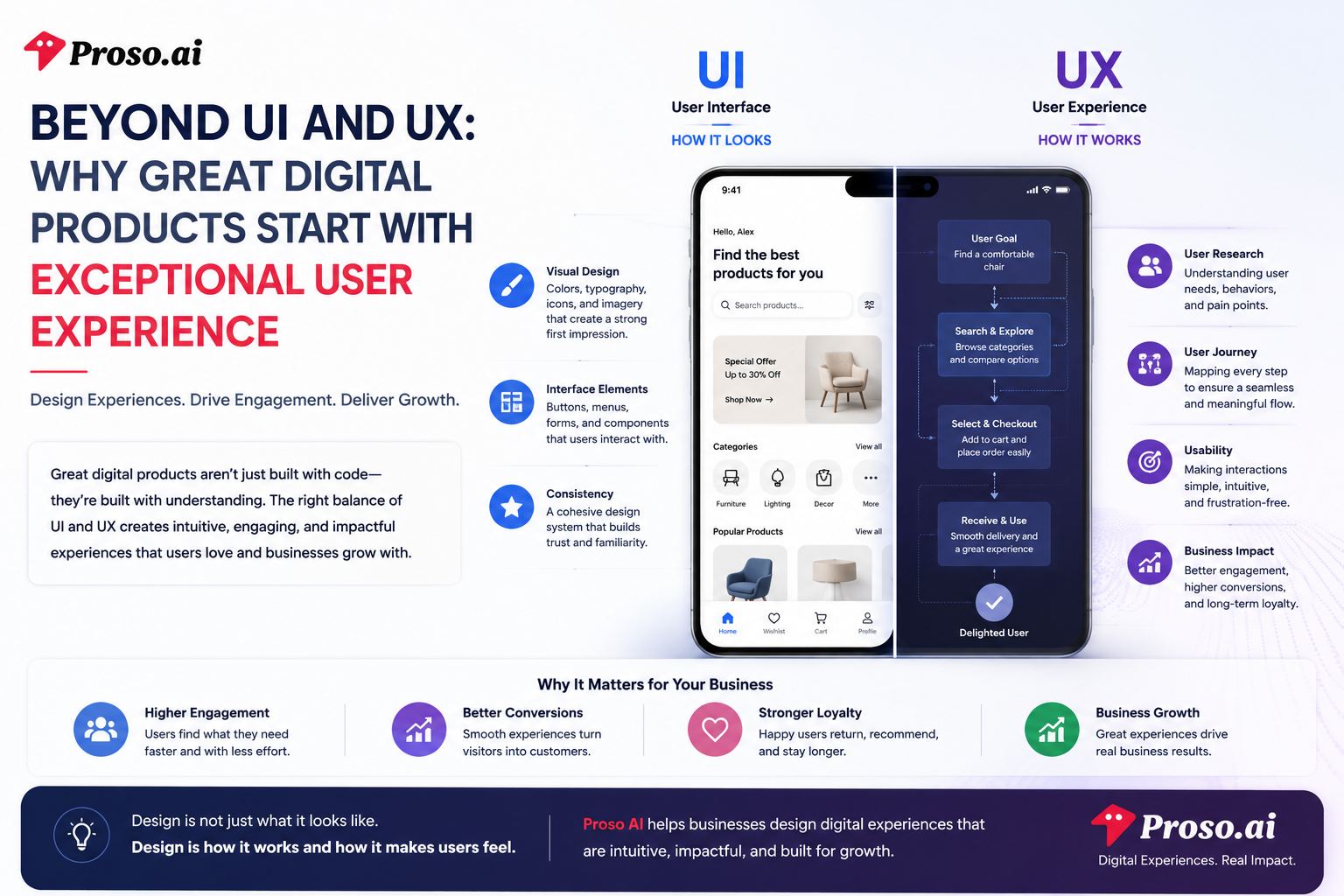
One of the biggest misconceptions in digital product development is that UI (User Interface) and UX (User Experience) are the same.
They aren't.
While they work together to create exceptional digital products, they solve two very different challenges.
Think of it this way.
Imagine walking into a beautifully designed retail store. The lighting is perfect, the shelves are organized, and the branding immediately catches your attention. That's UI—the visual layer that shapes your first impression.
Now imagine trying to find a product, asking for assistance, making a payment, and leaving the store satisfied because everything was simple and effortless. That's UX—the complete experience you had from beginning to end.
The same principle applies to digital products.
A beautifully designed application may attract users, but if navigation feels confusing, pages load slowly, or completing simple tasks becomes frustrating, users won't stay for long.
On the other hand, a product with outstanding functionality but an outdated or inconsistent interface can struggle to build trust and engagement.
Successful digital products require both.
UI creates confidence.
UX creates loyalty.
Businesses that invest in both don't just launch better applications—they create experiences that encourage users to return, engage more often, and become long-term customers.
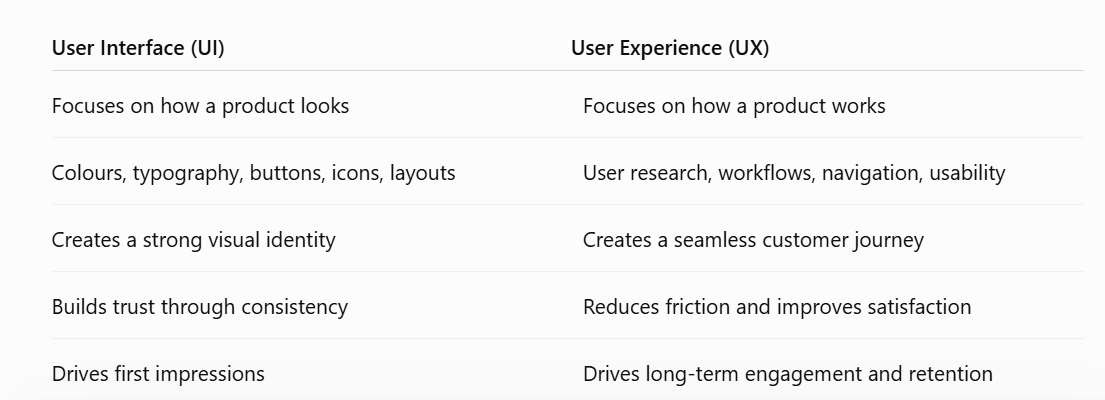
The most successful digital products don't ask users to adapt to technology.
They design technology around the way people naturally think and work.
That's why organizations that prioritize both UI and UX often see:
Whether you're building a customer portal, an enterprise application, or a mobile app, great design isn't about making products look better.
It's about making them easier to use, easier to trust, and easier to grow with.
For many businesses, UI and UX are still viewed as the final step in product development—a way to make an application look modern before launch.
In reality, they're among the earliest decisions that influence whether a product succeeds or fails.
Today's customers have more choices than ever. They compare experiences, not just products. If an application feels slow, confusing, or difficult to navigate, users won't spend time trying to figure it out—they'll simply move to a competitor that offers a smoother experience.
That's why great user experience has become a competitive advantage.
An intuitive digital product helps users accomplish their goals with minimal effort. Every interaction feels natural, every screen serves a purpose, and every step in the journey is designed to reduce friction. The result isn't just happier users—it's measurable business growth.
Organizations that invest in thoughtful UI and UX often see improvements across every stage of the customer journey. Visitors are more likely to complete registrations, customers spend more time engaging with the platform, support requests decrease because workflows are easier to understand, and teams benefit from higher adoption rates for internal applications.
Simply put, when users enjoy using your product, they keep coming back.
Clear navigation, intuitive interfaces, and well-designed user journeys make it easier for visitors to take action—whether that's signing up, making a purchase, or requesting a demo.
Users are more likely to stay loyal to products that are simple, consistent, and enjoyable to use. A better experience encourages repeat usage and long-term engagement.
When users can complete tasks without confusion, they rely less on support teams. This reduces operational costs while improving customer satisfaction.
Whether it's a customer-facing platform or an internal business application, intuitive design helps users learn faster and become productive with minimal training.
Every interaction shapes how customers perceive your business. A polished, seamless experience communicates professionalism, reliability, and attention to detail.
Building feature-rich software is only valuable if people actually use it. Great UI/UX ensures your technology delivers measurable business outcomes by improving usability, engagement, and adoption.
Customers may initially notice how your product looks.
But they'll remember how it made them feel.
Businesses that prioritize user experience don't just build better digital products—they build stronger customer relationships, higher-performing teams, and sustainable competitive advantages.

Every business believes its product is easy to use.
Until customers start leaving.
Poor user experience rarely announces itself with a single complaint. Instead, it quietly affects every stage of the customer journey. Visitors abandon your website before taking action. Users download your mobile application but never return. Customers reach out to support for tasks that should have been intuitive. Conversion rates remain lower than expected despite increased marketing investments.
These aren't just usability issues—they're business problems.
When users struggle to navigate your product, they lose confidence in your brand. Every extra click, confusing workflow, slow-loading page, or unclear call-to-action creates friction that pushes customers toward competitors offering a smoother experience.
The challenge is that businesses often blame the wrong things.
They invest more in marketing to increase traffic, add new product features, or redesign the visual interface, hoping these changes will improve results. But if the underlying user experience remains broken, growth continues to stall.
Before investing in your next feature release, ask yourself a few important questions.
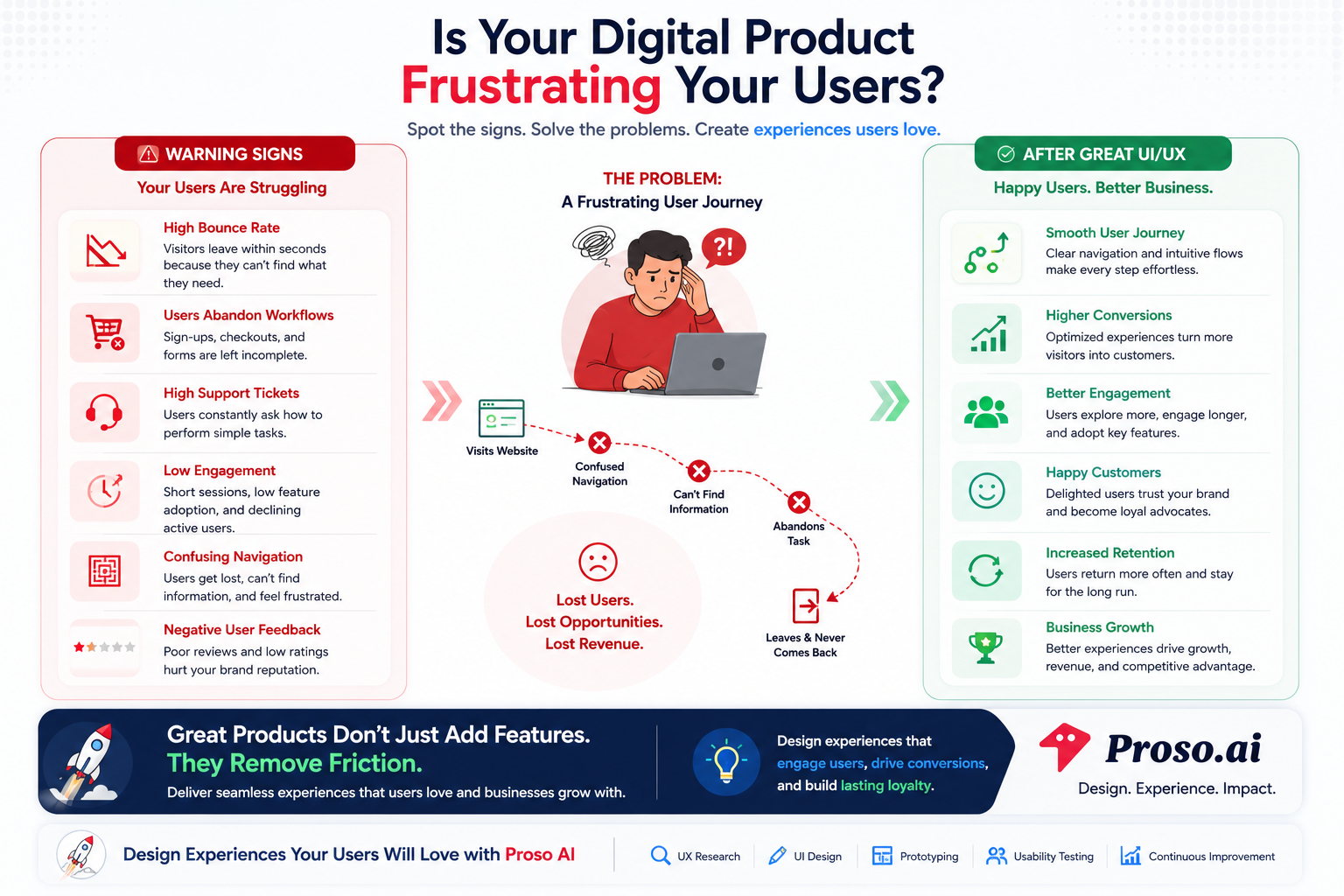
Visitors land on your website but leave within seconds because they can't immediately understand the value or find what they're looking for.
Whether it's signing up, completing a purchase, or submitting a form, customers drop off before reaching the final step.
If users constantly ask how to perform simple actions, the product isn't communicating effectively.
Low session durations, declining active users, or poor feature adoption often indicate that the experience isn't meeting user expectations.
As businesses evolve, new features are continuously added. Without thoughtful UX planning, products become cluttered, inconsistent, and increasingly difficult to navigate.
The best digital products are built around real user behavior—not internal opinions. Without usability testing, customer feedback, and user research, it's easy to solve the wrong problems.
They remove friction.
The most successful companies aren't always the ones with the most functionality—they're the ones that make every interaction feel effortless.
When businesses prioritize usability alongside innovation, customers don't just use the product.
They enjoy using it.
And that's what turns first-time users into long-term advocates.
Every successful digital product shares one thing in common—it makes complex tasks feel simple.
Great user experiences aren't created by adding more screens, animations, or features. They're created by understanding how users think, what they need, and removing every obstacle between them and their goal.
Whether someone is purchasing a product, submitting a support request, managing finances, or collaborating with a team, every interaction should feel natural, predictable, and effortless.
The best digital experiences are almost invisible.
Users don't stop to think about where to click next because the interface guides them intuitively.
They don't need lengthy tutorials because the product explains itself.
And they don't abandon workflows because every step has been designed with their needs in mind.
Great products begin with understanding users—not assumptions. Interviews, usability testing, customer feedback, and behavioral analysis reveal what people actually need before design begins.
Users should always know where they are, where they can go next, and how to complete a task without confusion. Logical navigation creates confidence.
Buttons, colors, typography, layouts, and interactions should behave consistently throughout the product. Familiarity reduces cognitive effort and improves usability.
A great digital experience works for everyone, regardless of age, ability, or device. Accessibility isn't an afterthought—it's a fundamental design principle.
Even the best-designed interface loses value if pages load slowly or interactions feel delayed. Fast, responsive experiences keep users engaged.
User expectations evolve. Businesses that regularly analyze user behavior, gather feedback, and refine their products stay ahead of competitors.
The most successful digital products aren't built once and forgotten.
They're continuously tested, refined, and improved based on real user behavior.
Every update, every feature, and every design decision should move the experience closer to one goal:
Helping users achieve more with less effort.
Building a successful digital product requires more than great development.
It requires a deep understanding of your users, your business goals, and the journey that connects the two.
At Proso AI, we believe that exceptional digital experiences are built through strategy, research, and thoughtful design—not guesswork. Our UI/UX specialists work closely with startups, growing businesses, and enterprises to create products that are intuitive, scalable, and built around real user needs.
From the first wireframe to the final interface, every design decision is guided by one objective: helping businesses deliver experiences that users enjoy, trust, and return to.
Whether you're launching a new product, modernizing an existing platform, or improving an enterprise application, our team ensures that every interaction contributes to better engagement, stronger customer relationships, and measurable business outcomes.
Every successful product begins with understanding its users. We conduct user research, stakeholder workshops, competitor analysis, and journey mapping to uncover real business challenges and customer expectations before design begins.
We organize complex ideas into clear, intuitive user journeys. Through structured wireframes and logical information architecture, we ensure every screen supports a seamless experience.
Our designers create visually engaging interfaces that reflect your brand while maintaining consistency, accessibility, and ease of use across web and mobile platforms.
Before development starts, we build interactive prototypes that allow teams to validate ideas, gather feedback, and refine experiences early—saving both time and development costs.
Design doesn't end after launch. We continuously test user behavior, identify friction points, and optimize experiences to improve engagement, conversions, and customer satisfaction.
As products evolve, consistency becomes essential. We create reusable design systems and component libraries that help businesses scale efficiently while maintaining a unified user experience.
Organizations partner with Proso AI because we don't simply design interfaces—we solve business challenges through user-centered design.
With expertise across enterprise applications, customer portals, mobile apps, SaaS platforms, and digital transformation initiatives, we help businesses create experiences that are as functional as they are visually compelling.
Our approach combines design thinking, modern technologies, and business strategy to deliver digital products that are easier to use, faster to adopt, and built to grow with your organization.
Because the best digital experiences aren't measured by how they look.
They're measured by how effortlessly they help people achieve their goals.

.jpg)

.png)
.png)