.png)

Generative AI has rapidly become part of everyday work. Employees are using AI tools to draft content, summarize documents, analyze data, generate code, and automate routine tasks. In many organizations, AI adoption is happening organically, often faster than official policies, governance frameworks, or security controls can keep up.
While this surge in adoption is driving productivity gains, it is also creating a new challenge for enterprise leaders: visibility.
Most organizations cannot accurately answer fundamental questions about AI usage across their workforce. Which AI tools are employees using? What data is being shared with those tools? How much is the organization spending on AI services? Are security and compliance requirements being followed consistently?
This gap between AI adoption and AI governance has given rise to what many organizations now recognize as Shadow AI—the use of artificial intelligence tools without centralized oversight, governance, or enterprise controls.
The issue is not that employees are using AI. In fact, AI has become an essential productivity tool across departments and functions. The real challenge is ensuring that innovation can scale without compromising security, compliance, operational control, or cost management.
As enterprises move beyond experimentation and into large-scale AI adoption, governance can no longer be treated as an afterthought. Organizations need a framework that enables employees to leverage AI effectively while providing leadership with the visibility, controls, and accountability required to manage risk.
This shift—from unmanaged AI usage to governed AI adoption—is becoming one of the most important priorities for enterprises seeking to scale AI securely and responsibly.
AI adoption in the workplace is no longer a future trend—it is already happening at scale.
Across departments, employees are using generative AI tools to accelerate everyday work. Marketing teams use AI to create content, developers rely on it for coding assistance, HR teams leverage it for drafting communications, and analysts use it to summarize data and generate insights. The accessibility of AI has empowered employees to work faster and more efficiently than ever before.
However, this rapid adoption has largely occurred outside traditional IT procurement and governance processes.
Instead of using organization-approved platforms, employees often sign up for AI tools individually, experiment with different models, and integrate them into their daily workflows without notifying IT or security teams. As a result, organizations are witnessing the rise of Shadow AI—AI usage that exists beyond the visibility and control of enterprise leadership.
Unlike traditional software deployments, generative AI tools can be adopted in minutes. A user can create an account, upload documents, analyze sensitive information, or generate business-critical outputs without any formal review or approval process. While this ease of access accelerates innovation, it also introduces significant operational and governance challenges.
For enterprise leaders, the concern is not employee intent. Most employees adopt AI because they want to be more productive. The challenge is that unmanaged AI usage creates blind spots that make it difficult to enforce security policies, maintain compliance standards, monitor spending, and understand how AI is influencing business decisions.
As AI adoption continues to grow, the question facing enterprises is no longer whether employees are using AI. The real question is whether the organization has the visibility and governance framework necessary to manage AI responsibly at scale.
While AI has the potential to transform productivity, unmanaged adoption can introduce risks that extend far beyond technology. As employees increasingly rely on AI tools without centralized oversight, organizations face challenges that can impact security, compliance, financial control, and operational consistency.
One of the most significant risks associated with Shadow AI is the possibility of sensitive information being shared with external AI platforms. Employees may unintentionally upload confidential business data, customer information, financial records, or proprietary intellectual property into public AI tools without fully understanding how that data is processed or stored.
Without visibility into these interactions, organizations have limited ability to monitor potential data exposure or enforce security policies consistently.
For organizations operating in regulated industries, AI adoption introduces additional compliance considerations. Regulations often require strict controls around data handling, access management, record keeping, and auditability.
When AI usage occurs outside approved enterprise environments, maintaining compliance becomes increasingly difficult. Organizations may struggle to demonstrate who accessed specific information, how AI-generated outputs were created, or whether internal policies were followed.
AI adoption often begins with individual subscriptions and team-level experimentation. Over time, this can result in multiple departments using different AI tools with separate billing structures and consumption models.
Without centralized monitoring, organizations may face rising AI costs without a clear understanding of utilization, business impact, or return on investment. What starts as a productivity initiative can quickly evolve into a fragmented and difficult-to-manage technology expense.
Different AI models produce different outputs, responses, and recommendations. When teams independently select tools and workflows, organizations risk creating inconsistencies in how information is generated, interpreted, and acted upon.
This lack of standardization can affect everything from customer communications and content creation to internal decision-making processes and knowledge management.
Perhaps the greatest challenge created by Shadow AI is the absence of visibility. Enterprise leaders cannot effectively govern what they cannot see.
Without centralized oversight, it becomes difficult to answer critical questions:
As AI adoption accelerates, these questions become essential for balancing innovation with responsible enterprise oversight.
The organizations that successfully scale AI will not be those that restrict adoption. They will be the ones that establish the visibility, governance, and controls needed to enable AI usage securely and responsibly across the enterprise.
When organizations first began encountering Shadow AI, many responded with a familiar strategy: restrict access.
Some attempted to block AI tools entirely. Others introduced blanket policies discouraging AI usage or limited access to a small group of approved users. While these approaches may have seemed practical initially, they are becoming increasingly difficult to enforce in today's workplace.
The reality is that AI is no longer an emerging technology reserved for experimentation. It has become a core productivity tool used across business functions. Employees rely on AI to streamline workflows, accelerate decision-making, and reduce repetitive tasks. As the technology becomes more accessible, efforts to completely restrict its use often lead to workarounds rather than compliance.
This creates a fundamental challenge for enterprise leaders. Restrictive policies may reduce visibility even further, pushing AI usage deeper into the shadows instead of bringing it under organizational control.

The organizations seeing the greatest success with AI are not those attempting to prevent adoption. Instead, they are creating environments where employees can use AI safely within clearly defined governance frameworks.
This shift represents a move away from controlling access to controlling outcomes.
Rather than asking:
"How do we stop employees from using AI?"
Forward-thinking organizations are asking:
"How do we enable employees to use AI securely, responsibly, and at scale?"
The distinction is critical.
Effective AI governance is not about limiting innovation. It is about creating the visibility, controls, and accountability necessary to support innovation confidently.
As AI adoption expands across departments, governance becomes the foundation that allows organizations to scale responsibly.
Without governance:
With governance:
The future of enterprise AI will not be defined by the organizations using the most AI tools. It will be defined by the organizations that successfully balance innovation with governance.
This is where the conversation shifts from AI adoption to governed AI adoption—a model that enables organizations to harness the benefits of AI while maintaining the control, security, and accountability required at enterprise scale.
For many organizations, the challenge is not whether to adopt AI but how to adopt it responsibly at scale. As AI becomes embedded in daily operations, enterprises need a governance model that balances innovation, security, compliance, and operational control.
Governed AI provides that foundation.
Rather than allowing AI adoption to occur across disconnected tools and unmanaged environments, governed AI creates a centralized framework through which employees can access and utilize AI capabilities securely and consistently.
One of the defining characteristics of governed AI is centralized access.
Instead of employees independently signing up for multiple AI tools, organizations can provide a unified environment where approved AI models and services are accessible through a single platform. This not only simplifies the user experience but also gives leadership greater visibility into how AI is being used across the organization.
A centralized approach helps reduce tool sprawl while enabling employees to leverage the strengths of different AI models based on their specific use cases.
As AI adoption grows, ensuring that the right individuals have access to the right capabilities becomes increasingly important.
Governed AI environments integrate with enterprise identity systems, enabling organizations to enforce authentication, user provisioning, role-based access controls, and organizational policies. This ensures that AI access aligns with existing security frameworks rather than operating as a separate, unmanaged ecosystem.
Organizations cannot govern what they cannot measure.
A governed AI framework provides visibility into how AI is being used across teams, departments, and business units. Leaders gain insights into adoption patterns, user engagement, model utilization, and overall activity levels.
This visibility enables more informed decision-making while helping organizations identify opportunities for optimization, training, and policy refinement.
As AI adoption scales, managing costs becomes a critical priority.
A governed approach allows organizations to monitor consumption, track utilization, and establish accountability around AI-related expenditures. Instead of operating with limited visibility into spending, leadership teams can better understand usage trends and align investments with business outcomes.
This level of oversight helps organizations maximize the value of AI while maintaining financial control.
Enterprise AI adoption requires more than productivity gains—it requires trust.
Governed AI environments incorporate security, policy enforcement, and compliance controls directly into the user experience. By establishing approved access pathways and centralized oversight, organizations can reduce risk while ensuring that AI usage aligns with internal governance requirements and external regulatory expectations.
Ultimately, governed AI is not about restricting innovation. It is about creating the structure that allows innovation to scale safely.
When organizations combine centralized access, identity management, visibility, cost controls, and security governance, AI transitions from a collection of individual productivity tools into a strategic enterprise capability.
This shift enables organizations to move beyond experimentation and establish a sustainable framework for long-term AI adoption—one that supports both business growth and responsible governance.
Most organizations do not arrive at enterprise-scale AI adoption overnight. Instead, they progress through a series of stages as AI usage expands across teams, departments, and business functions.
Understanding where your organization sits on this maturity journey can help identify the governance capabilities needed to scale AI successfully.
At this stage, AI adoption is driven by individual curiosity and early exploration.
Employees test public AI tools for content generation, research, coding assistance, and productivity tasks. Usage is limited, informal, and often disconnected from broader business objectives.
While experimentation helps organizations understand the potential of AI, there is little visibility into how the technology is being used.
Characteristics:
As employees begin to realize the value of AI, adoption accelerates across teams.
Different departments start using different AI platforms independently, often without IT approval or governance controls. Productivity increases, but so do risks related to security, compliance, and spending.
This is where many organizations find themselves today.
Characteristics:
Recognizing the risks of unmanaged AI usage, organizations begin introducing basic controls.
Policies are established, approved tools are identified, and IT teams start monitoring adoption more closely. However, governance remains fragmented, and visibility is often limited.
While this stage improves oversight, organizations still struggle to scale AI consistently across the enterprise.
Characteristics:
At this stage, organizations move beyond isolated controls and establish a centralized governance framework.
AI access, usage monitoring, security controls, and policy enforcement become integrated into a unified operating model. Leadership gains visibility into adoption patterns, expenditures, and organizational outcomes.
AI becomes a managed enterprise capability rather than a collection of individual tools.
Characteristics:
Organizations that reach this stage successfully combine innovation with governance.
Employees have access to the AI capabilities they need, while leadership maintains the visibility and control required to manage risk and optimize performance. AI becomes embedded within business processes, supporting productivity, decision-making, and long-term growth.
Rather than reacting to AI adoption, organizations are actively shaping it.
Characteristics:
Many organizations assume that AI maturity is measured by the number of tools deployed or the volume of usage generated. In reality, maturity is determined by an organization's ability to manage AI responsibly while enabling innovation.
The most successful enterprises are not necessarily those adopting AI the fastest. They are the ones building the governance foundations that allow AI to scale securely, efficiently, and sustainably across the business.
AI adoption is no longer a question of if—it is a question of how.
Across industries, employees are embracing AI to work faster, make better decisions, and unlock new levels of productivity. However, as adoption accelerates, organizations must address the challenges that come with unmanaged growth. Shadow AI may deliver short-term gains, but without visibility, governance, and control, it can expose enterprises to unnecessary risks.
The path forward is not to restrict innovation or limit access to AI. Instead, organizations must create environments where employees can leverage AI confidently within a framework that supports security, compliance, accountability, and cost management.
Governed AI represents the next stage of enterprise AI maturity. It provides the structure needed to transform AI from a collection of disconnected tools into a scalable business capability that delivers measurable value across the organization.
As enterprises continue their AI journey, the leaders who succeed will be those who strike the right balance between innovation and governance. By establishing centralized oversight, secure access controls, usage visibility, and operational accountability, organizations can scale AI responsibly while maintaining the trust of employees, customers, and stakeholders.
The future belongs not to the organizations using the most AI, but to those using it with the greatest clarity, control, and purpose.
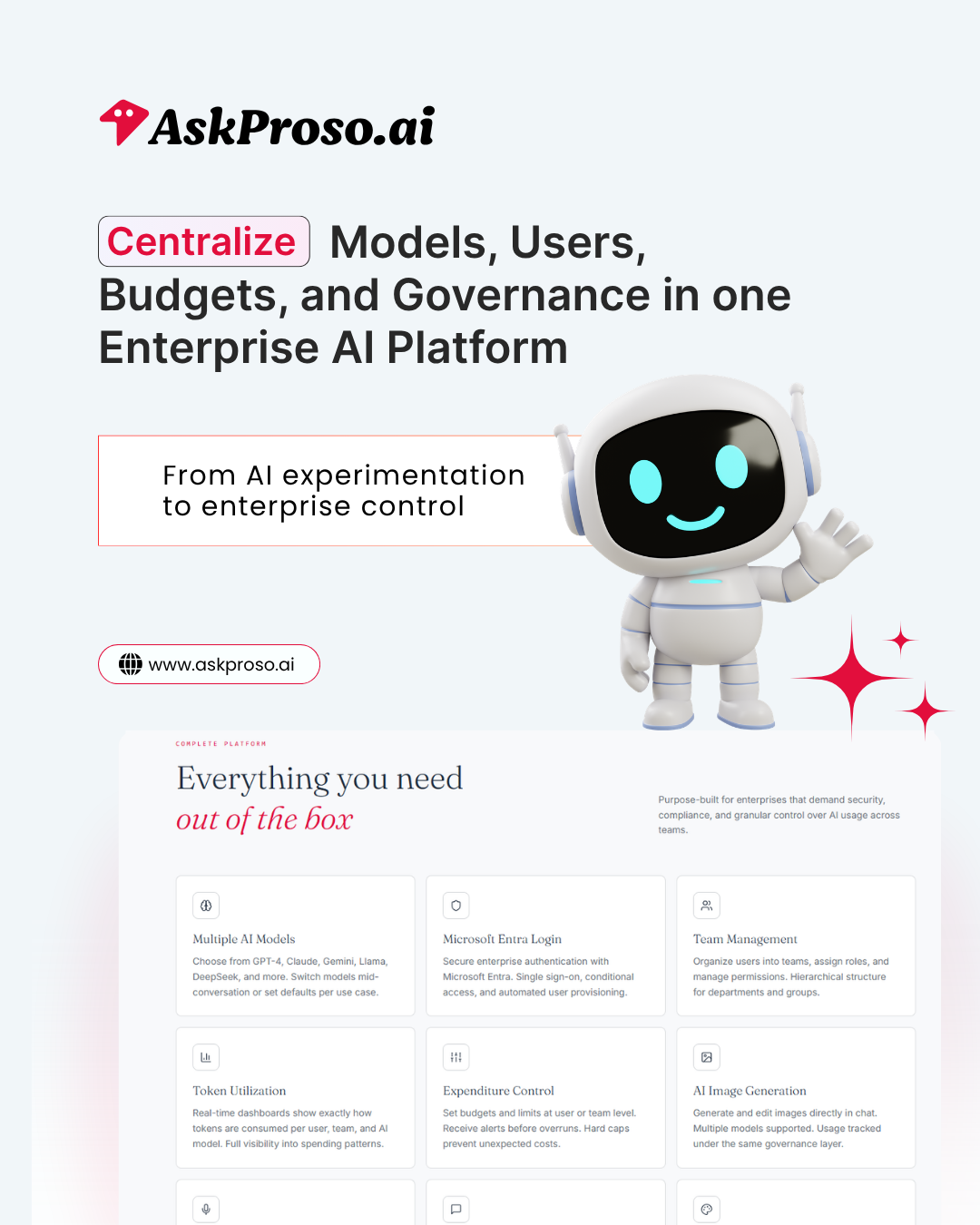
AskProso helps enterprises centralize AI access, strengthen governance, monitor usage, control costs, and scale AI adoption securely across teams. By bringing multiple AI models, enterprise security, analytics, and governance into a single platform, organizations can enable innovation without sacrificing control.
Discover how your organization can transition from unmanaged AI adoption to a governed AI framework built for enterprise scale.

.jpg)

.png)
.png)