.png)
Every startup begins with momentum.
A small team. Big ambitions. A product people believe in. Every new customer feels like a milestone, and every closed deal validates the vision that inspired the business in the first place.
In the early days, simplicity works in your favor. Customer details live in spreadsheets, sales conversations happen over emails and WhatsApp, tasks are managed through shared documents, and everyone knows exactly what's happening because the team can fit around a single table.
For a while, that feels enough.
Then growth happens.
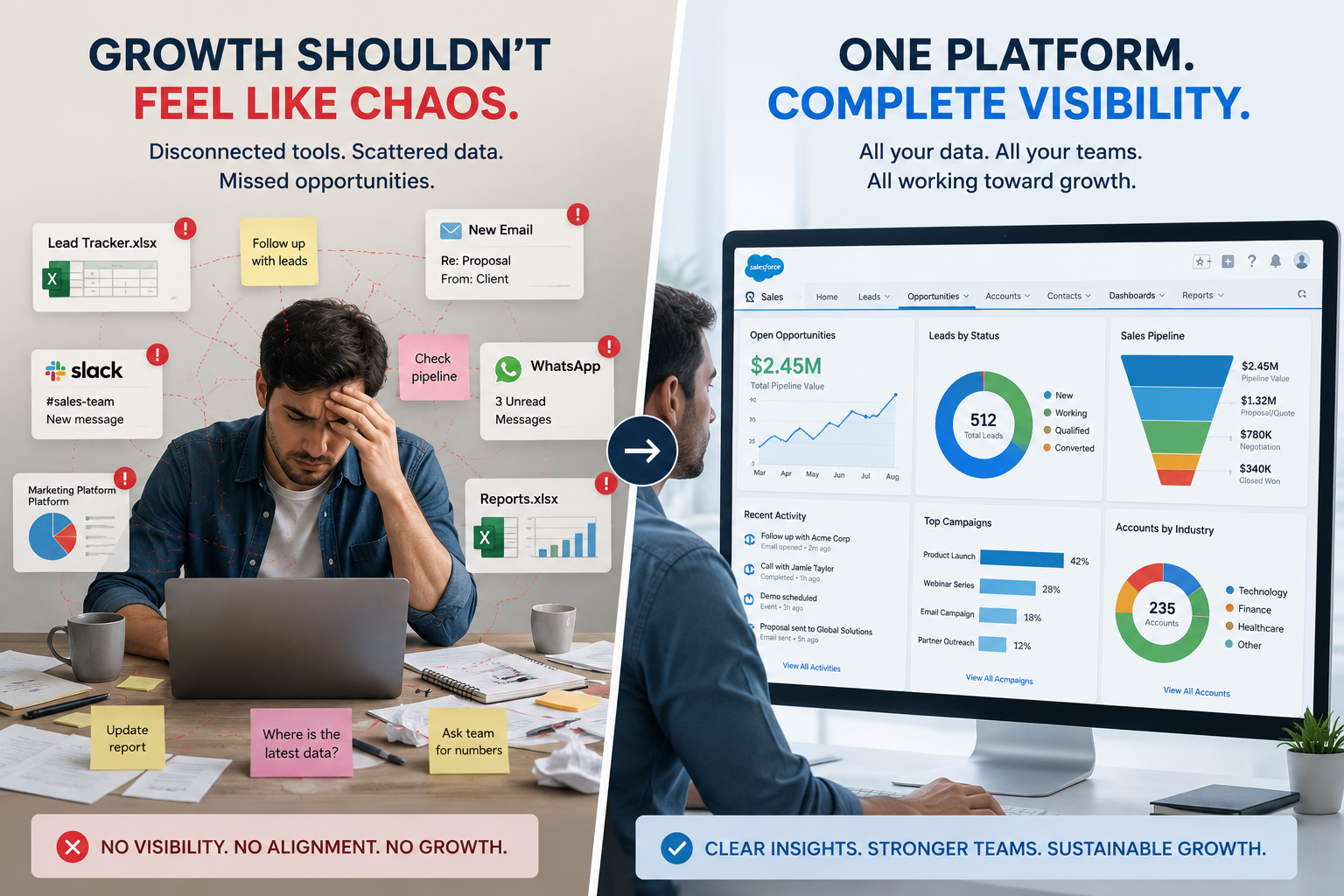
Five customers become fifty. Fifty become hundreds. New sales representatives join. Marketing starts generating more leads. Customer support requests increase. Multiple opportunities move through the pipeline at the same time. Suddenly, information is scattered across different tools, follow-ups start slipping through the cracks, and simple questions—"Which leads are ready to buy?" or "What's our sales forecast this month?"—become surprisingly difficult to answer.
Ironically, the very growth every startup works so hard to achieve begins to expose the limitations of the systems that once worked perfectly.
This is the point where many startups make a costly mistake. Instead of building a scalable operational foundation, they continue adding more spreadsheets, more communication channels, and more disconnected applications. The business grows, but the processes don't.
What starts as a few manual workarounds eventually becomes operational chaos—slowing down teams, reducing visibility, and making it harder to deliver the customer experience that fueled the company's early success.
Scaling isn't just about winning more customers.
It's about building a business that can support every customer you win.
That's where a modern CRM like Salesforce becomes more than a sales tool. It becomes the foundation that connects people, processes, and customer data—helping startups scale with confidence instead of complexity.

Growth doesn't usually break a startup overnight.
It happens gradually.
One missed follow-up becomes ten. Customer conversations are scattered across emails, Slack, WhatsApp, and spreadsheets. Sales representatives create their own ways of tracking leads. Marketing generates demand, but there's no clear visibility into which campaigns are actually driving revenue. Leadership asks for a sales forecast, and the team spends hours pulling data together from multiple tools.
None of these problems seem critical on their own.
But together, they create operational friction that slows growth when momentum matters most.
For many founders, this becomes a familiar cycle. As the business grows, instead of investing in connected systems, they add more software to solve individual problems. One tool manages emails. Another tracks tasks. A separate platform stores customer information. Reporting happens in spreadsheets. Before long, the organization is working across disconnected applications that don't communicate with one another.
The result isn't just inefficiency—it's a lack of visibility.
Sales teams don't know which opportunities require immediate attention. Marketing struggles to measure campaign impact. Customer success teams lack a complete view of client interactions. Leadership makes critical decisions using incomplete or outdated information.
And perhaps the biggest challenge of all?
Your team spends more time managing work than delivering value.
The irony is that startups don't lose momentum because they lack ambition. They lose momentum because their processes can't keep up with their growth.
That's why successful startups don't wait until operations become chaotic. They build scalable systems early—creating a foundation that supports every new customer, every new employee, and every new stage of growth.
The world's fastest-growing startups don't scale because they hire more people.
They scale because they build better systems.
Behind every successful startup is a business that knows where its customers are, understands its sales pipeline, tracks every opportunity, and enables teams to work from a single source of truth. That's exactly what Salesforce CRM was built to deliver.
Rather than managing leads in spreadsheets, tracking conversations across multiple platforms, or relying on manual updates, Salesforce brings every customer interaction into one intelligent, connected workspace.
Imagine a sales representative opening a single dashboard and instantly seeing every lead assigned to them, recent customer conversations, upcoming follow-ups, deal stages, and revenue forecasts—all without switching between five different applications.
Now imagine every department working with that same level of visibility.
Marketing can identify which campaigns generate qualified leads. Sales teams know which opportunities need immediate attention. Customer success teams have complete account histories before every conversation. Leadership gains real-time insights into business performance instead of waiting for weekly reports.
When every team works from the same data, collaboration becomes effortless, decisions become faster, and growth becomes more predictable.
Salesforce doesn't simply help startups manage customers.
It helps them build a business that's ready for the next stage of growth.
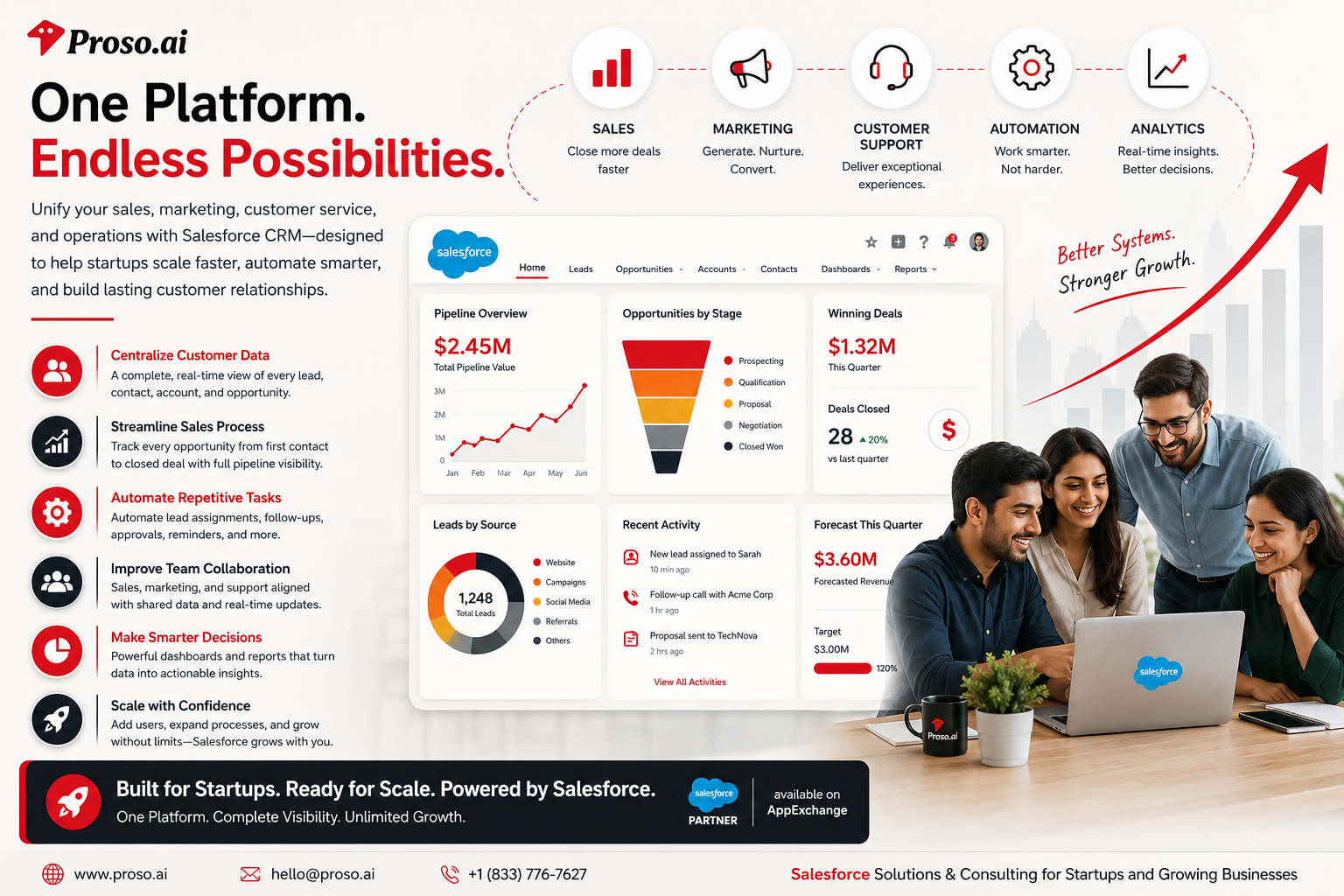
Instead of juggling disconnected tools, startups gain a connected platform that enables them to:
Create a complete view of every lead, contact, account, and opportunity in one place.
Track every opportunity from the first interaction to a closed deal with complete visibility into the sales pipeline.
Reduce manual tasks by automating lead assignments, follow-ups, approvals, reminders, and notifications.
Keep sales, marketing, and customer success aligned through shared customer data and real-time updates.
Access powerful dashboards, reports, and forecasts that provide actionable insights into business performance.
As your startup grows, Salesforce grows with you—supporting new users, expanding teams, and evolving business processes without disrupting operations.
Implementing a CRM isn't simply about replacing spreadsheets or organizing customer data.
It's about changing how your entire business operates.
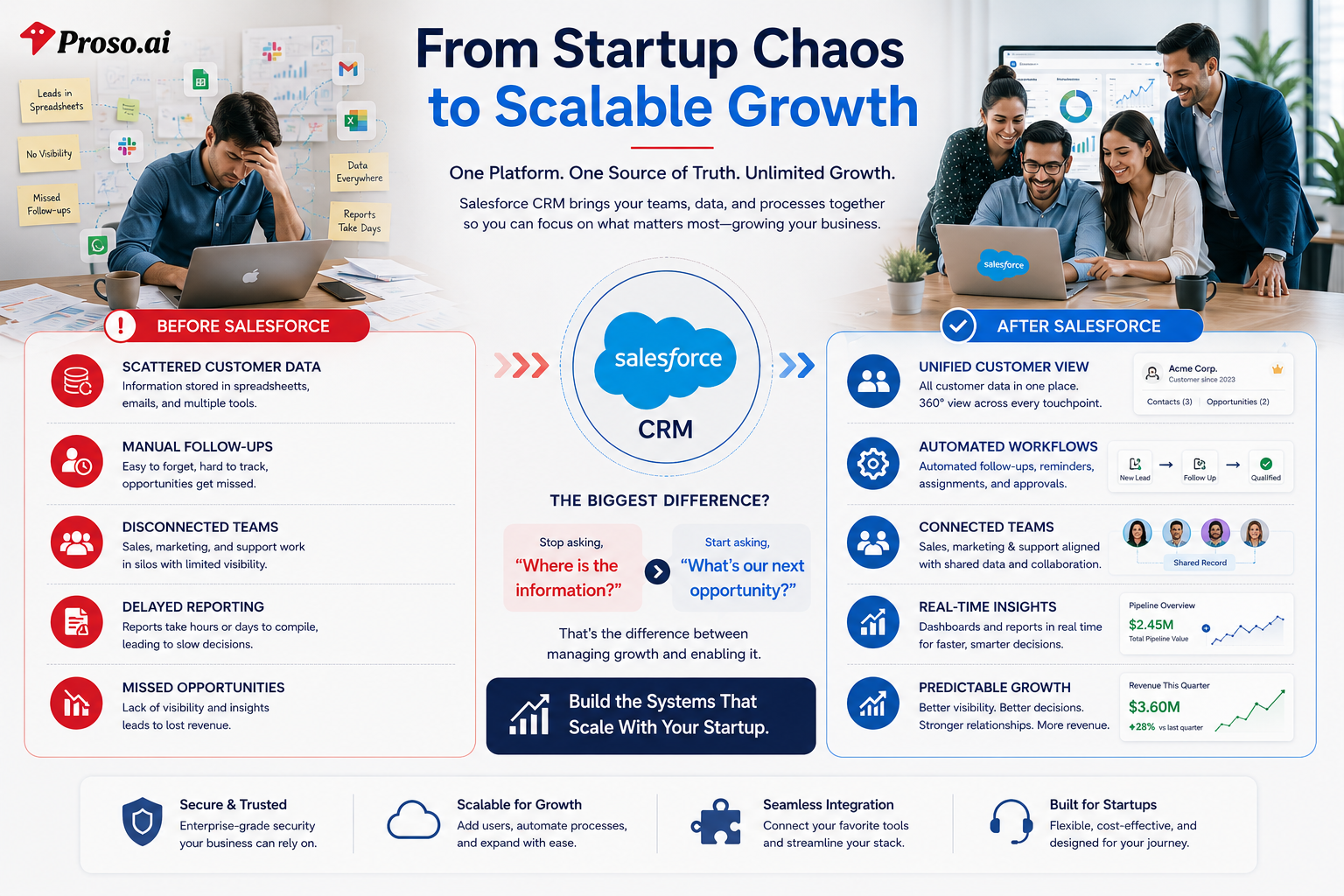
When startups adopt Salesforce, the transformation extends far beyond the sales team. Marketing gains better visibility into campaign performance. Sales representatives spend less time searching for information and more time building customer relationships. Customer support teams gain complete context before every interaction. Leadership can make faster decisions backed by real-time insights instead of assumptions.
Every department begins working from the same source of truth.
Instead of reacting to problems, teams become proactive. Opportunities are followed up automatically. Customer interactions are captured in one place. Reports are generated instantly. Managers no longer chase updates because the data is already available.
As the business grows, new employees can quickly adapt because standardized workflows replace manual processes. Instead of creating complexity, growth becomes structured, predictable, and easier to manage.
This is the real value of Salesforce.
It doesn't just help startups manage more customers—it helps them build an organization that's ready for the next stage of growth.
Every opportunity is tracked, follow-ups are automated, and the entire sales pipeline becomes visible in one centralized platform.
Campaign performance, lead sources, and customer engagement are measured in real time, helping teams invest in strategies that actually drive revenue.
Every interaction—from the first inquiry to post-sales support—is available in one place, enabling personalized experiences that build long-term loyalty.
Routine administrative tasks are automated, approvals move faster, and employees spend less time on repetitive work.
Real-time dashboards and forecasting provide decision-makers with the confidence to plan hiring, investments, and expansion based on accurate business data.
Growing startups stop asking,
"Where is the information?"
and start asking,
"What's our next opportunity?"
That's the difference between managing growth and enabling it.
Implementing a CRM isn't simply about replacing spreadsheets or organizing customer data.
It's about changing how your entire business operates.
When startups adopt Salesforce, the transformation extends far beyond the sales team. Marketing gains better visibility into campaign performance. Sales representatives spend less time searching for information and more time building customer relationships. Customer support teams gain complete context before every interaction. Leadership can make faster decisions backed by real-time insights instead of assumptions.
Every department begins working from the same source of truth.
Instead of reacting to problems, teams become proactive. Opportunities are followed up automatically. Customer interactions are captured in one place. Reports are generated instantly. Managers no longer chase updates because the data is already available.
As the business grows, new employees can quickly adapt because standardized workflows replace manual processes. Instead of creating complexity, growth becomes structured, predictable, and easier to manage.
This is the real value of Salesforce.
It doesn't just help startups manage more customers—it helps them build an organization that's ready for the next stage of growth.
Every opportunity is tracked, follow-ups are automated, and the entire sales pipeline becomes visible in one centralized platform.
Campaign performance, lead sources, and customer engagement are measured in real time, helping teams invest in strategies that actually drive revenue.
Every interaction—from the first inquiry to post-sales support—is available in one place, enabling personalized experiences that build long-term loyalty.
Routine administrative tasks are automated, approvals move faster, and employees spend less time on repetitive work.
Real-time dashboards and forecasting provide decision-makers with the confidence to plan hiring, investments, and expansion based on accurate business data.
Growing startups stop asking,
"Where is the information?"
and start asking,
"What's our next opportunity?"
That's the difference between managing growth and enabling it.
At Proso AI, we don't believe in one-size-fits-all CRM implementations.
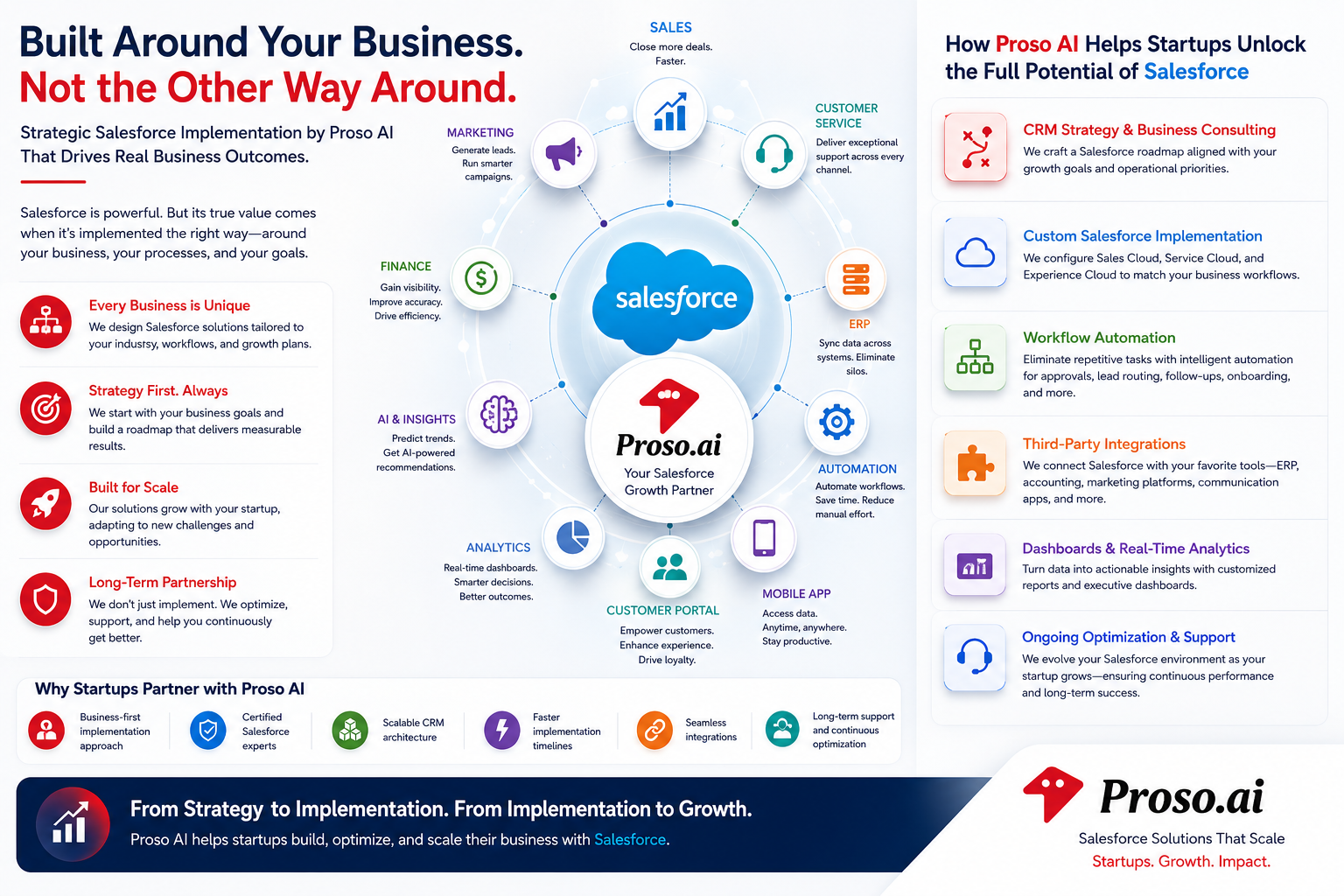
We begin by understanding how your business sells, serves customers, and plans to grow. From there, we design a Salesforce ecosystem that aligns with your unique processes—helping you scale without disrupting the way your teams work.
Our Salesforce experts help startups:
Build a Salesforce roadmap aligned with your growth goals and operational priorities.
Configure Sales Cloud, Service Cloud, and Experience Cloud to match your business workflows.
Eliminate repetitive tasks through intelligent automation for approvals, lead routing, follow-ups, notifications, and customer onboarding.
Connect Salesforce with ERP systems, accounting software, marketing platforms, communication tools, and other business-critical applications.
Transform business data into actionable insights with customized reports and executive dashboards.
As your startup grows, your CRM evolves with you. We continuously optimize your Salesforce environment to meet new business requirements.
✔ Business-first implementation approach
✔ Certified Salesforce experts
✔ Scalable CRM architecture
✔ Faster implementation timelines
✔ Seamless integrations
✔ Long-term support and optimization
The most successful startups aren't defined by the number of employees they hire.
They're defined by the systems they build.
And those systems determine how confidently they can grow tomorrow.
Every successful startup reaches a turning point.
It's the moment when ambition alone is no longer enough. Growth brings more customers, larger teams, higher expectations, and increasingly complex operations. The systems that once supported your business begin to hold it back.
The startups that continue to grow aren't necessarily the ones with the biggest teams or the largest budgets. They're the ones that invest in the right technology at the right time.
Salesforce provides the foundation to manage customer relationships, automate business processes, improve collaboration, and make data-driven decisions—all from a single, connected platform.
But technology delivers real value only when it's aligned with your business goals.
That's why choosing the right implementation partner matters just as much as choosing the right platform.
At Proso AI, we help startups move beyond basic CRM implementation. We design Salesforce solutions that fit your business, streamline your operations, and prepare your organization for sustainable, long-term growth.
Whether you're building your first sales process, expanding into new markets, or preparing for your next funding round, the right CRM foundation can become your greatest competitive advantage.
Because scaling isn't about doing more work.
It's about building smarter systems that make growth effortless.
Your next stage of growth deserves more than disconnected tools and manual processes.
Partner with Proso AI to implement Salesforce solutions that help you automate operations, strengthen customer relationships, and scale with confidence.
✔ Salesforce Consulting
✔ CRM Implementation
✔ Workflow Automation
✔ Third-Party Integrations
✔ Analytics & AI
✔ Ongoing Optimization & Support
Let's build a Salesforce ecosystem that grows with your business—not against it.
Transform your startup with Salesforce solutions tailored to your business by Proso AI.

.jpg)

.png)
.png)