


Imagine you're a CIO responsible for managing technology across a growing organization. Your employees rely on Microsoft 365 for collaboration, your teams are exploring AI to improve productivity, and your security team is working to protect business-critical information. Meanwhile, your finance department expects you to control software spending and demonstrate a clear return on investment.
The challenge isn't simply adopting new technology. It's ensuring that every tool, license, and AI capability delivers meaningful business value without creating additional complexity or risk.
You may already be paying for Microsoft 365 licenses that include capabilities your employees aren't using. Your IT team may be managing security and device controls across multiple tools. Employees may be experimenting with AI without a consistent approach to governance, visibility, or cost management.
These challenges can lead to underutilized licenses, fragmented workflows, unnecessary spending, and security blind spots.
This is where a more strategic approach to enterprise technology becomes essential.
At Proso AI, we help organizations look beyond individual tools and focus on how their technology ecosystem can work more effectively together. By aligning enterprise applications, integrations, AI adoption, and operational workflows with business goals, organizations can identify inefficiencies, improve visibility, and make more informed technology decisions.
Microsoft's 2026 Microsoft 365 update brings these priorities into focus. With expanded AI, security, and device management capabilities—and commercial pricing changes effective July 1, 2026—businesses have a timely opportunity to evaluate their current environment and determine how to get greater value from their Microsoft investments.
.png)
For IT leaders, a Microsoft 365 pricing update is more than a change in subscription costs. It is an opportunity to reassess whether their technology environment is equipped to support productivity, security, and AI adoption without adding unnecessary complexity.
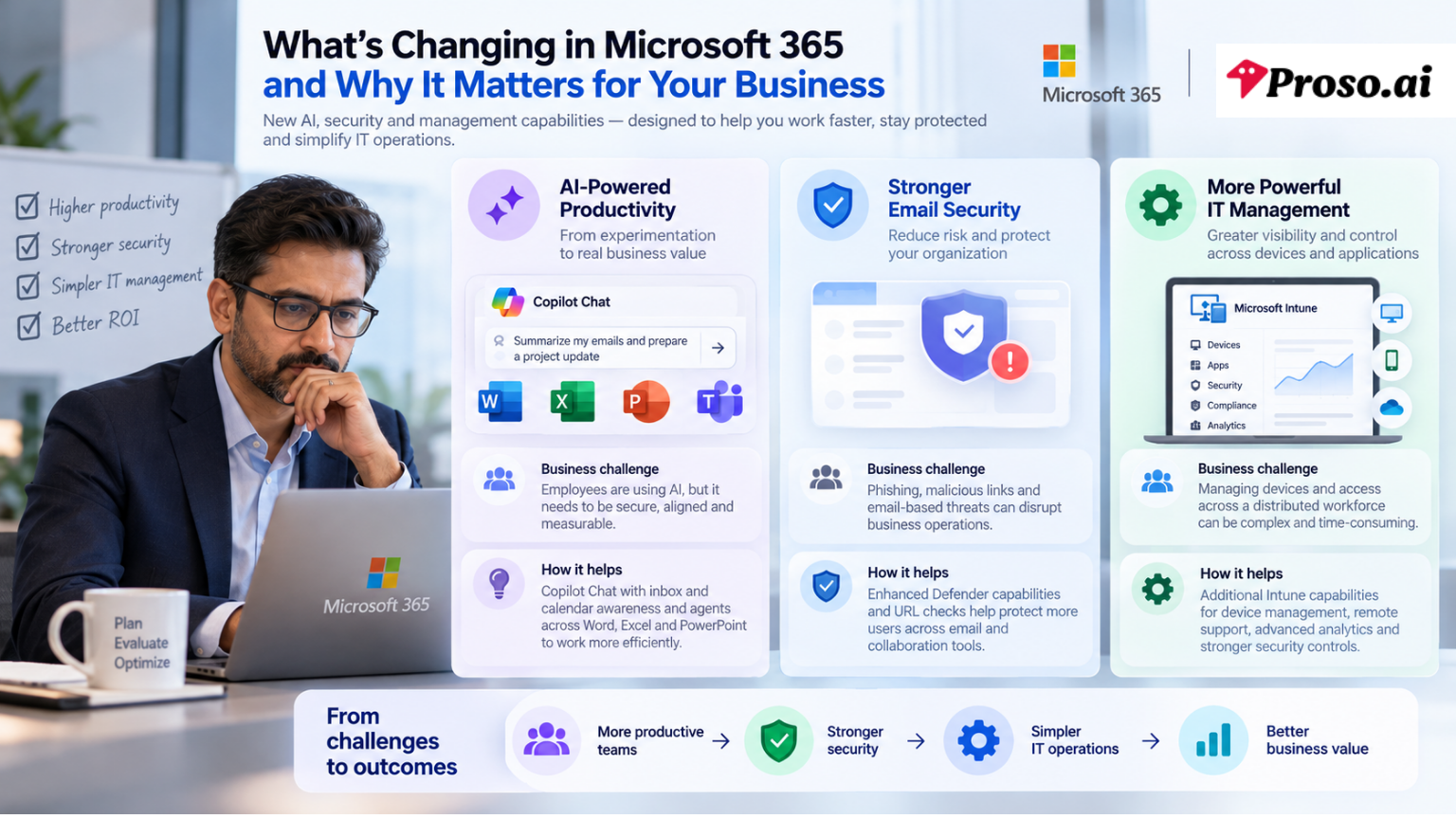
Microsoft's announcement outlines enhancements across three key areas: AI-powered productivity, email security, and endpoint management. Understanding how these changes relate to existing business challenges can help organizations make better technology decisions.
The business problem: Employees are exploring AI to work faster, but organizations need to ensure that AI adoption is useful, secure, and aligned with business goals.
Microsoft is expanding Copilot Chat capabilities, including greater awareness of inbox and calendar context and access to agents for tasks involving Word, Excel, and PowerPoint. These capabilities can help employees work more efficiently across familiar applications.
However, access to AI alone does not guarantee business value. Organizations also need clear usage policies, appropriate access controls, and visibility into how AI is being adopted across teams.
How businesses can respond: Start by identifying repetitive workflows where AI could save time, establish governance guidelines, and measure adoption against meaningful outcomes such as reduced manual effort and faster task completion. Review the capabilities available under existing licenses before investing in additional tools.
At Proso AI, our broader approach to enterprise technology centers on connecting tools and workflows to business objectives—so AI adoption is guided by operational needs rather than novelty.
The business problem: Email remains a critical business communication channel, but phishing, malicious links, and other email-based threats can expose organizations to operational and financial risk.
Microsoft has announced enhanced email security capabilities for selected Microsoft 365 and Office 365 plans, including additional Defender for Office 365 Plan 1 capabilities for eligible E3 subscriptions and URL-checking enhancements for certain E1 and Business plans.
For IT teams, the practical question is not simply whether new security features are available. It is whether the organization's current configuration, licensing, and security policies adequately address its risk exposure.
How businesses can respond: Review current security coverage, identify gaps in email protection, validate which capabilities are included in existing subscriptions, and ensure that policies are configured to match the organization's risk profile.
A structured review can help IT leaders prioritize genuine security gaps instead of purchasing overlapping tools without a clear need.
The business problem: Managing devices, applications, and access across a distributed workforce can create administrative overhead and inconsistent security controls.
Microsoft is adding Intune capabilities to selected Microsoft 365 E3 and E5 plans. Depending on the subscription, these include tools for remote support, advanced analytics, endpoint privilege management, enterprise application management, and Cloud PKI.
These capabilities can help eligible organizations strengthen device management and simplify certain IT operations. However, the benefits depend on licensing eligibility, configuration, and how effectively the tools fit into existing workflows.
How businesses can respond: Map existing endpoint management processes, identify repetitive administrative tasks, assess current license entitlements, and determine which additional capabilities would address measurable operational or security gaps.
The objective is to make device management more consistent and efficient—not simply to activate more features.
The business problem: When software costs increase, IT leaders are expected to justify every expense while ensuring employees have the tools they need to work securely and efficiently.
Microsoft announced that updated commercial pricing for affected Microsoft 365 subscriptions would take effect on July 1, 2026. Existing customers will generally see the new pricing at their next renewal after that date. The changes accompany expanded capabilities across productivity, security, and IT management.
For businesses, the key question is no longer just how much will our subscriptions cost? It is how can we ensure that our technology spending delivers the greatest possible business value?
1. Audit existing licenses and usage
Review the subscriptions assigned across teams. Identify inactive accounts, overlapping tools, underused capabilities, and differences between what employees need and what their licenses provide.
2. Evaluate the value of the new capabilities
Assess whether the expanded AI, security, and endpoint management features address actual business requirements. Compare the potential operational benefits with the revised subscription costs before deciding whether to retain, change, or upgrade a plan.
3. Align technology spending with business outcomes
Move beyond evaluating software costs in isolation. Consider whether investments are helping reduce manual work, improve security coverage, simplify IT administration, or support employee productivity. Establish measurable indicators so future technology decisions are based on evidence rather than assumptions.
Technology decisions become more effective when organizations understand how their applications, integrations, AI initiatives, and operational workflows support their wider business objectives.
Proso AI's enterprise technology perspective is centered on helping businesses approach these decisions strategically: identifying inefficiencies, improving how technology works across the organization, and aligning technology initiatives with measurable goals.
The objective is not simply to spend less on software. It is to reduce waste, avoid unnecessary complexity, and make every technology investment work harder for the business.
.png)
Understanding Microsoft's updates is only the first step. The real value comes from knowing where your organization stands today, what needs attention, and which actions will have the greatest impact.
Before your next Microsoft 365 renewal or technology planning cycle, use this checklist to assess your organization's readiness.
A checklist can reveal potential gaps, but prioritization is what drives results. Some organizations may need to improve license utilization first. Others may need stronger AI governance, more consistent security controls, or better integration across enterprise applications.
The right approach is to evaluate each opportunity based on business impact, implementation effort, risk, and cost.
At Proso AI, the goal is to help organizations think beyond individual technology changes and focus on a connected, outcome-driven enterprise environment. By aligning technology decisions with business priorities, companies can make more informed investments and build a stronger foundation for future growth.
.png)
Microsoft 365's 2026 updates highlight a broader shift in enterprise technology. AI, security, and IT management are becoming increasingly connected, while organizations must continue to justify technology spending and demonstrate measurable results.
For CIOs and IT leaders, the priority is not simply to adapt to new features or revised subscription prices. It is to ensure that technology investments support business goals, employees work efficiently, security controls remain effective, and resources are used wisely.
That starts with understanding the current environment, identifying gaps, and prioritizing improvements based on business impact. A well-planned review can help organizations make more informed licensing decisions, establish stronger AI governance, and identify opportunities to simplify operations.
At Proso AI, we believe technology should solve business problems—not create new layers of complexity. By taking a strategic, connected approach to enterprise applications, integrations, and AI initiatives, organizations can build a stronger foundation for productivity, security, and sustainable growth.
Review your Microsoft 365 environment, identify your highest-priority gaps, and build a roadmap that connects technology decisions to measurable business outcomes.
Connect with Proso AI to explore a more strategic approach to enterprise technology.
.jpg)

.png)
.png)