It's 2:00 AM.
A database administrator receives yet another alert.
A reporting workload has overwhelmed the data warehouse. Queries that usually take seconds are now taking minutes. Business users are unable to access critical reports before an executive review scheduled for the next morning.
The DBA logs in, investigates performance bottlenecks, adjusts resources, reviews indexes, checks storage utilization, and begins troubleshooting.
A few weeks later, another challenge emerges.
A security patch must be applied immediately to address a newly discovered vulnerability. The team schedules maintenance windows, prepares rollback plans, coordinates with stakeholders, and carefully executes updates to avoid business disruption.
Then comes the next cycle—capacity planning, performance tuning, backups, monitoring, upgrades, and recovery testing.
For many organizations, this has become the reality of managing modern data warehouses.
As data volumes grow and analytics become central to business strategy, IT teams find themselves trapped in an endless cycle of operational maintenance. Highly skilled professionals spend significant portions of their time keeping systems running instead of helping the business unlock value from its data.
The question facing enterprise leaders today is no longer whether they need a data warehouse.
The real question is:
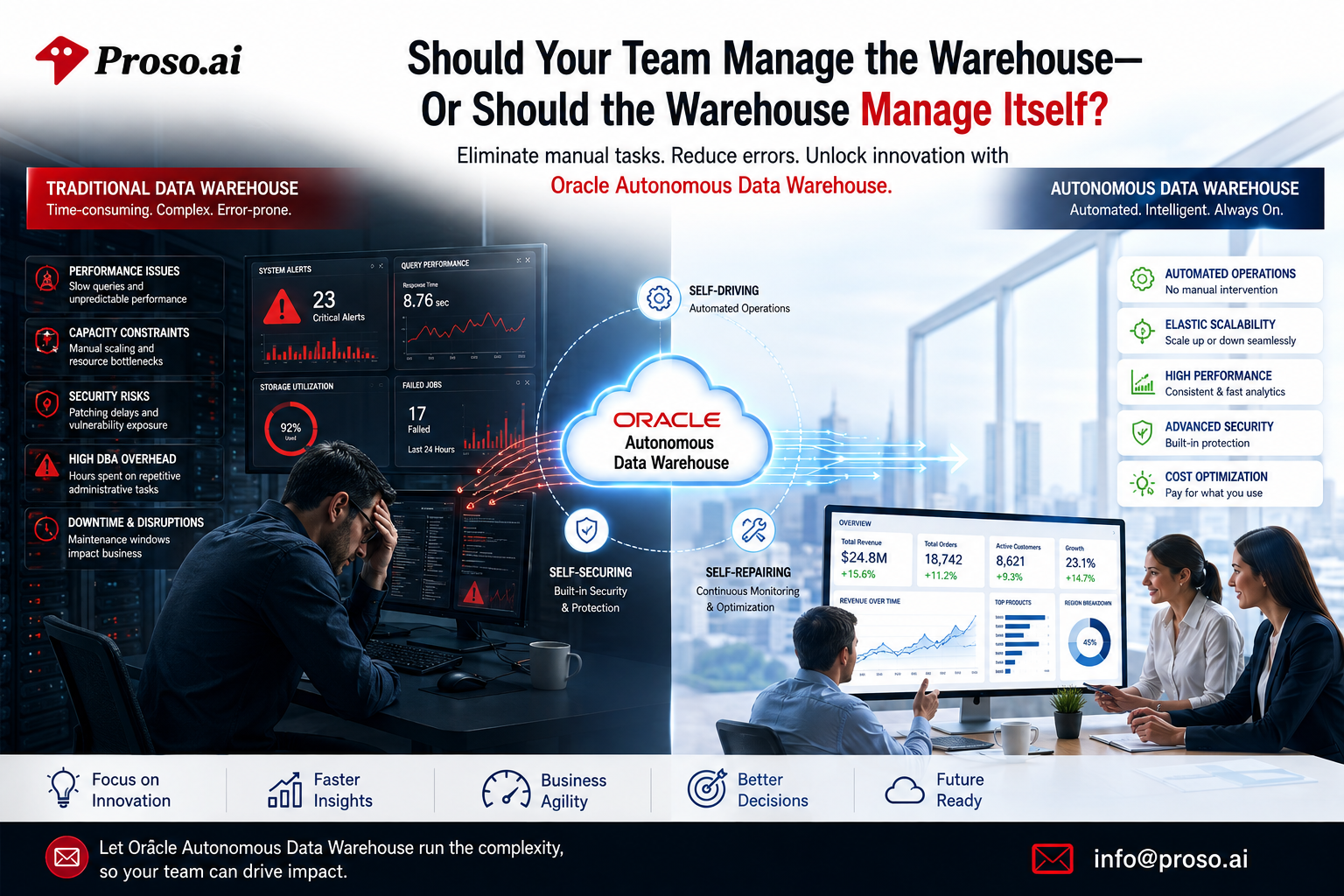
Should your team continue managing the warehouse, or should the warehouse start managing itself?
This shift in thinking has fueled the rise of autonomous data platforms.
Oracle Autonomous Data Warehouse (ADW) was designed around a simple but transformative idea: eliminate the repetitive and complex administrative tasks that consume valuable IT resources while delivering the performance, scalability, and security modern enterprises demand. Built on Oracle's Autonomous Database technology, ADW automates provisioning, tuning, patching, backups, scaling, and security management with minimal human intervention. Oracle describes it as a fully autonomous database that delivers fast query performance, elastic scalability, and requires no traditional database administration.
For organizations pursuing digital transformation, the value extends beyond operational efficiency. Autonomous Data Warehouse enables IT teams to shift their focus from maintenance to innovation, empowering data engineers, analysts, and business leaders to spend more time generating insights and less time managing infrastructure. Oracle positions ADW as a self-driving, self-securing, and self-repairing platform designed to reduce human error while maintaining enterprise-grade reliability and security.
In this article, we'll explore how Oracle Autonomous Data Warehouse is redefining enterprise analytics, why organizations are increasingly embracing autonomous database technologies, and how businesses can accelerate their journey toward a truly modern data platform.
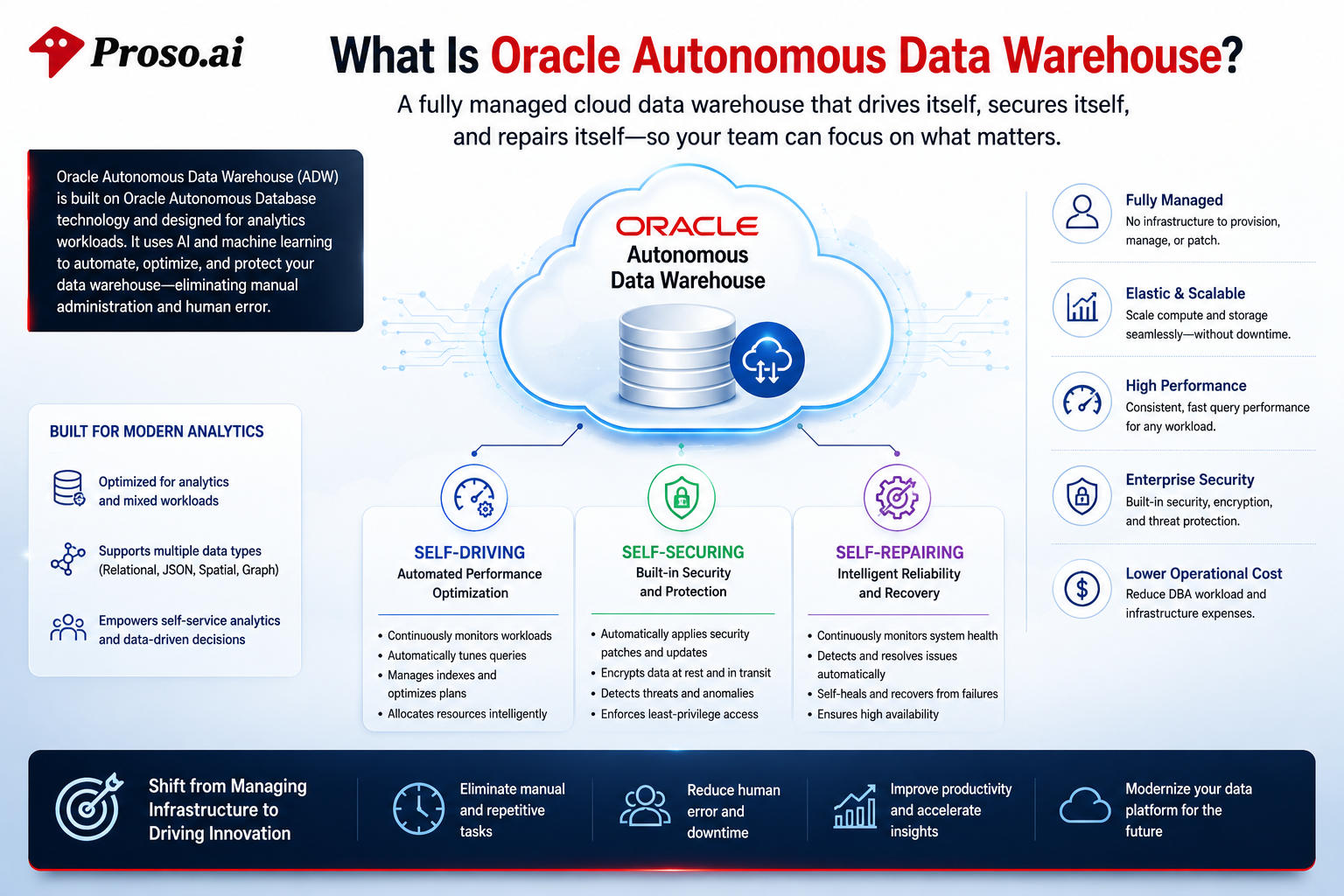
Imagine if your data warehouse could monitor itself, optimize itself, secure itself, repair itself, and scale itself—without requiring constant intervention from database administrators.
That's the vision Oracle set out to achieve with Oracle Autonomous Data Warehouse (ADW).
Oracle Autonomous Data Warehouse is a fully managed cloud data warehouse service built on Oracle Autonomous Database technology. Designed specifically for analytics and data warehousing workloads, ADW leverages artificial intelligence, machine learning, and automation to eliminate many of the routine tasks traditionally performed by database administrators.
Instead of spending hours provisioning infrastructure, tuning queries, applying security patches, managing backups, or planning capacity upgrades, organizations can rely on the platform to perform these activities automatically.
Oracle describes Autonomous Data Warehouse as a database that is:
These three capabilities form the foundation of what makes the platform "autonomous."
One of the most time-consuming responsibilities for database teams is maintaining performance.
As workloads increase and data volumes grow, administrators must continuously monitor systems, optimize queries, manage indexes, and allocate resources to ensure users receive fast responses.
Oracle Autonomous Data Warehouse automates these processes.
Using machine learning algorithms, the platform continuously analyzes workload patterns and automatically adjusts performance configurations to optimize query execution and resource utilization.
The result is consistent performance without constant manual tuning.
Cybersecurity threats continue to evolve, and database environments are often among the most valuable targets for attackers.
Traditional database environments frequently require scheduled maintenance windows for security updates and vulnerability patching.
Oracle Autonomous Data Warehouse significantly reduces this burden by automatically applying security updates and patches while maintaining high availability.
Combined with encryption, access controls, threat detection capabilities, and continuous monitoring, ADW helps organizations strengthen their security posture while minimizing operational complexity.
Downtime can impact productivity, revenue, customer experience, and business continuity.
Oracle Autonomous Data Warehouse continuously monitors system health and automatically detects potential issues before they affect users.
The platform performs automated recovery processes, infrastructure monitoring, and fault management to maintain service availability and reliability.
This self-healing capability helps organizations reduce operational risks while improving overall system resilience.
While many organizations initially view ADW as simply another cloud data warehouse, its value extends far beyond storage and reporting.
Oracle Autonomous Data Warehouse combines:
into a single unified platform.
This allows organizations to focus on generating business insights instead of managing database operations.
For data leaders, the shift is significant.
Rather than asking:
"How do we maintain our data warehouse?"
The conversation becomes:
"How do we use our data more effectively to drive business growth?"
And that shift—from infrastructure management to business innovation—is exactly why autonomous databases are becoming a critical component of modern data strategies.
For most organizations, the challenge isn't collecting data—it's managing the growing complexity that comes with it.
As businesses scale, data warehouses become larger, workloads become more demanding, and administrative requirements continue to increase. Database teams often find themselves spending more time maintaining infrastructure than supporting business innovation.
Oracle Autonomous Data Warehouse was designed to address these challenges by automating the most resource-intensive aspects of data warehouse management.
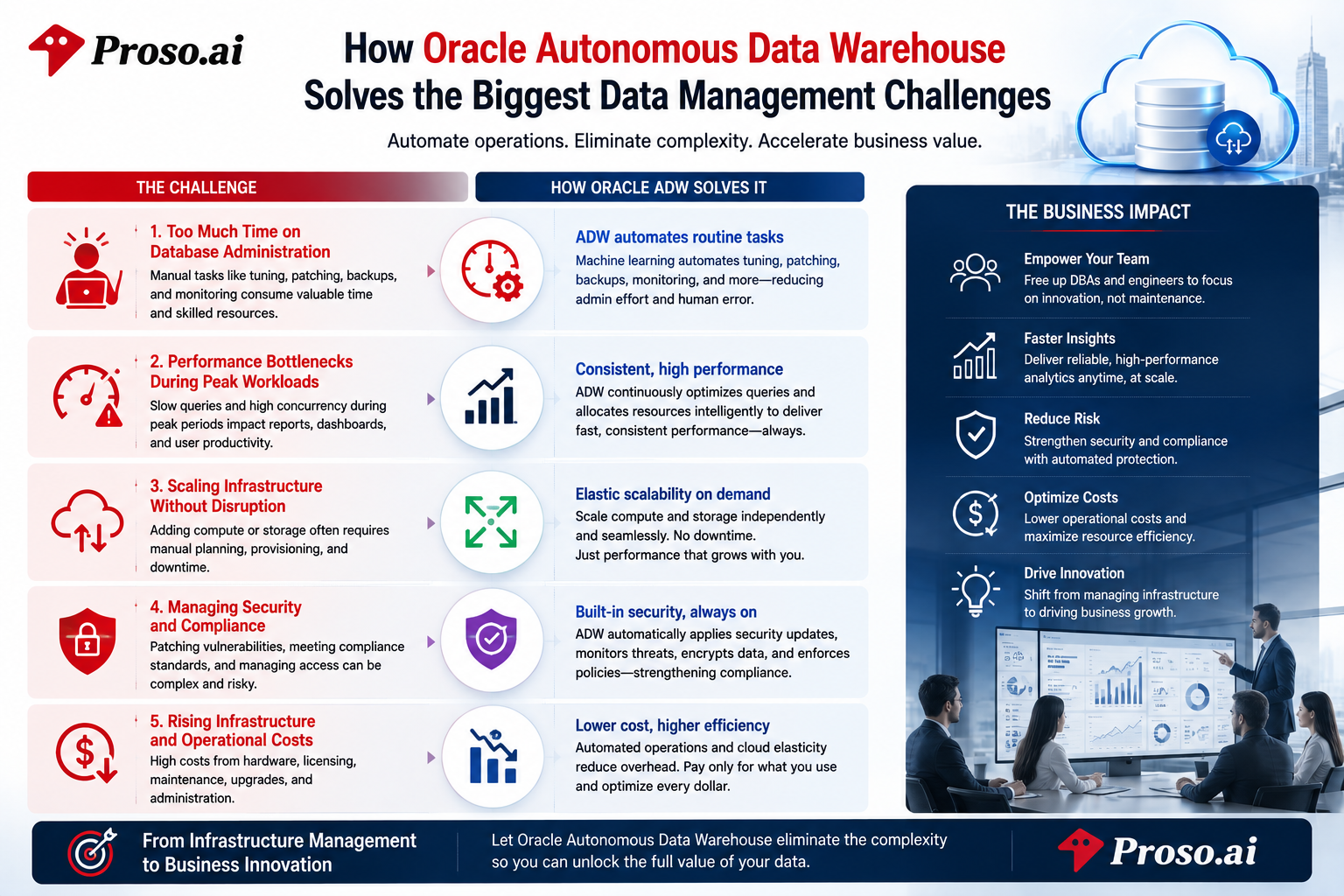
Let's explore the key problems organizations face and how ADW helps solve them.
Traditional data warehouse environments require constant monitoring and maintenance.
Database administrators are responsible for:
While these activities are essential, they rarely create direct business value.
Highly skilled professionals often spend hours managing routine operational tasks instead of focusing on strategic initiatives.
Oracle Autonomous Data Warehouse automates many of these responsibilities through machine learning and intelligent automation.
The platform continuously:
This reduces administrative effort while minimizing the risk of human error.
The result is a more productive IT team and a lower operational burden.
Business users expect reports and dashboards to deliver insights instantly.
However, traditional environments often struggle when workloads spike during:
Performance degradation can impact decision-making and user productivity.
Oracle Autonomous Data Warehouse continuously optimizes query performance and resource allocation.
Its intelligent architecture automatically adjusts to changing workload demands, ensuring users receive fast and consistent performance without manual intervention.
Whether supporting hundreds or thousands of concurrent users, the platform is designed to maintain responsiveness at scale.
One of the biggest limitations of traditional environments is scalability.
When organizations need additional compute or storage resources, infrastructure upgrades often require:
As business requirements evolve, this approach becomes increasingly difficult to manage.
Oracle Autonomous Data Warehouse provides elastic scalability.
Organizations can scale compute and storage resources independently based on workload requirements.
More importantly, scaling occurs while applications and analytics workloads continue running.
This enables businesses to adapt quickly to changing demands without impacting users.
Data warehouses often contain an organization's most sensitive information, including customer records, financial data, operational metrics, and intellectual property.
Protecting this data requires continuous vigilance.
Many organizations struggle with:
Delays or oversights can create significant risk.
Security is built directly into Oracle Autonomous Data Warehouse.
The platform automatically applies security updates, continuously monitors for threats, and incorporates enterprise-grade protection mechanisms.
By automating security operations, organizations can strengthen compliance and reduce exposure without increasing administrative complexity.
Maintaining traditional data warehouse environments often requires substantial investment in:
As data volumes grow, these costs can escalate rapidly.
Oracle Autonomous Data Warehouse reduces operational overhead through automation and cloud-based consumption models.
Organizations only pay for the resources they use while benefiting from automated management, optimization, and maintenance.
This helps improve cost efficiency while enabling teams to focus on higher-value business initiatives.
The true value of Oracle Autonomous Data Warehouse extends beyond technology.
By eliminating repetitive administrative tasks, improving performance, enhancing security, and simplifying scalability, organizations can redirect resources toward innovation, analytics, and strategic decision-making.
Instead of asking:
"How do we manage our data warehouse?"
Business leaders can focus on a more important question:
"How do we generate more value from our data?"
That shift is what makes autonomous data platforms a key component of modern enterprise data strategies.
Every organization's cloud journey is different.
Some businesses prioritize cost efficiency and rapid deployment. Others require strict security controls, predictable performance, or compliance with data residency regulations.
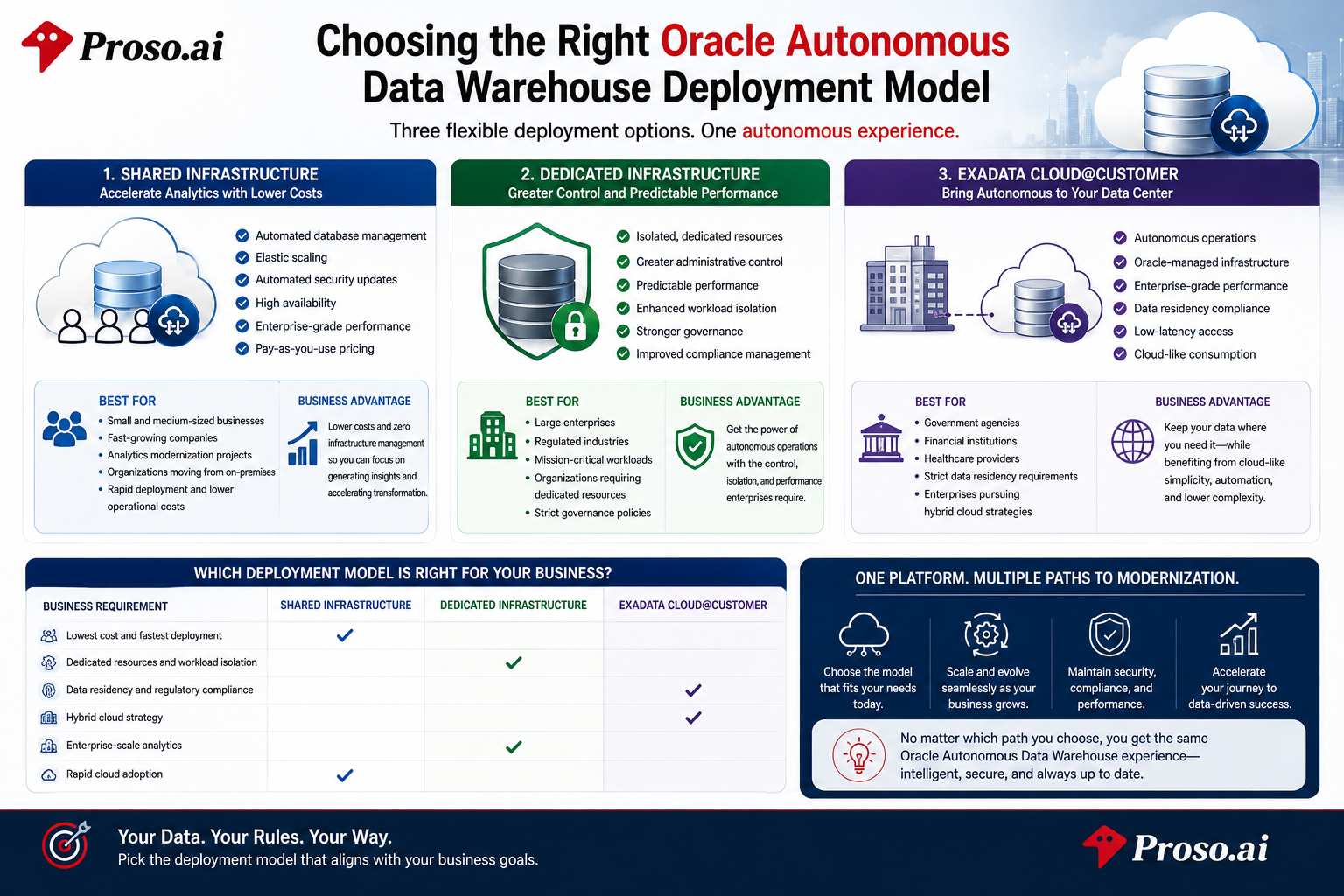
Recognizing these diverse requirements, Oracle Autonomous Data Warehouse offers three deployment options that allow organizations to balance flexibility, control, compliance, and cost according to their unique business needs.
Rather than forcing customers into a single cloud model, Oracle enables organizations to choose the deployment approach that aligns with their operational and regulatory requirements.
Let's examine each option and the business scenarios where it makes the most sense.
For many organizations beginning their cloud modernization journey, simplicity and cost efficiency are top priorities.
Oracle's Shared Infrastructure deployment model provides access to the full capabilities of Autonomous Data Warehouse while operating within Oracle's public cloud environment.
Organizations benefit from:
Because infrastructure resources are shared across multiple Oracle Cloud customers, organizations can reduce costs while still benefiting from Oracle's autonomous capabilities.
Instead of investing heavily in infrastructure management, organizations can focus on generating business insights and accelerating digital transformation initiatives.
As organizations grow, they often require greater control over their cloud environments.
Industries such as financial services, healthcare, telecommunications, and government frequently operate workloads that demand higher levels of isolation and performance predictability.
Oracle's Dedicated Infrastructure deployment option addresses these requirements by providing customers with their own isolated cloud infrastructure.
Unlike shared environments, resources are dedicated exclusively to a single organization.
This enables:
Organizations receive the benefits of Autonomous Data Warehouse while maintaining a cloud architecture that closely resembles traditional enterprise infrastructure.
Dedicated Infrastructure combines the automation benefits of autonomous operations with the control and predictability enterprise workloads often require.
For some organizations, moving sensitive data entirely to the public cloud is not an option.
Regulatory requirements, data sovereignty laws, internal security policies, and latency considerations may require data to remain within company-controlled environments.
Oracle addresses these concerns through Exadata Cloud@Customer.
This deployment model brings Oracle's cloud services directly into the customer's data center while maintaining autonomous cloud management capabilities.
Organizations gain:
The result is a hybrid approach that combines the benefits of on-premises deployment with the operational simplicity of the cloud.
Organizations maintain control over where their data resides while still reducing administrative complexity through Oracle's autonomous capabilities.
The ideal deployment model depends on your organization's priorities.
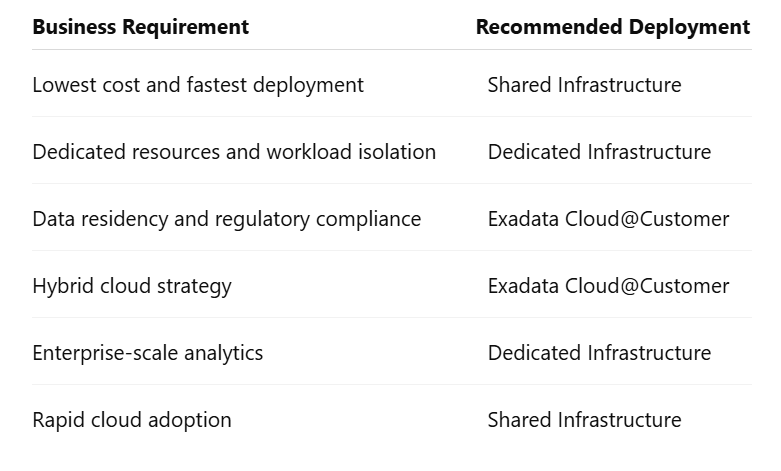
The key advantage is flexibility.
Organizations can select the model that aligns with their current needs while maintaining a consistent Oracle Autonomous Data Warehouse experience across environments.
Whether you're pursuing a cloud-first strategy, maintaining strict compliance requirements, or balancing both through a hybrid approach, Oracle Autonomous Data Warehouse provides a deployment model designed to support your goals.
By offering shared, dedicated, and customer-managed deployment options, Oracle enables organizations to modernize analytics environments without compromising on security, performance, governance, or business agility.
The question is no longer whether autonomous data warehousing fits your organization.
The question is which deployment model will help you achieve your business objectives faster.
The cloud data warehouse market has become increasingly competitive. Organizations evaluating modern analytics platforms often compare solutions based on performance, scalability, security, automation, and operational efficiency.
While many platforms offer cloud-based storage and analytics capabilities, Oracle Autonomous Data Warehouse stands apart because it was built around a fundamentally different objective: eliminating database administration through intelligent automation.
Rather than simply hosting a database in the cloud, Oracle has created a platform that continuously manages, optimizes, secures, and scales itself.
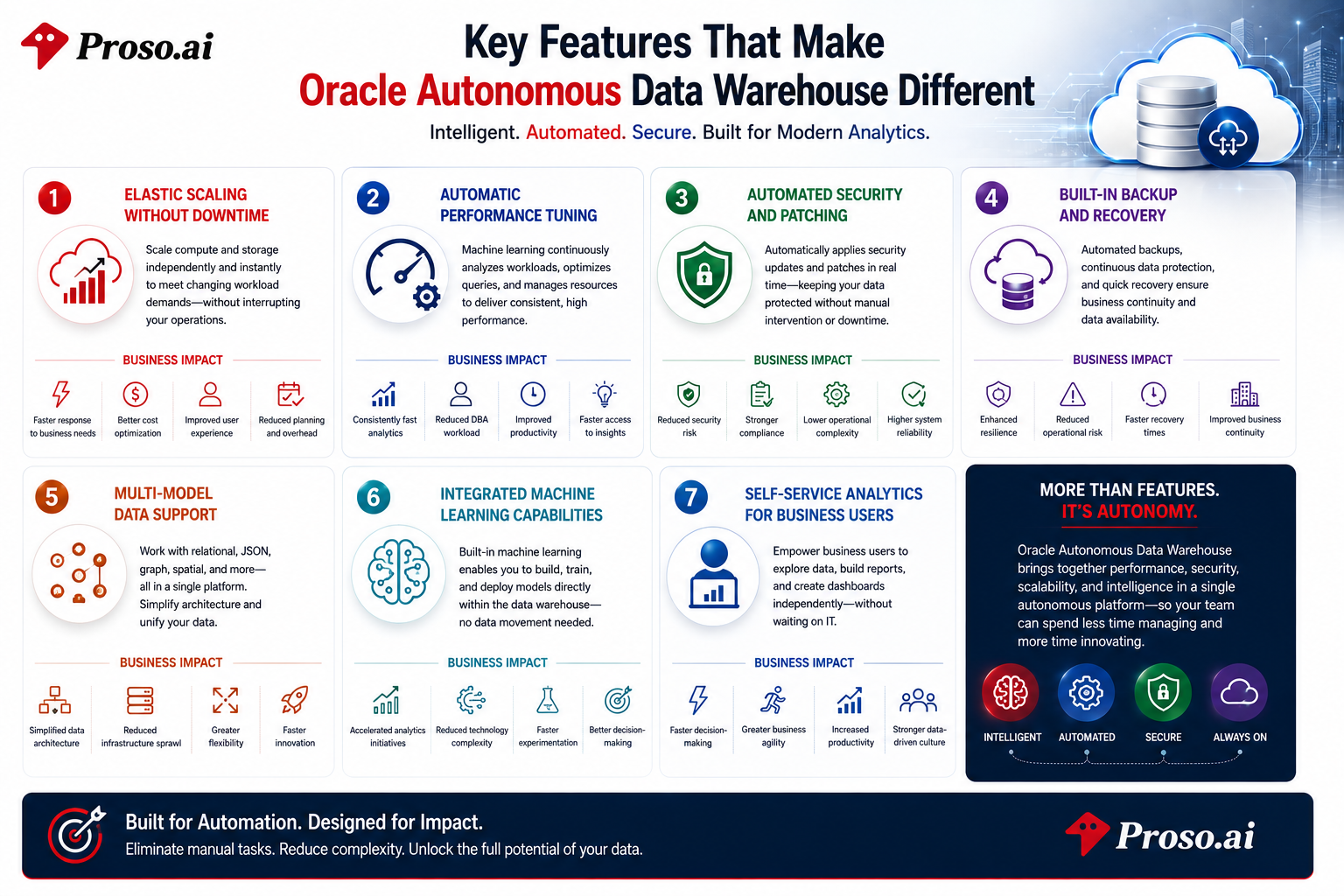
Let's explore the capabilities that make Oracle Autonomous Data Warehouse a unique solution for modern enterprises.
One of the biggest challenges organizations face is predicting future infrastructure requirements.
Traditional environments require teams to estimate future workloads, provision resources in advance, and schedule upgrades when additional capacity is needed.
This approach often results in either:
Oracle Autonomous Data Warehouse eliminates this challenge through elastic scaling.
Organizations can instantly scale compute and storage resources independently based on workload demands.
Unlike many traditional environments, scaling can occur while applications, dashboards, and analytics workloads remain active.
Performance optimization is one of the most time-consuming responsibilities for database administrators.
In traditional environments, maintaining performance requires:
Oracle Autonomous Data Warehouse continuously analyzes workload patterns and automatically optimizes performance.
Machine learning algorithms help ensure queries execute efficiently without requiring manual tuning.
Security vulnerabilities are constantly evolving.
Organizations must regularly apply patches and updates to protect critical systems from emerging threats.
Manual patching processes often introduce:
Oracle Autonomous Data Warehouse automates security updates and patch management while maintaining high availability.
This enables organizations to remain protected without disrupting business operations.
Data availability is essential for modern organizations.
Unexpected outages, hardware failures, or operational errors can result in significant business disruption.
Oracle Autonomous Data Warehouse automatically manages backup and recovery processes.
This helps ensure business continuity while reducing the burden on IT teams.
Today's enterprises work with more than traditional relational data.
Organizations increasingly manage:
Oracle Autonomous Data Warehouse supports multiple data models within a single platform.
This reduces architectural complexity and enables organizations to consolidate workloads more effectively.
Artificial intelligence and machine learning have become critical components of modern analytics strategies.
Many organizations invest in separate tools and infrastructure to support data science initiatives.
Oracle Autonomous Data Warehouse includes built-in machine learning capabilities that enable teams to analyze data and develop predictive insights directly within the platform.
The demand for data-driven decision-making continues to grow across every business function.
However, many organizations struggle because business users rely heavily on technical teams for reporting and analytics requests.
Oracle Autonomous Data Warehouse includes self-service capabilities that allow users to:
without requiring extensive technical expertise.
While individual capabilities such as scalability, security, and analytics are important, the true differentiator of Oracle Autonomous Data Warehouse is the combination of these capabilities within a single autonomous platform.
Instead of managing separate tools for performance optimization, security, backup, scaling, and infrastructure management, organizations gain an intelligent platform that handles these functions automatically.
The result is more than operational efficiency.
It is a shift from maintaining technology to extracting value from data.
For organizations pursuing digital transformation, that shift can significantly accelerate innovation, improve agility, and reduce the total cost of managing enterprise analytics environments.
Technology investments are ultimately measured by business outcomes.
While features such as automation, scalability, and security are important, organizations typically evaluate data platforms based on one critical question:
How will this help my business make better decisions faster?
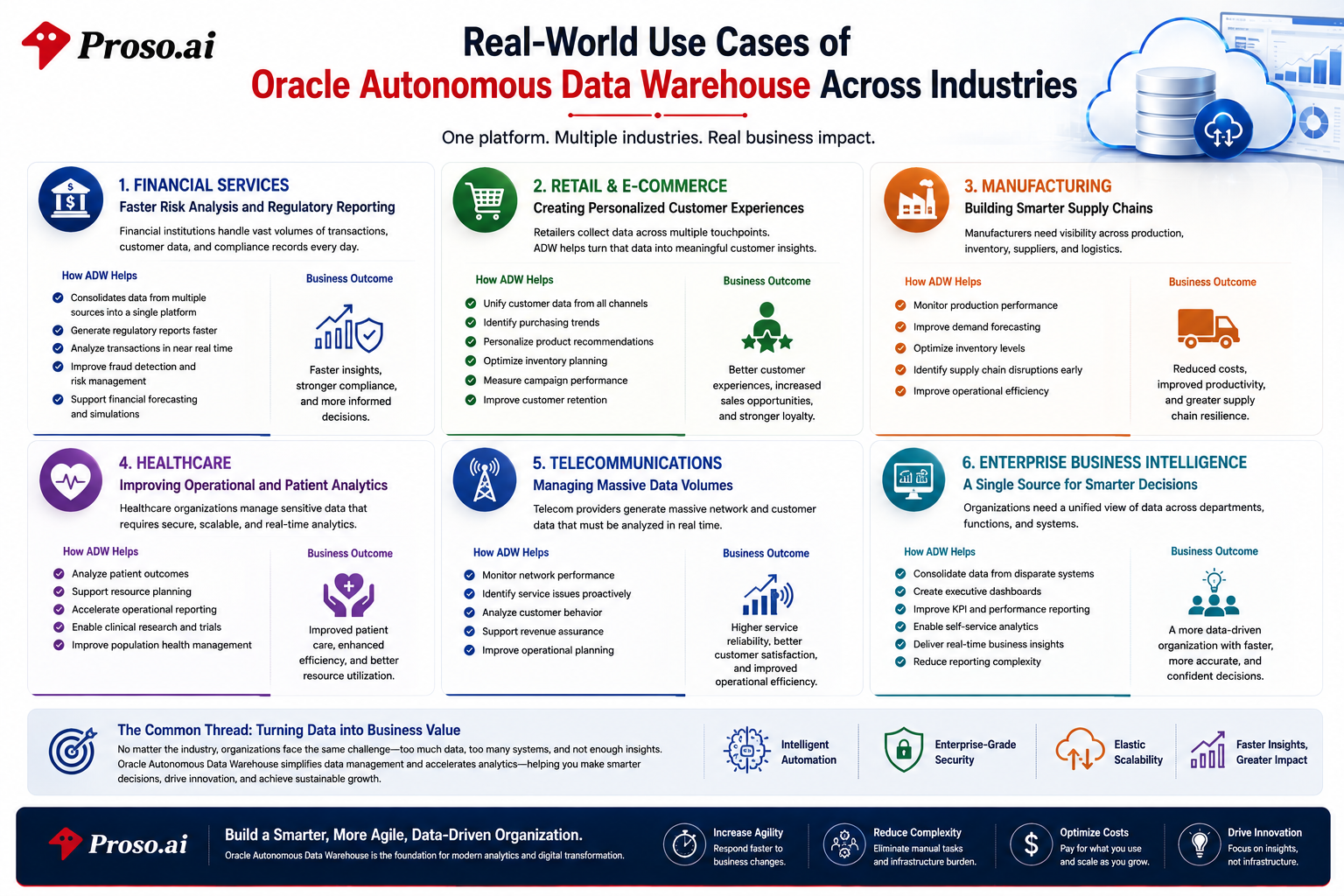
Oracle Autonomous Data Warehouse is being used across industries to unify data, improve analytics, accelerate reporting, and support digital transformation initiatives.
Because the platform combines automated management with enterprise-grade performance, organizations can focus on extracting value from data rather than managing infrastructure.
Let's explore how different industries are leveraging Oracle Autonomous Data Warehouse to drive measurable business outcomes.
Financial institutions generate enormous volumes of data every day—from transactions and customer interactions to compliance records and market activities.
Managing this information efficiently is critical for:
Traditional reporting systems often struggle to process growing data volumes while meeting strict compliance requirements.
Oracle Autonomous Data Warehouse enables financial organizations to consolidate data from multiple sources into a single analytics platform.
This allows teams to:
Faster insights, improved compliance, and more informed decision-making.
Modern retailers collect data from numerous touchpoints including:
The challenge lies in transforming this data into actionable customer insights.
Oracle Autonomous Data Warehouse helps retailers unify customer data and analyze buying behavior at scale.
Organizations can:
Better customer experiences, increased sales opportunities, and stronger customer loyalty.
Manufacturers operate within increasingly complex supply chains that require visibility across production, logistics, inventory, and supplier networks.
Disconnected systems often create delays in reporting and decision-making.
Oracle Autonomous Data Warehouse consolidates operational data from ERP systems, manufacturing applications, IoT devices, and supply chain platforms.
This enables organizations to:
Reduced costs, improved productivity, and greater supply chain resilience.
Healthcare organizations manage large volumes of sensitive clinical, operational, and financial data.
Delivering better patient outcomes increasingly depends on the ability to analyze this information efficiently and securely.
Oracle Autonomous Data Warehouse provides healthcare providers with a scalable and secure analytics environment capable of supporting:
Improved healthcare delivery, enhanced operational efficiency, and better resource utilization.
Telecommunications providers generate vast amounts of network and customer data every second.
Analyzing this information is essential for:
Oracle Autonomous Data Warehouse enables telecom organizations to process and analyze large-scale operational datasets efficiently.
Teams can:
Higher service reliability, better customer satisfaction, and improved operational efficiency.
Beyond industry-specific applications, many organizations adopt Oracle Autonomous Data Warehouse to modernize enterprise reporting environments.
Business leaders often struggle with fragmented data spread across:
Oracle Autonomous Data Warehouse serves as a centralized analytics foundation that consolidates enterprise data into a single trusted source.
Organizations can:
A more data-driven organization with faster and more accurate decision-making.
Regardless of industry, organizations face a similar challenge:
They possess more data than ever before but often struggle to transform it into actionable insights.
Oracle Autonomous Data Warehouse helps bridge that gap by providing an intelligent, automated platform that simplifies data management while accelerating analytics.
The result is not simply a more efficient data warehouse.
It's a foundation for smarter decisions, faster innovation, and sustainable business growth.
As organizations continue to modernize their data strategies, the ability to turn information into competitive advantage will become increasingly important—and autonomous data platforms are playing a central role in making that possible.
For decades, organizations relied on traditional data warehouses to store, manage, and analyze business data. These systems played a critical role in supporting reporting, business intelligence, and analytics initiatives.
However, as data volumes expanded and business demands evolved, traditional environments became increasingly difficult to manage.
Database teams now face growing pressure to maintain performance, strengthen security, control costs, and support real-time analytics—all while managing larger and more complex datasets.
This is where Oracle Autonomous Data Warehouse represents a significant shift.
Rather than relying on manual administration and ongoing infrastructure management, Oracle Autonomous Data Warehouse uses automation, machine learning, and cloud-native architecture to simplify operations and improve efficiency.
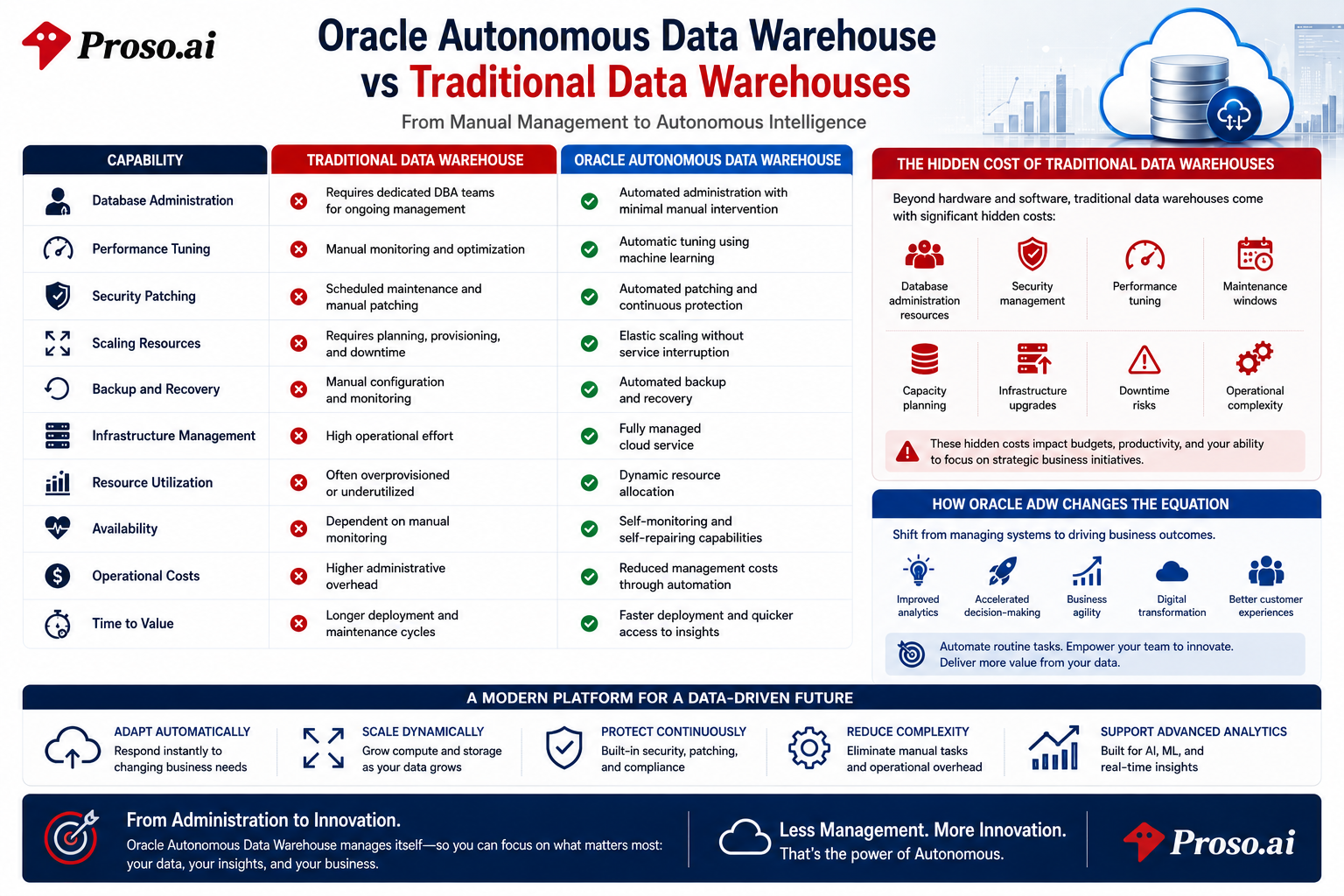
Let's compare the two approaches.
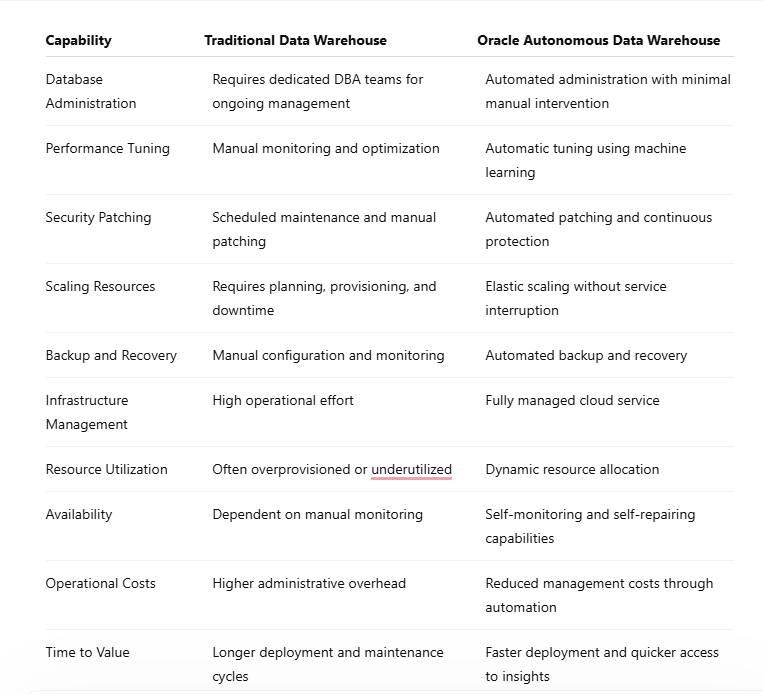
When organizations evaluate data platforms, they often focus on infrastructure costs.
However, the true cost of traditional data warehouses extends beyond hardware and software.
Organizations must also account for:
Over time, these hidden costs can significantly impact both budgets and productivity.
In many organizations, highly skilled technical teams spend a large portion of their time maintaining systems rather than delivering strategic business value.
Oracle Autonomous Data Warehouse shifts the focus from system management to business outcomes.
Instead of asking:
"Do we have enough resources to manage our environment?"
Organizations can focus on:
By automating routine database operations, Oracle allows IT teams to dedicate more time to initiatives that directly support business growth.
The volume, velocity, and variety of enterprise data continue to grow.
Traditional approaches that depend heavily on manual administration are becoming increasingly difficult to sustain.
Organizations need platforms that can:
Oracle Autonomous Data Warehouse was built with these requirements in mind.
Rather than simply modernizing existing infrastructure, it introduces a fundamentally different operating model—one where the data warehouse manages itself, allowing teams to focus on extracting value from data rather than maintaining the systems behind it.
For organizations looking to modernize their analytics ecosystem, the comparison is becoming less about cloud versus on-premises and more about automation versus administration.
And that distinction is reshaping the future of enterprise data management.
Digital transformation is no longer a future initiative.
It is a business necessity.
Organizations across industries are investing heavily in cloud technologies, artificial intelligence, advanced analytics, and automation to improve agility, enhance customer experiences, and remain competitive in an increasingly data-driven economy.
However, many digital transformation initiatives encounter a common challenge:
Legacy data infrastructure often becomes the bottleneck.
While businesses strive to become more innovative, their technology teams frequently remain occupied with maintaining databases, managing infrastructure, applying security updates, and troubleshooting performance issues.
The result is a significant gap between business ambition and operational reality.
Oracle Autonomous Data Warehouse helps bridge that gap by providing an intelligent data platform designed to support modern digital transformation initiatives.
One of the biggest obstacles to innovation is the amount of time technical teams spend maintaining existing systems.
Database administrators, infrastructure teams, and analytics professionals often dedicate significant resources to:
While these activities are essential, they rarely create direct business value.
Oracle Autonomous Data Warehouse automates many of these operational responsibilities, enabling organizations to redirect technical talent toward strategic initiatives such as:
By reducing administrative overhead, organizations can accelerate innovation without expanding operational complexity.
Modern organizations generate vast amounts of data from:
The challenge is not collecting data.
The challenge is transforming it into actionable insights quickly enough to support business decisions.
Oracle Autonomous Data Warehouse provides a centralized, scalable analytics platform that enables organizations to consolidate data, improve visibility, and deliver trusted insights across the enterprise.
Business leaders gain access to:
This helps organizations move from reactive decision-making to proactive business strategy.
Artificial intelligence is rapidly becoming a core component of digital transformation strategies.
However, AI success depends heavily on the quality, accessibility, and management of enterprise data.
Many organizations struggle because their data remains fragmented across multiple systems.
Oracle Autonomous Data Warehouse helps establish a unified analytics environment capable of supporting machine learning and AI workloads.
With integrated machine learning capabilities and scalable infrastructure, organizations can accelerate:
By simplifying data management, ADW allows teams to focus on building models and generating insights rather than managing infrastructure.
Market conditions change faster than ever before.
Organizations must be able to respond quickly to:
Traditional infrastructure often limits an organization's ability to adapt.
Oracle Autonomous Data Warehouse enables greater agility through:
This flexibility allows businesses to scale analytics capabilities as requirements evolve without major infrastructure investments.
As organizations accelerate digital transformation, cybersecurity and compliance remain top priorities.
Data breaches, regulatory requirements, and evolving security threats continue to increase pressure on IT leaders.
Oracle Autonomous Data Warehouse incorporates enterprise-grade security controls and automated protection mechanisms designed to help organizations maintain compliance while reducing risk.
This includes:
Strong governance and security are essential components of any successful digital transformation strategy, and ADW helps organizations address both without increasing operational complexity.
Digital transformation is not a one-time project.
It is an ongoing evolution.
Organizations need data platforms that can support future growth, emerging technologies, and changing business requirements.
Oracle Autonomous Data Warehouse provides a cloud-native architecture designed to evolve alongside the business.
Whether supporting:
ADW delivers the scalability and flexibility required for long-term success.
The most successful organizations no longer view data infrastructure as a back-office technology function.
They view data as a strategic asset.
The ability to collect, analyze, secure, and act on information quickly has become a competitive advantage.
Oracle Autonomous Data Warehouse helps organizations unlock that advantage by reducing operational complexity and enabling faster access to business insights.
The result is not simply a more efficient data warehouse.
It is a platform that supports innovation, accelerates digital transformation, and helps organizations become truly data-driven enterprises.
For many business leaders, that is the real value of autonomous data management.
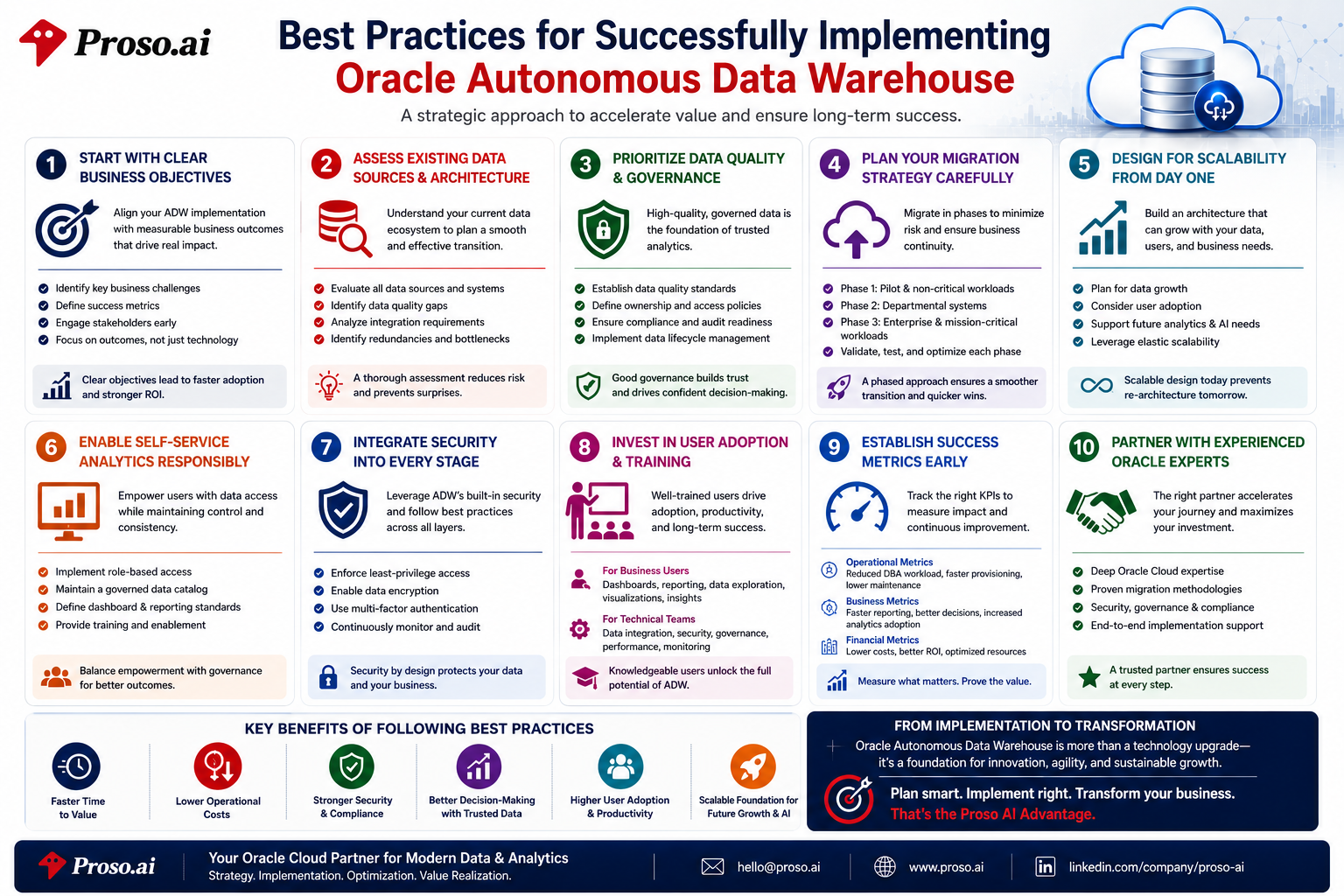
Implementing a modern data platform is not simply a technology upgrade—it is a strategic transformation initiative.
While Oracle Autonomous Data Warehouse significantly reduces administrative complexity through automation, organizations still need a well-defined implementation strategy to maximize business value.
Successful deployments are typically those that align technology decisions with business objectives, data governance requirements, analytics goals, and long-term growth plans.
Whether you're migrating from an on-premises data warehouse, modernizing legacy analytics infrastructure, or building a cloud-first data strategy, the following best practices can help ensure a smooth and successful implementation.
One of the most common mistakes organizations make is treating data warehouse modernization as an infrastructure project rather than a business initiative.
Before implementing Oracle Autonomous Data Warehouse, stakeholders should clearly define:
Organizations that begin with measurable business outcomes typically achieve faster adoption and stronger ROI.
A clearly defined objective helps guide every subsequent implementation decision.
Before migrating workloads, organizations should perform a comprehensive assessment of their current data ecosystem.
This includes evaluating:
The goal is to identify:
A thorough assessment helps prevent unexpected issues during migration and enables a more effective modernization strategy.
Even the most advanced analytics platform cannot compensate for poor-quality data.
Organizations should establish strong governance frameworks before onboarding critical workloads.
Key focus areas include:
Strong governance ensures that business users can trust the insights generated from the platform.
Data migration is often the most critical phase of implementation.
Rather than attempting a large-scale migration all at once, organizations should adopt a phased approach.
Phase 1
Phase 2
Phase 3
This approach reduces risk while allowing teams to gain experience with the platform before broader adoption.
One of the key advantages of Oracle Autonomous Data Warehouse is elastic scalability.
However, organizations should still design architectures with future growth in mind.
Consider factors such as:
Building scalability into the initial architecture helps avoid costly redesign efforts later.
Many organizations adopt Autonomous Data Warehouse to empower business users with greater access to data.
While self-service analytics can improve agility, it should be implemented with appropriate governance controls.
Organizations should establish:
The objective is to balance accessibility with security and consistency.
Security should never be treated as an afterthought.
Although Oracle Autonomous Data Warehouse provides extensive built-in security capabilities, organizations should still define a comprehensive security strategy.
Best practices include:
Security must remain a core component of the implementation lifecycle.
Technology adoption often determines the success or failure of digital transformation initiatives.
Organizations should provide training for:
The more effectively users understand the platform, the faster organizations can realize value from their investment.
Many organizations implement new technologies without defining how success will be measured.
Before deployment, establish key performance indicators (KPIs) such as:
Measuring outcomes helps demonstrate business value and supports future investment decisions.
Implementing an autonomous data platform requires more than technical knowledge.
Organizations often benefit from working with experienced Oracle specialists who understand:
The right implementation partner can help accelerate deployment, reduce risk, and maximize business outcomes.
Oracle Autonomous Data Warehouse simplifies many aspects of database administration, but successful adoption still depends on strategic planning.
Organizations that combine automation with strong governance, thoughtful architecture, and clear business objectives are best positioned to achieve long-term success.
The goal is not simply to migrate data.
The goal is to create a modern analytics foundation that enables innovation, improves decision-making, and supports future growth.
When implemented effectively, Oracle Autonomous Data Warehouse becomes more than a technology platform—it becomes a catalyst for enterprise transformation.
The role of enterprise data is changing.
Organizations are no longer collecting data solely for reporting purposes. Today, data powers strategic decision-making, customer experiences, operational efficiency, predictive analytics, and artificial intelligence initiatives.
As businesses continue to generate unprecedented volumes of information, traditional approaches to data management are becoming increasingly difficult to sustain.
The future belongs to organizations that can transform data into insights quickly, securely, and efficiently.
This is precisely where autonomous data platforms are redefining enterprise analytics.
Over the last decade, enterprise data ecosystems have become significantly more complex.
Organizations now manage information across:
Managing these environments manually creates operational bottlenecks that slow innovation.
Business leaders expect faster answers.
Customers expect personalized experiences.
Executives demand real-time visibility.
Traditional data infrastructure often struggles to keep pace with these expectations.
Oracle Autonomous Data Warehouse addresses this challenge by introducing intelligence directly into the data platform itself.
Instead of relying on continuous human intervention, the platform automatically manages many of the operational activities that previously consumed valuable IT resources.
The future of enterprise analytics is increasingly automated.
Organizations are already embracing automation across:
Data management is following the same path.
As datasets grow larger and analytics workloads become more sophisticated, manual administration becomes less practical and more expensive.
Autonomous technologies help organizations:
The ability to automate routine database operations allows teams to focus on higher-value activities that drive business growth.
Artificial intelligence is rapidly moving from experimentation to enterprise-wide adoption.
However, successful AI initiatives require a strong data foundation.
Organizations must ensure that data is:
Without these fundamentals, even the most advanced AI initiatives can struggle to deliver value.
Oracle Autonomous Data Warehouse helps establish the infrastructure required to support modern AI and machine learning workloads.
By combining automation, analytics, and scalability within a unified platform, organizations can prepare for future innovation while maintaining operational efficiency.
Business conditions can change overnight.
Organizations need the ability to adapt quickly to:
Agility increasingly depends on the ability to access and analyze information in real time.
Oracle Autonomous Data Warehouse enables organizations to respond faster by simplifying data management and accelerating analytics.
This allows business leaders to make decisions with greater confidence and speed.
The most successful organizations no longer view data as a byproduct of operations.
They view it as a strategic asset.
The ability to collect, manage, analyze, and act on information faster than competitors creates measurable business value.
Organizations that can leverage data effectively often achieve:
Oracle Autonomous Data Warehouse helps create the foundation needed to unlock these outcomes.
The conversation is no longer about simply storing data.
It is about creating intelligent systems capable of supporting business growth, digital transformation, and future innovation.
Oracle Autonomous Data Warehouse represents a significant step in this evolution.
By automating administration, optimizing performance, enhancing security, and simplifying scalability, the platform enables organizations to focus less on infrastructure and more on outcomes.
As enterprise analytics continues to evolve, autonomous technologies will play an increasingly important role in helping organizations transform information into competitive advantage.
For forward-thinking enterprises, adopting autonomous data management is not simply a technology decision—it is a strategic investment in the future of the business.
The demands placed on enterprise data platforms have never been greater.
Organizations are expected to process growing volumes of data, support real-time analytics, strengthen security, enable artificial intelligence initiatives, and deliver insights faster than ever before. At the same time, IT teams face increasing pressure to reduce operational complexity and maximize the value of technology investments.
Traditional data warehouse environments were not designed for this level of speed, scale, and agility.
Manual administration, performance tuning, security patching, infrastructure management, and capacity planning can consume significant resources—resources that could otherwise be focused on innovation and business growth.
Oracle Autonomous Data Warehouse represents a new approach to enterprise analytics.
By combining automation, machine learning, enterprise-grade security, elastic scalability, and high-performance analytics within a single platform, ADW enables organizations to move beyond infrastructure management and focus on what truly matters: generating business value from data.
Whether you're modernizing legacy data warehouse environments, supporting advanced analytics initiatives, enabling AI-driven decision-making, or building a future-ready cloud strategy, Oracle Autonomous Data Warehouse provides the foundation required to succeed in a data-driven world.
The question is no longer whether organizations should modernize their data platforms.
The question is how quickly they can adopt intelligent, autonomous technologies that allow their teams to innovate faster, operate more efficiently, and make better decisions with confidence.
Successfully implementing an autonomous data strategy requires more than technology—it requires expertise, planning, and a deep understanding of business objectives.
At Proso AI, we help organizations accelerate their Oracle Cloud transformation journeys through:
Our team works closely with organizations to design scalable, secure, and future-ready data platforms that support long-term business growth and innovation.
Whether you're evaluating Oracle Autonomous Data Warehouse for the first time or looking to optimize an existing environment, Proso AI can help you unlock the full potential of your enterprise data.
Connect with our Oracle experts to explore how Oracle Autonomous Data Warehouse can help your organization reduce complexity, improve analytics performance, and accelerate digital transformation.
Email: info@proso.ai
Website: Proso AI
Let's build a smarter, more autonomous future for your data.

.jpg)

.png)
.png)