For years, enterprise cybersecurity strategies have focused on securing the network perimeter—firewalls, endpoint protection, identity management, and threat detection. While these remain essential, the rapid adoption of cloud platforms, AI-driven applications, and distributed workforces has fundamentally changed where organizations face their greatest security risks.
Today, the database has become one of the most valuable—and vulnerable—assets within the enterprise.
Oracle databases power some of an organization's most critical business functions, from financial transactions and customer records to HR systems and supply chain operations. As these databases continue to grow in scale and complexity, so do the challenges of protecting sensitive information, managing privileged access, maintaining continuous visibility, and meeting increasingly stringent regulatory requirements.
At the same time, security teams are under growing pressure to demonstrate compliance with evolving frameworks such as GDPR, PCI DSS, HIPAA, ISO 27001, and regional data protection regulations. For many organizations, the challenge is no longer deploying security tools—it's gaining a clear understanding of where sensitive data resides, who can access it, how it is being used, and whether existing controls are sufficient to reduce risk.
Traditional database security approaches often rely on manual assessments, fragmented monitoring tools, and reactive audits. In an environment where business applications, cloud services, and users are constantly changing, these approaches struggle to provide the continuous visibility modern enterprises require.
This shift has led organizations to rethink database security—not as an isolated IT responsibility, but as a critical component of enterprise risk management and digital transformation.
Oracle Data Safe addresses this challenge by helping organizations continuously assess database security, identify sensitive data, monitor user activity, strengthen compliance, and reduce risk across their Oracle database environments through a unified cloud-based platform.
In this article, we'll explore why database security has become a strategic priority, the challenges organizations face in protecting their Oracle environments, and how Oracle Data Safe enables businesses to build a stronger, more resilient security posture.
For years, cybersecurity strategies focused on protecting the network perimeter. Firewalls, endpoint security, intrusion detection systems, and identity management formed the first line of defense against external threats. While these technologies remain critical, today's enterprise environments demand a much broader security strategy.
As organizations accelerate cloud adoption, modernize legacy applications, and embrace AI-driven operations, databases have become the central repository for an organization's most valuable information. Customer records, financial transactions, employee data, intellectual property, and operational insights all reside within enterprise databases, making them one of the most attractive targets for cybercriminals and insider threats alike.
The challenge is no longer preventing unauthorized access to the network.
It is ensuring that sensitive data remains protected even after someone has gained legitimate access to the environment.
Unlike traditional cyberattacks that focus on infrastructure, modern database threats often exploit excessive user privileges, misconfigured security settings, dormant administrative accounts, weak auditing policies, and unprotected copies of production databases used for testing or development. These vulnerabilities can exist unnoticed for months, creating significant compliance and business risks.
At the same time, regulatory expectations continue to evolve. Organizations are expected to demonstrate continuous compliance with frameworks such as GDPR, PCI DSS, HIPAA, ISO 27001, and regional privacy regulations. This requires more than periodic audits—it demands continuous visibility into where sensitive data resides, who can access it, how it is being used, and whether security controls remain effective over time.
For security leaders, the challenge is balancing three competing priorities:
Traditional database security tools were never designed to address these challenges at enterprise scale.
As a result, organizations are shifting from reactive security models to continuous database risk management—an approach that emphasizes visibility, automation, governance, and proactive threat detection rather than relying solely on perimeter defenses.
This shift is redefining how enterprises think about database security, transforming it from an operational IT responsibility into a strategic business function that supports resilience, regulatory compliance, and long-term digital transformation.
Modern enterprises rarely struggle with a lack of security tools.
Most organizations already have identity and access management platforms, SIEM solutions, endpoint protection, vulnerability scanners, cloud security tools, and compliance frameworks in place. Yet despite these investments, database security often remains one of the least visible areas of the enterprise security landscape.
The reason is simple.
Traditional cybersecurity solutions are designed to protect networks, devices, and applications. They rarely provide continuous insight into what is happening inside the database itself—where an organization's most sensitive information resides.
Oracle Data Safe addresses this visibility gap.
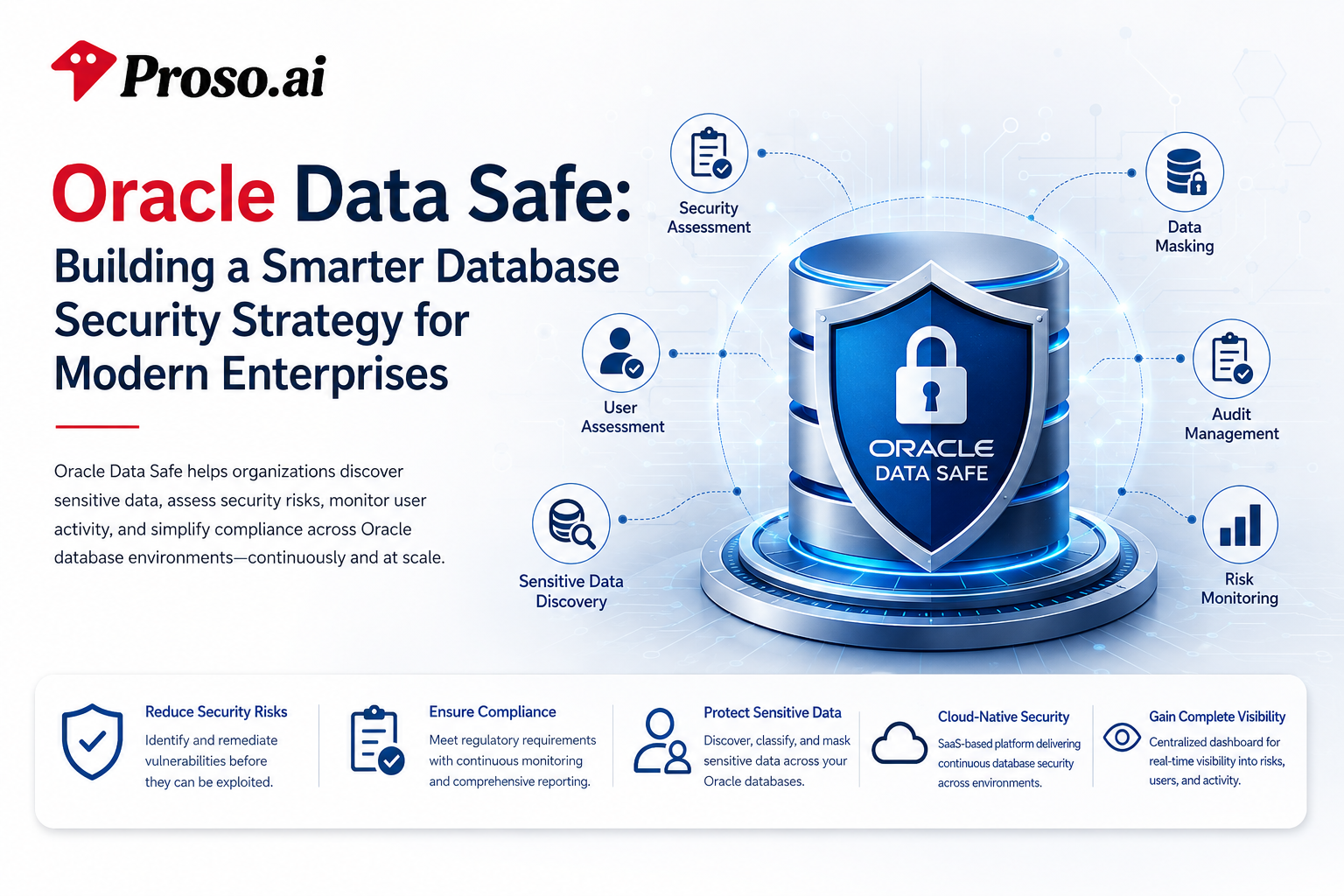
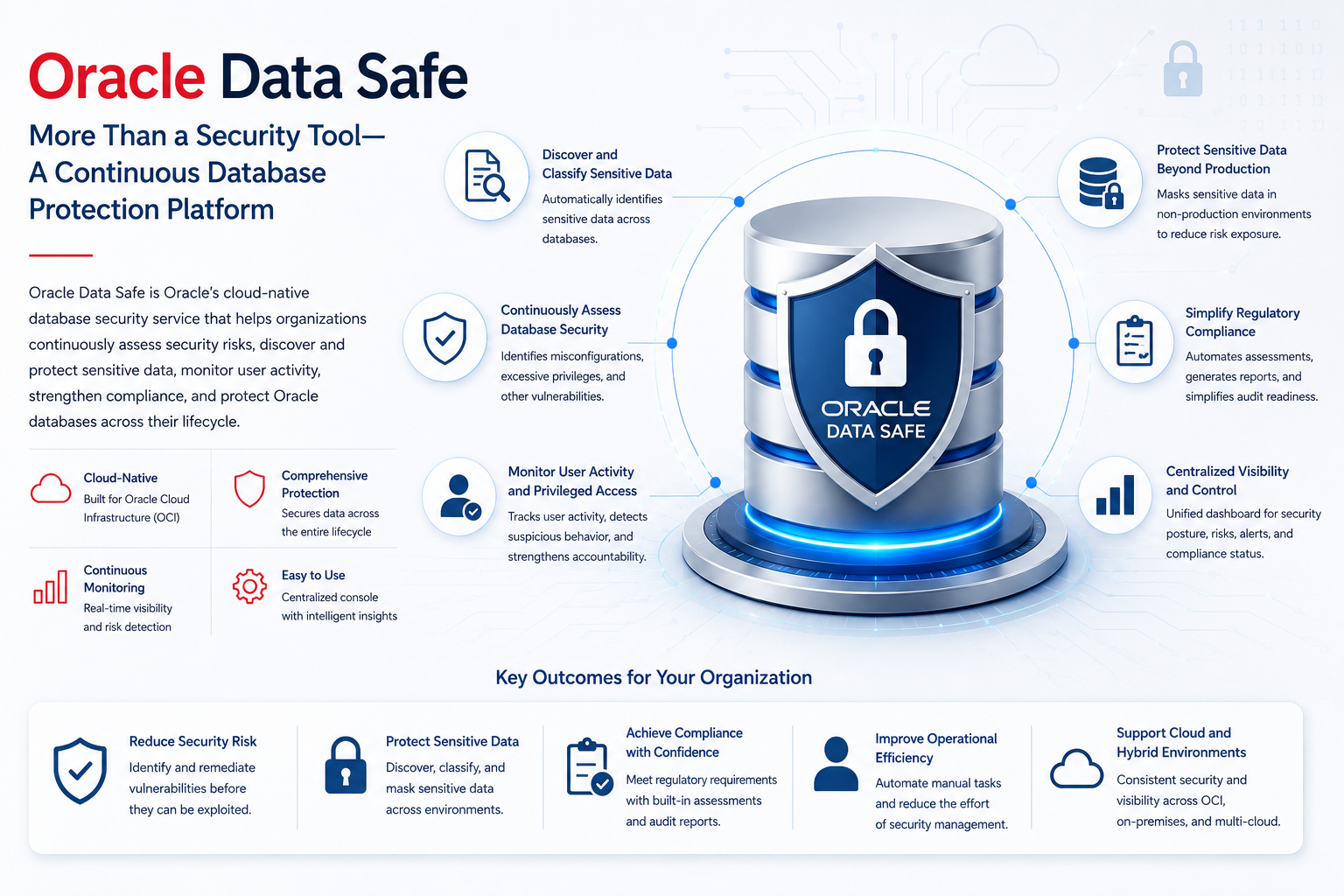
Built as Oracle's cloud-native database security service, Oracle Data Safe provides organizations with a centralized platform to continuously assess security risks, discover and classify sensitive data, monitor user activity, strengthen compliance, and protect Oracle databases throughout their lifecycle.
Rather than functioning as a standalone security product, Oracle Data Safe complements an organization's broader cybersecurity strategy by focusing specifically on the protection of database assets. It enables security teams to move beyond reactive investigations and adopt a proactive approach to identifying vulnerabilities before they become business risks.
The platform is designed to simplify complex database security operations through automation, intelligent risk assessment, and continuous monitoring, helping organizations reduce manual effort while improving governance across Oracle Database, Oracle Autonomous Database, and Oracle Cloud Infrastructure (OCI) environments.
As enterprises continue to expand their cloud footprint and adopt hybrid architectures, having a unified view of database security is no longer optional—it has become essential.
Instead of treating database security as a periodic compliance exercise, Oracle Data Safe enables organizations to build a continuous security posture.
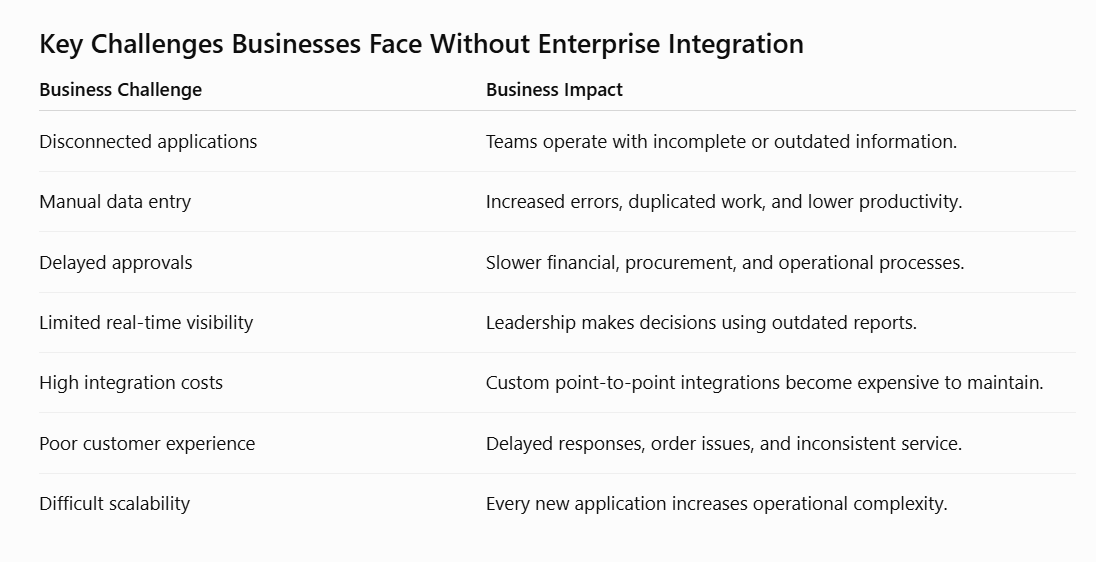
Its capabilities are designed around the core challenges modern enterprises face every day.
Before organizations can protect sensitive information, they need to know where it exists.
Oracle Data Safe automatically scans Oracle databases to identify personally identifiable information (PII), financial records, healthcare information, and other regulated data. This gives security and compliance teams complete visibility into sensitive assets across their database environment.
Security configurations change over time.
New users are created.
Privileges evolve.
Applications are added.
Oracle Data Safe continuously evaluates database configurations against Oracle security best practices, helping organizations identify misconfigurations, excessive privileges, weak password policies, and other potential vulnerabilities before they become exploitable.
One of the biggest security risks facing enterprises today isn't unauthorized access.
It's authorized users performing unauthorized actions.
Oracle Data Safe continuously monitors database activity, tracks privileged user actions, and provides centralized audit reporting that helps organizations detect unusual behavior, investigate incidents, and strengthen accountability across critical systems.
Development, testing, and quality assurance environments often contain production data.
Without proper protection, these environments can become significant security risks.
Oracle Data Safe enables organizations to mask sensitive information before it is shared with developers, testers, or third-party vendors, reducing the risk of exposing confidential business and customer data.
Meeting compliance requirements often involves weeks of manual data collection, auditing, and reporting.
Oracle Data Safe simplifies this process by providing centralized dashboards, automated reporting, security assessments, and audit capabilities that help organizations demonstrate compliance with internal governance policies and industry regulations.
Database security isn't a one-size-fits-all challenge.
A financial institution protecting customer transactions faces different risks than a healthcare provider managing patient records or a manufacturer safeguarding intellectual property. Yet, across industries, the objective remains the same—protect sensitive data, maintain compliance, and reduce operational risk without slowing the business down.
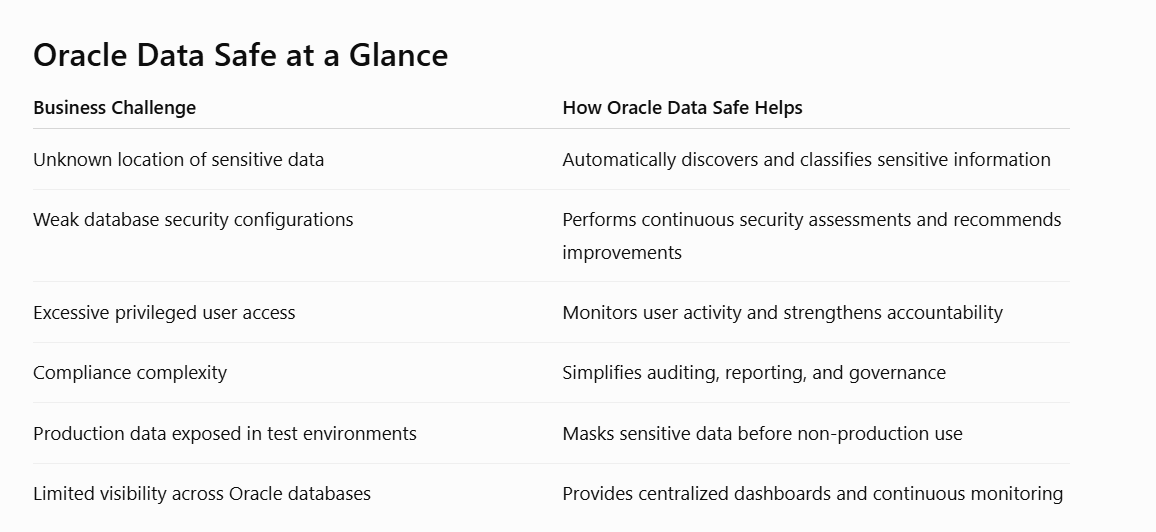
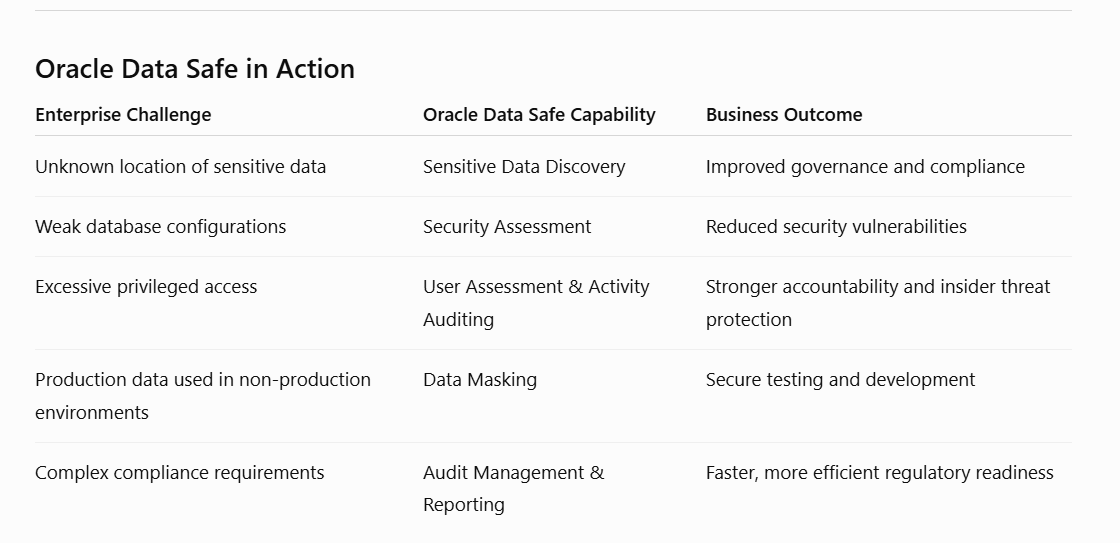
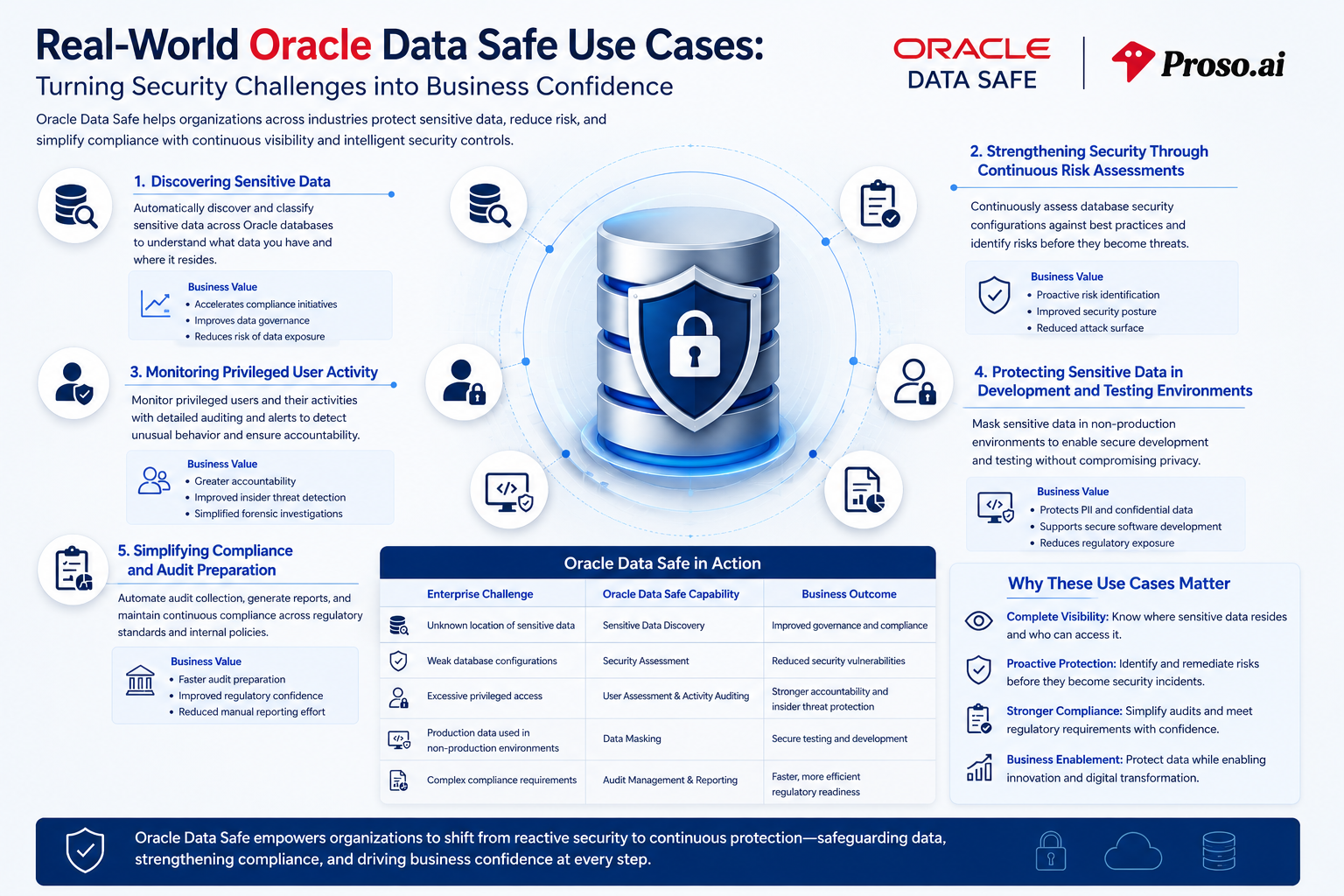
Oracle Data Safe enables organizations to achieve this by addressing practical security challenges that arise every day.
Let's explore some of the most common enterprise use cases.
One of the biggest challenges organizations face is understanding where sensitive information actually resides.
Customer records, employee information, payment details, healthcare data, and confidential business information often exist across multiple Oracle databases, making manual discovery nearly impossible.
Oracle Data Safe automatically scans databases to identify and classify sensitive information, giving security and compliance teams complete visibility into regulated data across the enterprise.
Security configurations evolve continuously.
New users are created.
Applications are deployed.
Privileges change.
Without regular assessments, security gaps can remain unnoticed until they become vulnerabilities.
Oracle Data Safe continuously evaluates Oracle databases against Oracle security best practices, helping organizations identify configuration weaknesses, excessive privileges, weak password policies, and other potential risks before they impact operations.
Not every security incident originates from an external attacker.
Privileged users—including administrators, contractors, vendors, and service accounts—often have extensive access to critical systems.
Organizations need visibility into how privileged accounts interact with sensitive databases to detect unusual activity and strengthen accountability.
Oracle Data Safe provides centralized auditing and activity monitoring, allowing security teams to review user actions, investigate anomalies, and support internal governance requirements.
Development and testing environments frequently rely on copies of production databases.
Without proper controls, these environments can unintentionally expose confidential customer or employee information to developers, testers, and external partners.
Oracle Data Safe helps organizations mask sensitive data before it is used outside production, ensuring realistic test environments without compromising privacy or compliance.
Preparing for regulatory audits often requires weeks of collecting logs, validating access records, and demonstrating security controls.
Oracle Data Safe centralizes audit data, automates reporting, and provides continuous visibility into database security, making compliance significantly more efficient.
Whether the requirement is GDPR, HIPAA, PCI DSS, ISO 27001, or regional privacy regulations, organizations gain a stronger foundation for ongoing compliance.
Cybersecurity incidents are not always the result of sophisticated attacks.
In many cases, organizations unknowingly create security gaps through misconfigurations, excessive privileges, inconsistent governance, or outdated operational practices. These vulnerabilities often remain unnoticed until a compliance audit, security assessment, or data breach exposes them.
As Oracle environments become increasingly distributed across on-premises, hybrid, and cloud infrastructures, maintaining a strong database security posture requires continuous visibility rather than periodic reviews.
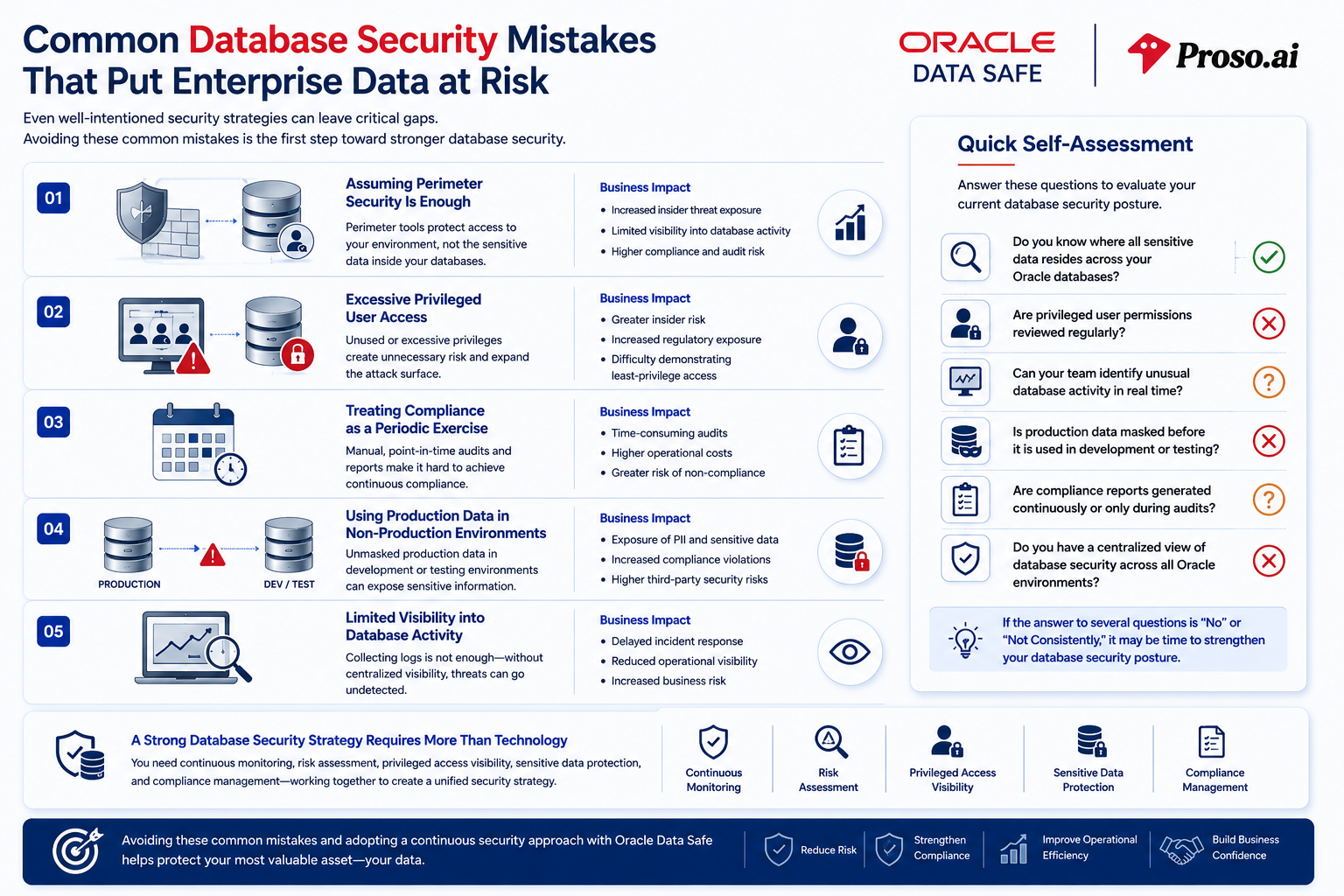
Here are some of the most common database security challenges enterprises continue to face.
Firewalls, endpoint protection, and identity management solutions remain essential components of any cybersecurity strategy. However, they primarily protect access to the environment—not the sensitive information stored within enterprise databases.
Organizations that focus exclusively on network security often lack visibility into database activity, privileged access, and data exposure risks.
Over time, employees change roles, contractors complete projects, and administrators receive elevated permissions to perform temporary tasks.
Without regular reviews, organizations accumulate privileged accounts that no longer align with operational requirements.
This expands the attack surface and increases the likelihood of unauthorized access to critical business information.
Many organizations prepare for compliance only when an audit approaches.
Logs are collected manually.
Reports are generated on demand.
Security configurations are reviewed only once or twice a year.
Modern compliance frameworks increasingly expect continuous governance rather than point-in-time validation.
Organizations that rely on manual processes often struggle to demonstrate consistent compliance.
Development, testing, and quality assurance environments frequently require realistic datasets.
Without proper masking, these environments may contain customer records, financial information, employee data, or other regulated information that should never be exposed outside production.
This remains one of the most overlooked sources of enterprise data risk.
Organizations often generate extensive audit logs but lack the tools and processes required to convert that information into actionable insights.
Without centralized visibility, suspicious behavior may go undetected until after a security incident has occurred.
Effective database security depends not only on collecting audit information but also on continuously monitoring, analyzing, and responding to potential risks.
Addressing these challenges requires more than deploying additional security tools.
Organizations need a governance framework that combines continuous monitoring, risk assessment, privileged access visibility, sensitive data protection, and compliance management into a unified strategy.
This is where platforms such as Oracle Data Safe deliver significant value—not by replacing existing cybersecurity investments, but by strengthening one of the most critical layers of enterprise security: the database.
Before moving forward, consider the following questions:
If the answer to several of these questions is no or not consistently, it may indicate opportunities to strengthen your database security posture.
Technology alone doesn't create a secure enterprise.
A successful database security strategy requires the right combination of governance, architecture, automation, and continuous monitoring. While Oracle Data Safe provides the capabilities to strengthen database security, its effectiveness depends on how well it is integrated into an organization's broader security and compliance framework.
Many organizations invest in security technologies but struggle to translate those investments into measurable business outcomes. Security assessments remain inconsistent, compliance reporting becomes a manual effort, and visibility across databases is often fragmented. As Oracle environments grow across cloud, hybrid, and multi-region deployments, these challenges only become more complex.
This is where an experienced Oracle implementation partner makes the difference.
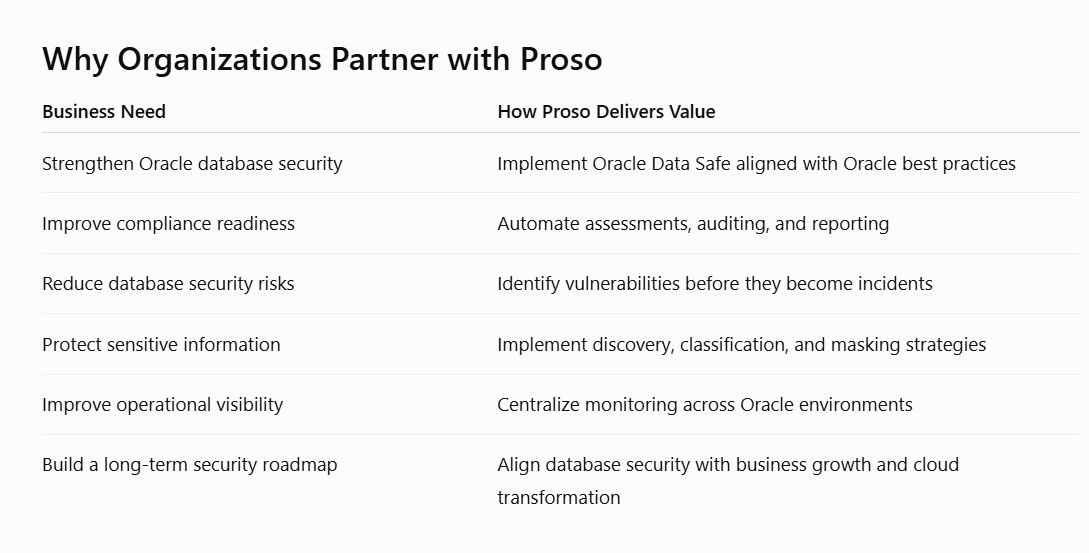
As an Oracle Partner, Proso helps organizations move beyond product implementation to build a long-term database security strategy that supports growth, regulatory compliance, and operational resilience.
Our approach begins by understanding your existing Oracle landscape, identifying security gaps, and aligning database protection with your business objectives—not simply deploying another security tool.
Whether you're running Oracle Database on Oracle Cloud Infrastructure (OCI), Oracle Autonomous Database, or hybrid Oracle environments, our consultants help you establish a security framework that is scalable, measurable, and built for the future.
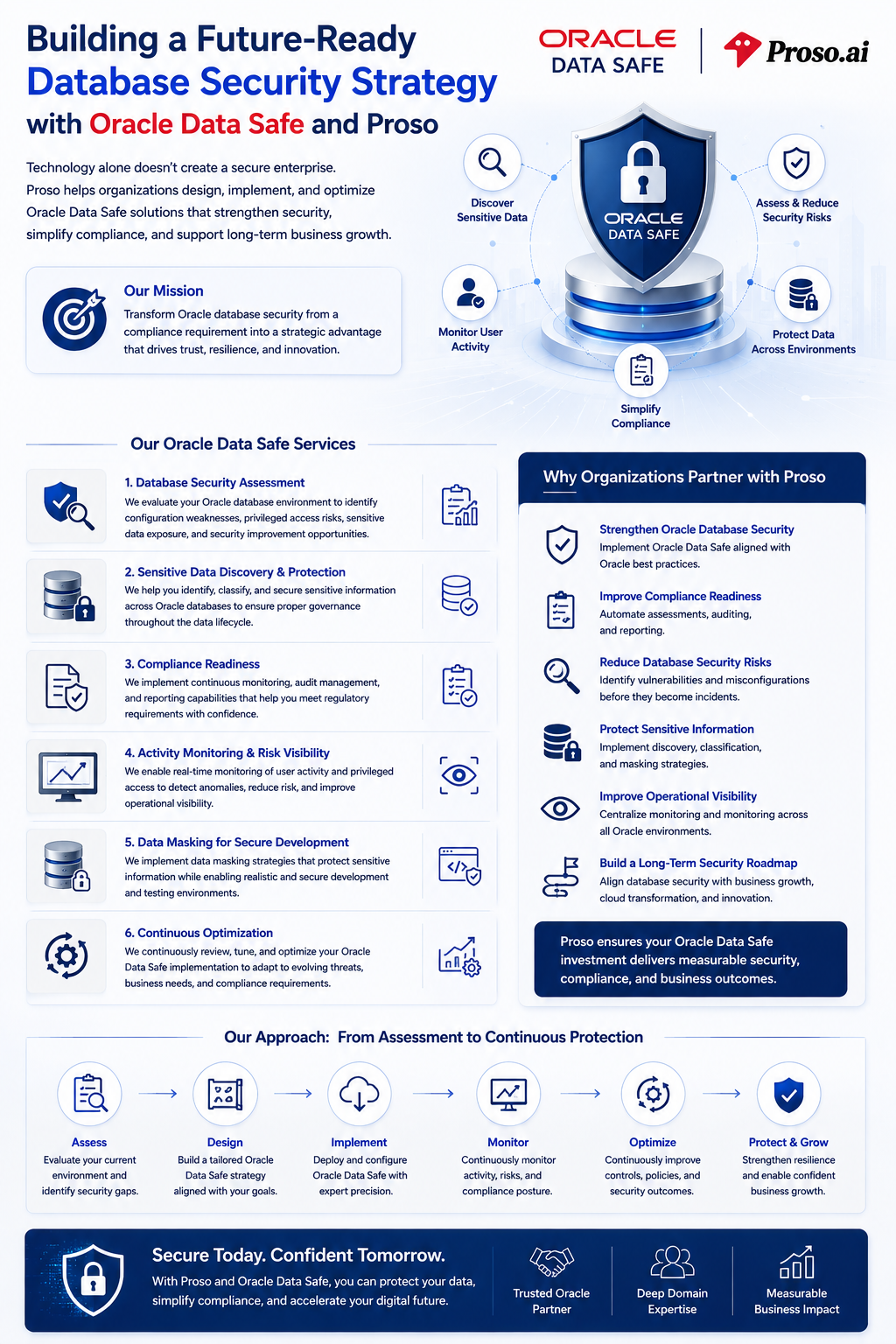
We evaluate your Oracle database environment to identify configuration weaknesses, privileged access risks, sensitive data exposure, and opportunities to strengthen your overall security posture.
Our team helps you identify, classify, and secure sensitive information across Oracle databases, ensuring critical business and customer data is properly governed throughout its lifecycle.
We help organizations simplify compliance with industry and regional regulations by implementing continuous monitoring, centralized audit management, and reporting capabilities that reduce manual effort while improving governance.
By implementing Oracle Data Safe's monitoring and auditing capabilities, we provide security teams with greater visibility into user activity, privileged access, and database events—helping organizations detect risks earlier and respond with confidence.
We enable secure development and testing by implementing data masking strategies that protect sensitive information while allowing development teams to work with realistic datasets.
Database security is not a one-time project.
As your Oracle environment evolves, we help optimize policies, assessments, and governance practices to ensure your security posture keeps pace with changing business requirements and emerging threats.
As organizations continue to embrace AI, cloud computing, and data-driven decision-making, database security has become a business enabler rather than simply a technical requirement.
The organizations that succeed are those that treat security as an ongoing process—continuously assessing risk, strengthening governance, and protecting sensitive information without slowing innovation.
Oracle Data Safe provides the technology to achieve this.
Proso helps organizations turn that technology into measurable business outcomes.
Enterprise cybersecurity is entering a new era.
As organizations continue to embrace AI, cloud-native applications, hybrid infrastructures, and data-driven decision-making, the volume, value, and movement of enterprise data will only continue to grow. At the same time, regulatory expectations are becoming more stringent, and cyber threats are evolving beyond traditional perimeter attacks to target the data itself.
In this environment, database security can no longer be treated as a periodic compliance exercise or a reactive IT function.
It must become a continuous business capability.
Organizations need the ability to understand where sensitive data resides, identify security gaps before they become vulnerabilities, monitor privileged activity in real time, and demonstrate compliance with confidence. More importantly, they need a security strategy that evolves alongside their business—not one that struggles to keep pace with it.
This is where Oracle Data Safe delivers lasting value.
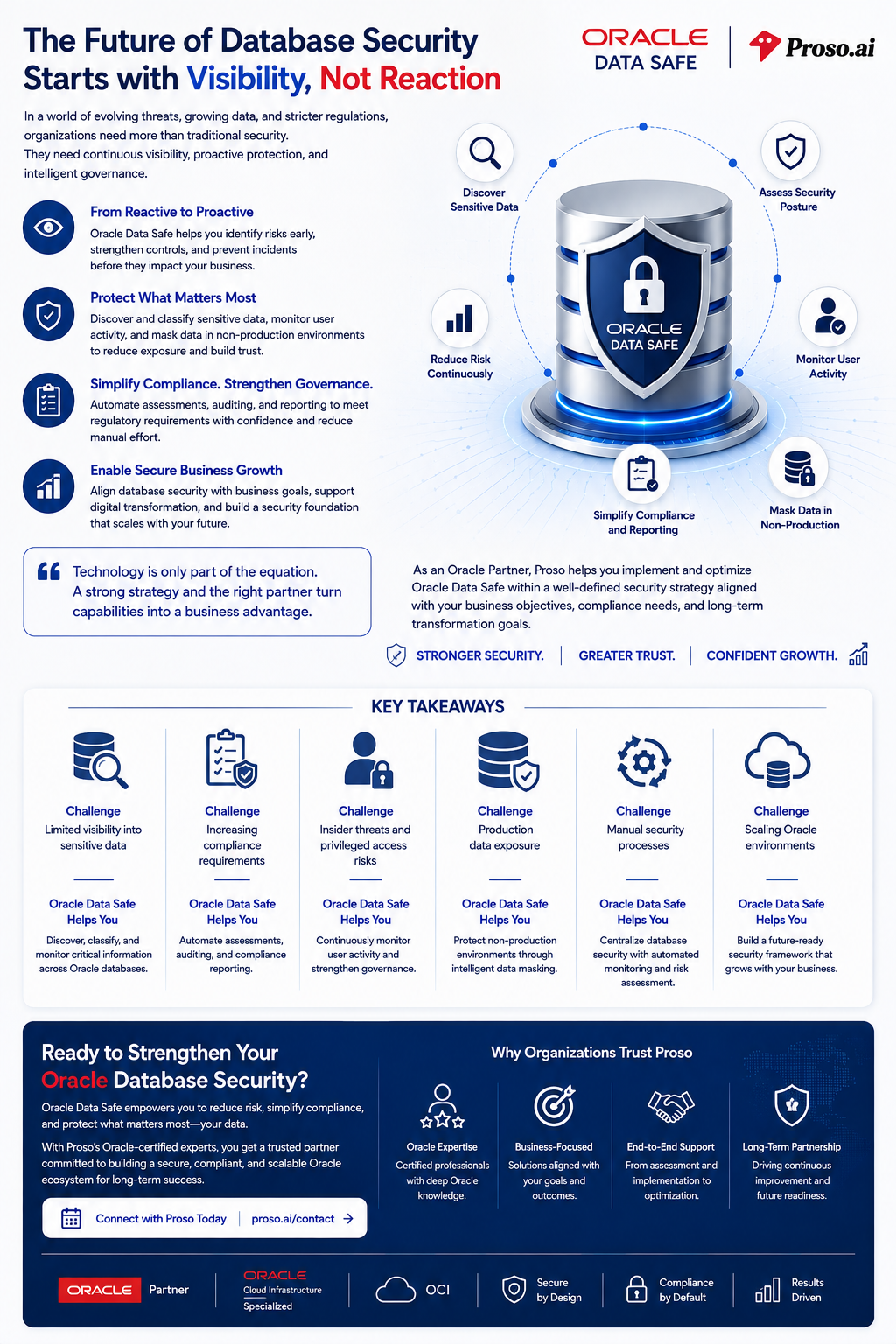
By combining continuous security assessments, sensitive data discovery, user activity monitoring, data masking, and centralized compliance management, Oracle Data Safe helps organizations move from reactive protection to proactive database security. Rather than simply responding to incidents, businesses gain the visibility and governance needed to reduce risk before it impacts operations.
However, technology alone is only part of the equation.
The greatest return comes from implementing Oracle Data Safe within a well-planned security strategy—one that aligns database protection with business objectives, regulatory requirements, and long-term digital transformation initiatives.
As an Oracle Partner, Proso helps organizations build that strategy. From assessing your current Oracle environment and implementing Oracle Data Safe to optimizing governance, compliance, and continuous monitoring, our consultants work alongside your team to ensure database security becomes a business advantage rather than a business challenge.
The future belongs to organizations that treat data as their most valuable asset—and protect it accordingly.
Because in today's digital economy, it's not just about preventing breaches. It's about building trust, ensuring resilience, and enabling confident business growth.
Oracle Data Safe is Oracle's cloud-native database security service that helps organizations strengthen the security of their Oracle databases. It provides capabilities such as security assessments, sensitive data discovery, user activity monitoring, data masking, and compliance reporting—all through a centralized platform. By offering continuous visibility into database risks, Oracle Data Safe enables organizations to protect sensitive information while simplifying governance and regulatory compliance.
Oracle Data Safe supports Oracle Database environments running on Oracle Cloud Infrastructure (OCI), including Oracle Autonomous Database and Oracle Base Database Service. It also supports selected Oracle databases in hybrid environments, allowing organizations to maintain consistent security and compliance across their Oracle ecosystem.
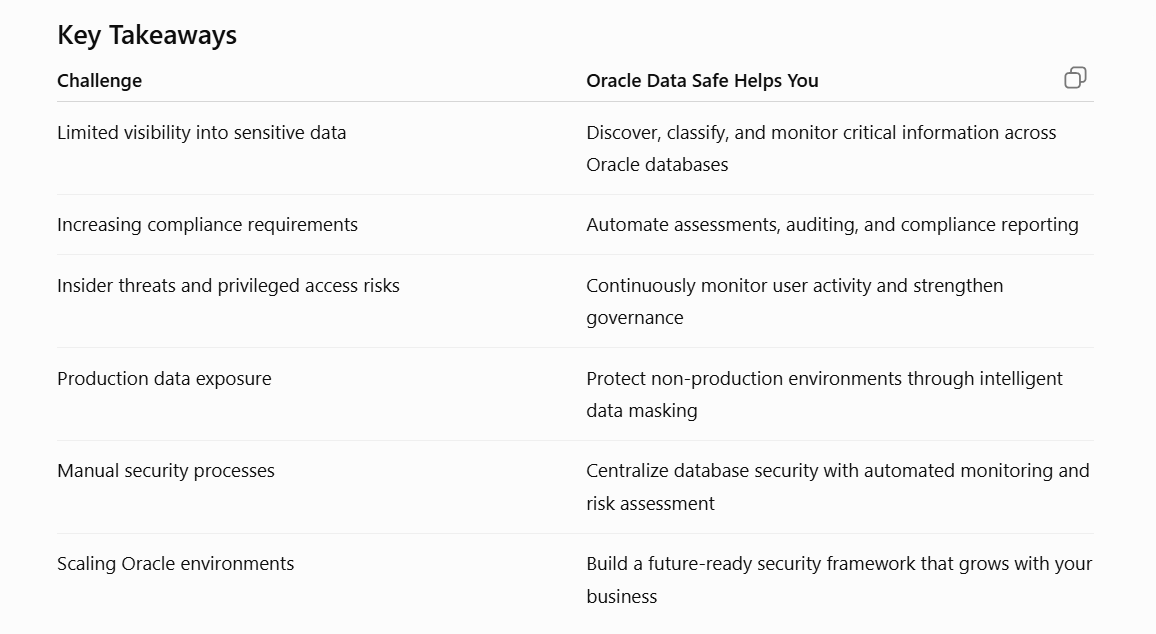
As organizations generate and store increasing volumes of sensitive data, databases have become one of the most attractive targets for cyber threats and insider misuse. Oracle Data Safe helps enterprises continuously identify security risks, monitor privileged users, discover sensitive information, and simplify compliance, making database security a proactive business capability rather than a reactive process.
Oracle Data Safe automates several activities that are essential for regulatory compliance, including security assessments, audit management, user activity monitoring, and sensitive data discovery. These capabilities help organizations prepare for standards such as GDPR, PCI DSS, HIPAA, ISO 27001, and other industry-specific regulations while reducing manual reporting effort.
Oracle Data Safe helps organizations reduce insider risk by continuously monitoring database activity and privileged user actions. Its centralized auditing capabilities provide visibility into who accessed sensitive data, what changes were made, and when those actions occurred, enabling faster investigations and stronger governance.
Sensitive Data Discovery automatically scans Oracle databases to locate and classify regulated information such as personally identifiable information (PII), financial records, healthcare data, and other confidential business information. This visibility enables organizations to apply appropriate security controls and meet compliance requirements more effectively.
Organizations frequently use production data in development and testing environments. Oracle Data Safe helps reduce this risk by masking sensitive information before it is copied outside production, allowing developers and testers to work with realistic datasets without exposing confidential business or customer information.
Yes. Oracle Data Safe is designed to support organizations of all sizes. Small and mid-sized businesses can benefit from enterprise-grade database security capabilities without deploying multiple standalone security solutions, making it easier to strengthen governance as the business grows.
As an Oracle Partner, Proso helps organizations assess their Oracle environments, identify database security risks, implement Oracle Data Safe, establish governance frameworks, and optimize security over time. Our consultants focus on aligning Oracle Data Safe with your business objectives, compliance requirements, and long-term cloud strategy.
The first step is understanding your current database security posture. Conduct a security assessment to identify sensitive data, privileged access risks, compliance gaps, and configuration weaknesses. From there, organizations can implement Oracle Data Safe as part of a broader database security strategy. Working with an experienced Oracle Partner like Proso can help accelerate implementation while ensuring security, governance, and scalability are built into the solution from day one.

.jpg)

.png)
.png)