.png)
Business leaders today have access to more data than ever before. Yet many organizations continue to struggle with one fundamental challenge—not the lack of information, but the inability to turn that information into timely, confident decisions.
Finance teams rely on one application to manage budgets and reporting. Human Resources works from a separate system to oversee workforce planning. Procurement, supply chain, customer operations, and project teams often operate on entirely different platforms, each maintaining its own processes and data. While these systems may perform well individually, they rarely function as a connected enterprise.
The result is a familiar cycle: fragmented data, manual reconciliation, delayed reporting, and decisions based on yesterday's information instead of today's business reality. As organizations expand across geographies, business units, and digital channels, these operational silos become increasingly difficult to manage.
At the same time, enterprise leaders are navigating an environment defined by constant change. Market conditions evolve rapidly, customer expectations continue to rise, regulatory requirements become more complex, and Artificial Intelligence is reshaping how organizations operate. Businesses can no longer afford systems that simply record transactions—they need platforms that provide real-time visibility, automate routine processes, and enable faster, more informed decision-making.
This shift is changing how organizations approach enterprise technology. Rather than investing in isolated applications for individual departments, many are adopting integrated cloud platforms that connect finance, human resources, supply chain, customer experience, and project operations into a single digital ecosystem.
Oracle Fusion Cloud Applications have emerged as one of the platforms enabling this transformation—not simply by moving business processes to the cloud, but by helping organizations unify operations, improve visibility, and build the agility required to adapt in an increasingly dynamic business environment.
In this article, we'll explore why Oracle Fusion Cloud Applications have become a strategic choice for modern enterprises, how they support long-term business resilience, and what organizations should consider when planning their digital transformation journey.
For many organizations, digital transformation isn't slowed by a lack of technology—it's slowed by technology that no longer works together.
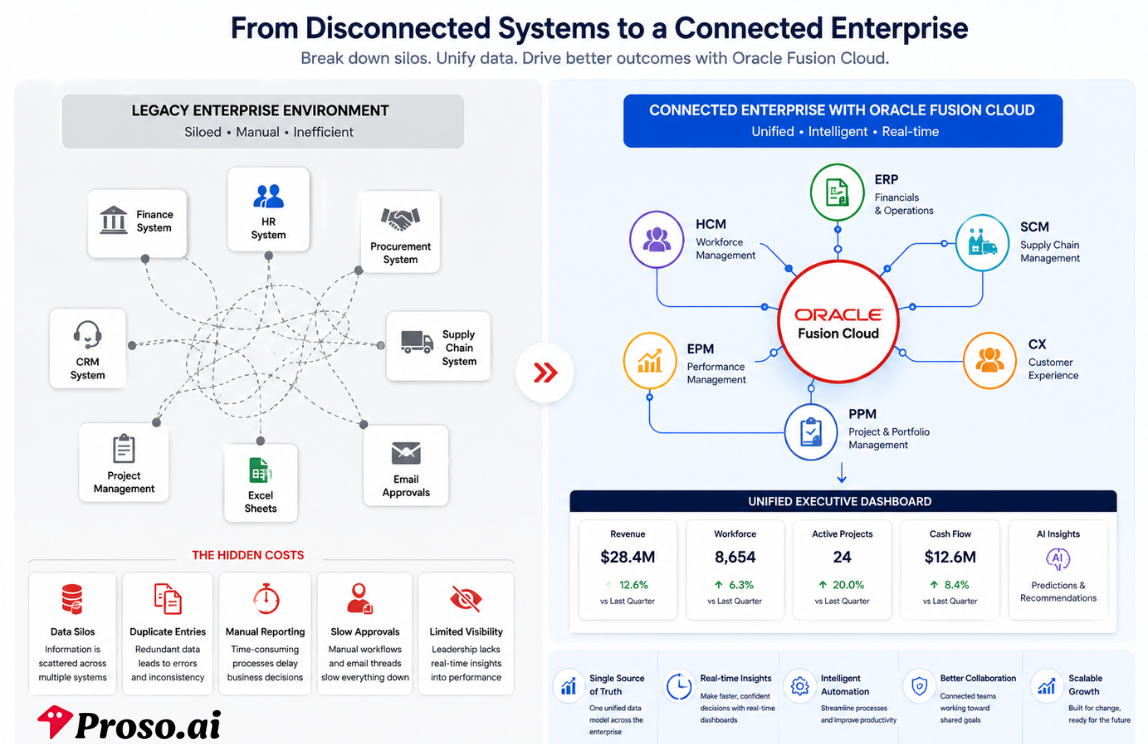
Over the years, businesses have adopted specialized applications to support individual departments. Finance teams use one platform for accounting and reporting, HR manages employee data in another, procurement relies on separate purchasing tools, while customer operations, supply chain, and project management often operate in their own systems.
Although each application serves a specific purpose, the overall business becomes fragmented.
Instead of creating a connected flow of information, these systems generate isolated data that requires manual reconciliation before meaningful decisions can be made. Employees spend valuable time exporting spreadsheets, validating reports, switching between applications, and following up through emails rather than focusing on activities that create business value.
As organizations expand across regions, business units, and digital channels, these inefficiencies become even more visible.
The impact of disconnected enterprise applications extends far beyond operational inconvenience.
When information is scattered across multiple platforms, organizations often experience:
Individually, these challenges may appear manageable. Collectively, they can slow growth, reduce operational agility, and make responding to market changes significantly more difficult.
Today's business leaders don't just need software that automates transactions—they need platforms that connect the entire organization.
A CFO should be able to understand how procurement decisions impact financial performance without waiting for multiple reports. HR leaders should have visibility into workforce planning that aligns with project demand. Supply chain teams should anticipate disruptions before they affect customer commitments. Executives should be able to monitor enterprise performance through a single, trusted source of information rather than piecing together insights from disconnected applications.
This shift represents more than a technology upgrade.
It's a move from managing systems to managing the business through connected intelligence—where every department contributes to a unified view of enterprise operations.
And this is precisely why organizations are moving away from fragmented legacy environments toward integrated cloud platforms that provide real-time visibility, automation, and end-to-end business connectivity.
Modern enterprises don't need more software.
They need software that works together.
This simple idea has become one of the biggest drivers behind enterprise cloud transformation. Organizations are no longer looking for separate applications to manage finance, human resources, supply chain, procurement, customer relationships, and projects independently. Instead, they are investing in platforms that unify these functions, creating a single source of truth across the business.
This is exactly where Oracle Fusion Cloud Applications deliver value.
Built as a comprehensive suite of cloud-native enterprise applications, Oracle Fusion connects critical business functions into one intelligent ecosystem. Rather than treating departments as isolated units, it enables every team to work with the same real-time data, standardized processes, and connected workflows—helping organizations improve collaboration, accelerate decision-making, and respond to change with greater confidence.
At the core of Oracle Fusion is a unified data model. Information entered in one part of the business is instantly available wherever it's needed, reducing duplication, improving data accuracy, and giving leaders a consistent view of enterprise performance.
For example, a procurement decision can immediately influence financial forecasts. Workforce planning can align with project demand. Inventory updates can inform customer commitments. Instead of waiting for departments to exchange reports, business leaders gain a connected view of operations as they happen.
Oracle Fusion Cloud Applications bring together every major business function within a single platform:
Manage finance, accounting, procurement, expenses, and enterprise operations with greater accuracy, automation, and financial visibility.
Support the entire employee lifecycle—from recruitment and onboarding to workforce planning, payroll, performance management, and talent development.
Strengthen supply chain resilience through intelligent planning, procurement, manufacturing, inventory management, and logistics visibility.
Create connected customer journeys across marketing, sales, commerce, and customer service using shared customer insights.
Plan, execute, and monitor enterprise projects with greater visibility into budgets, resources, timelines, and delivery performance.
Improve forecasting, financial planning, scenario modeling, and enterprise-wide performance management through connected analytics.
Individually, each application solves a business challenge.
Together, they create a connected enterprise where information flows seamlessly between departments, enabling faster decisions, better collaboration, and more resilient operations.
Oracle Fusion is more than a cloud platform—it is continuously evolving through built-in Artificial Intelligence, machine learning, predictive analytics, and embedded automation.
Instead of relying solely on historical reports, organizations can identify emerging risks, automate routine approvals, generate intelligent recommendations, and make proactive decisions using real-time operational insights.
This transforms enterprise applications from systems that simply record business activity into platforms that actively support business strategy.
.png)
Enterprise transformation isn't achieved by implementing new software—it's achieved by changing how people, processes, and data work together.
Oracle Fusion Cloud Applications help organizations move beyond isolated business functions by creating a connected operating model where every department has access to the same information, the same workflows, and the same business objectives. This shift enables organizations to become more agile, improve operational efficiency, and make decisions with greater confidence.
Let's explore how Oracle Fusion creates measurable value across the enterprise.
One of the biggest challenges enterprise leaders face is making decisions based on incomplete or outdated information. When finance, HR, procurement, and operations work in separate systems, gaining a complete picture of business performance often requires manual reporting and time-consuming reconciliation.
Oracle Fusion eliminates this challenge by providing a unified view of enterprise operations through interactive dashboards and role-based analytics.
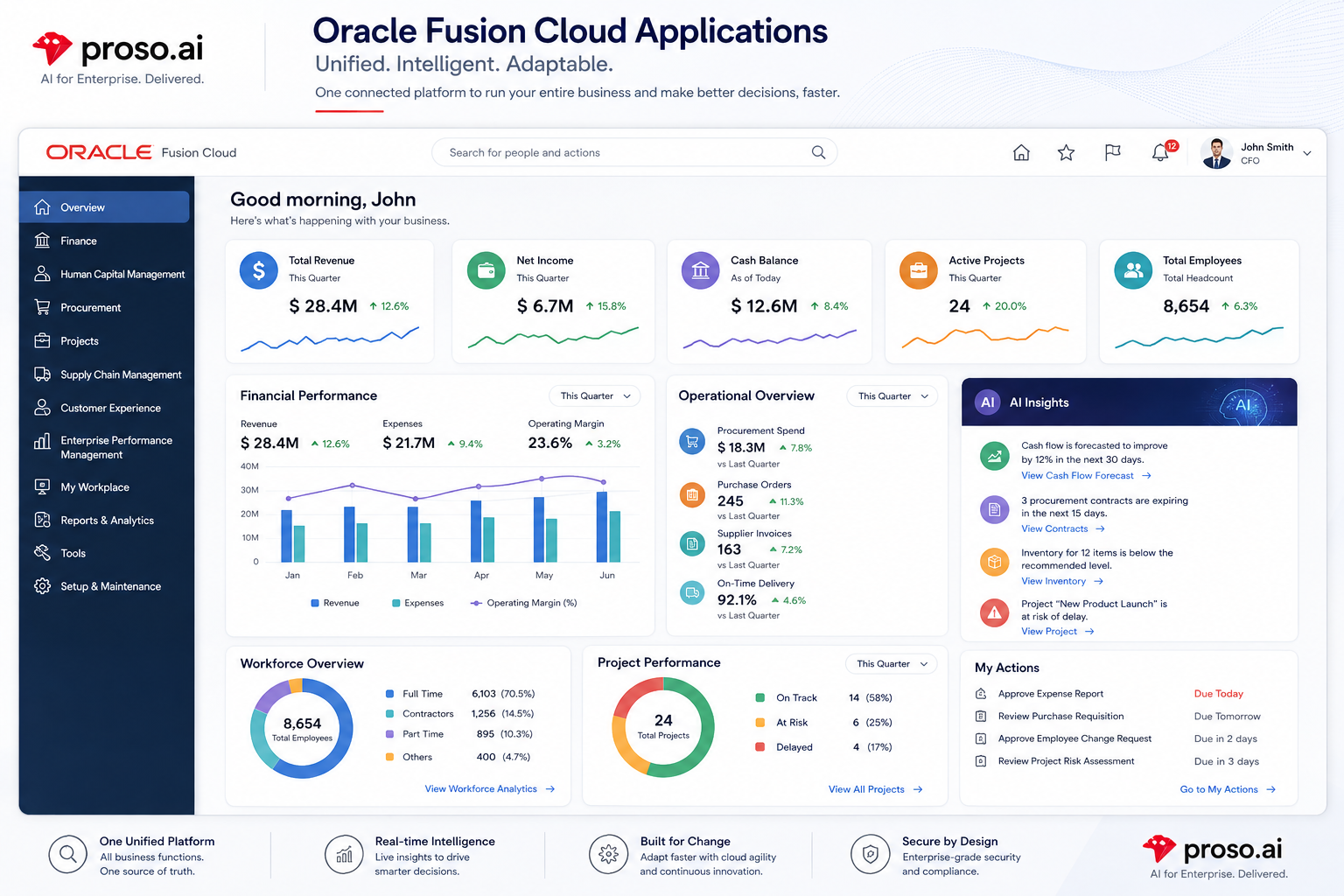
Executives can monitor financial performance, workforce metrics, procurement activity, project health, and operational KPIs in real time—all from a single platform. Instead of waiting for reports, decision-makers can respond to opportunities and risks as they emerge.
Many enterprise processes still depend on repetitive manual activities such as invoice approvals, expense management, procurement workflows, employee onboarding, and compliance checks.
These activities consume valuable time while increasing the likelihood of delays and human error.
Oracle Fusion introduces intelligent automation across core business functions, allowing organizations to standardize workflows, reduce administrative effort, and improve process consistency. Routine tasks that once required multiple approvals and manual intervention can be streamlined, enabling employees to focus on higher-value strategic initiatives.
Automation doesn't replace people—it allows them to spend more time solving business problems rather than managing operational tasks.
Business decisions rarely involve a single department.
A procurement request affects finance. Workforce planning influences project delivery. Customer demand impacts inventory and supply chain operations.
Oracle Fusion enables these functions to operate as part of one connected ecosystem. Because every department works from the same data model, teams collaborate more effectively, reduce communication gaps, and align their decisions around shared business objectives.
This level of collaboration creates a more responsive organization—one that can adapt quickly without losing operational control.
Modern organizations generate vast amounts of business data every day, but data alone doesn't create value.
The real advantage comes from turning that data into actionable insights.
Oracle Fusion incorporates embedded AI, predictive analytics, and intelligent recommendations to help organizations identify trends, forecast outcomes, detect anomalies, and prioritize actions before challenges become business risks.
Rather than simply reporting what has happened, Oracle Fusion helps leaders understand what is happening now—and what is likely to happen next.
One of the limitations of traditional enterprise software is that innovation often requires costly upgrades, extended downtime, and significant IT effort.
Oracle Fusion Cloud follows a continuous innovation model, delivering regular updates, security enhancements, new AI capabilities, and product improvements automatically through the cloud.
Organizations benefit from the latest innovations without the complexity typically associated with large-scale software upgrades, allowing them to remain competitive while reducing long-term maintenance costs.
As organizations expand into new markets, increase their workforce, or introduce new business models, enterprise systems must grow alongside them.
Oracle Fusion is designed to support this evolution through a scalable cloud architecture that enables organizations to add capabilities, integrate new processes, and support business growth without rebuilding their technology foundation.
Whether supporting regional expansion or global operations, Oracle Fusion provides the flexibility needed to adapt with confidence.
.png)
Technology creates value only when it solves real business problems.
Imagine a growing manufacturing and distribution company operating across multiple regions. Over the years, the business has expanded rapidly, but its technology landscape has grown just as quickly. Finance operates on one platform, Human Resources uses another, procurement relies on manual approval workflows, while project teams maintain separate spreadsheets to monitor delivery and budgets.
Each department has the information it needs.
The organization as a whole does not.
At the executive level, leadership struggles to answer seemingly simple questions:
Answering these questions often requires collecting reports from multiple teams, reconciling data manually, and waiting days before leadership has a complete picture.
By the time decisions are made, the business has already moved on.
The organization's daily operations are slowed by disconnected systems and manual processes.
Finance closes books using spreadsheets from multiple departments.
HR cannot accurately forecast workforce requirements because project demand changes faster than reports are updated.
Procurement approvals move through long email chains.
Project managers have limited visibility into budgets and resource utilization.
Executives rely on static reports that reflect yesterday's performance rather than today's business reality.
Instead of enabling growth, technology becomes another operational bottleneck.
Following the implementation of Oracle Fusion Cloud Applications, every major business function begins operating from a connected cloud platform.
Financial data, procurement activity, workforce information, project performance, and operational metrics are synchronized through a unified data model.
The executive dashboard provides real-time visibility across the enterprise.
A CFO can instantly monitor cash flow, operating margins, and procurement spend.
HR leaders can align workforce planning with upcoming project demand.
Project managers gain immediate insight into resource availability, delivery risks, and budget performance.
Procurement teams can identify supplier issues before they impact production schedules.
Leadership no longer waits for reports.
They make decisions using live business intelligence.
Instead of reacting to problems, they proactively manage business performance.
While every organization has different priorities, enterprises adopting connected cloud applications commonly experience meaningful improvements in how they operate.
They gain:
The transformation isn't simply about replacing legacy software.
It's about creating an enterprise where every department works from the same source of truth, allowing leaders to focus less on finding information and more on driving business outcomes.
.png)
Implementing Oracle Fusion Cloud Applications is an important milestone—but it's only the beginning of the transformation journey.
Many organizations successfully migrate to the cloud yet struggle to unlock the full value of their investment. New applications are deployed, but legacy processes remain unchanged. Teams continue working in familiar ways, integrations are underutilized, and valuable business insights never reach the people making strategic decisions.
Technology alone doesn't transform an enterprise.
Transformation happens when technology, people, and business processes evolve together.
That's why successful Oracle Fusion initiatives focus on more than deployment. They focus on adoption, optimization, governance, and continuous innovation—ensuring the platform continues to deliver value long after implementation is complete.
Organizations that maximize the value of Oracle Fusion typically share several characteristics:
Technology decisions are aligned with measurable business objectives such as operational efficiency, financial visibility, employee experience, and customer satisfaction rather than simply replacing legacy systems.
Oracle Fusion delivers the greatest value when it connects with existing enterprise applications, third-party platforms, analytics tools, and business workflows to create a unified digital ecosystem.
Business requirements evolve over time. Regular optimization ensures organizations continue benefiting from Oracle's quarterly innovations, AI capabilities, and new platform enhancements without disrupting operations.
Even the most advanced technology depends on people using it effectively. Successful transformation includes structured training, stakeholder engagement, and governance that encourages long-term adoption across the organization.
At Proso AI, we believe enterprise transformation is about creating measurable business outcomes—not simply deploying technology.
Our Oracle experts work closely with organizations to design, implement, integrate, and optimize Oracle Fusion Cloud Applications based on each client's operational goals and long-term digital strategy.
From ERP modernization and cloud migration to integration, automation, analytics, and continuous innovation, we help enterprises build connected digital ecosystems that improve agility, simplify operations, and accelerate business growth.
Whether you're planning your first Oracle Fusion implementation or looking to optimize an existing environment, our focus remains the same:
Helping your technology investment create lasting business value.
Implementing Oracle Fusion Cloud Applications is more than a technology initiative—it's a strategic business transformation. At Proso AI, we combine deep Oracle expertise with a business-first consulting approach to help organizations modernize operations, simplify complexity, and accelerate measurable outcomes.
From initial strategy and implementation to long-term optimization and innovation, our team works alongside your business to ensure every Oracle investment delivers lasting value.
We help organizations define a clear transformation roadmap, align Oracle Fusion capabilities with business goals, and build implementation strategies that support long-term growth.
Whether you're migrating from on-premises ERP systems or modernizing legacy applications, we ensure a seamless transition with minimal disruption and maximum business continuity.
Our certified consultants deliver Oracle Fusion ERP, HCM, SCM, CX, PPM, and EPM implementations tailored to your operational requirements, industry best practices, and future business needs.
Connect Oracle Fusion with third-party applications, legacy systems, APIs, and enterprise platforms to create a unified digital ecosystem that enables real-time collaboration and data consistency.
Leverage Oracle's embedded AI capabilities, intelligent automation, and predictive analytics to streamline business processes, reduce manual effort, and improve decision-making across the enterprise.
Oracle Cloud evolves continuously—and so should your business. We help organizations adopt new Oracle features, AI enhancements, and quarterly updates quickly while maintaining stability and governance.
Our engagement doesn't end after deployment. We continuously monitor, optimize, and enhance your Oracle environment to improve performance, maximize user adoption, and ensure long-term business value.
Protect your critical business data through robust security frameworks, governance best practices, compliance controls, and proactive risk management designed for enterprise-scale operations.
Technology investments create value only when they improve how businesses operate.
At Proso AI, we don't just implement Oracle Fusion Cloud Applications—we help organizations build connected, intelligent enterprises that are ready to adapt, innovate, and grow in an ever-changing business landscape.
Whether you're planning your first Oracle Fusion implementation, migrating from legacy systems, or optimizing an existing Oracle environment, our consultants partner with you at every stage of the transformation journey.
Empower your business with connected enterprise applications, intelligent automation, and a transformation strategy built for long-term success. Partner with Proso AI to modernize operations, accelerate innovation, and maximize the return on your Oracle Cloud investment.
CTA Button: Schedule a Consultation

.jpg)

.png)
.png)