
.png)
.png)
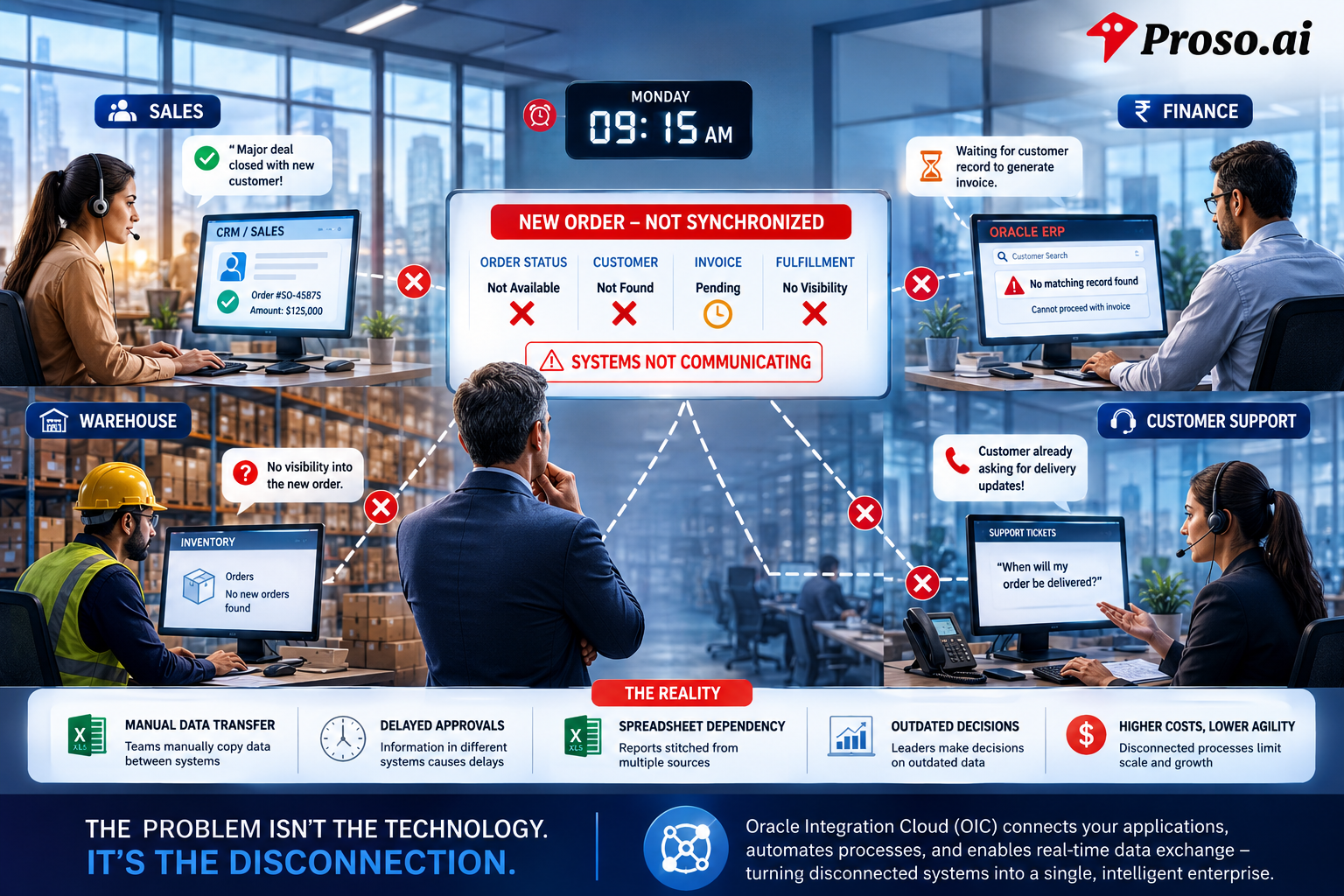
It's 9:15 on a Monday morning.
Your sales team has just closed a major customer, but the order isn't visible in your ERP. Finance is waiting for the customer record to appear before generating an invoice. Meanwhile, your warehouse has no visibility into the new order, and customer support is already fielding calls asking when the shipment will arrive.
None of these teams are doing anything wrong.
They're simply working in systems that don't communicate with each other.
This is the reality for many growing businesses. As organizations adopt best-of-breed platforms—Oracle Fusion Cloud ERP for finance, Salesforce for customer relationships, Microsoft 365 for collaboration, Workday for HR, and industry-specific applications for operations—the technology stack becomes more capable, but also more fragmented. Every new application improves a department's productivity while making enterprise-wide collaboration increasingly complex.
The result is a business that spends more time moving information than acting on it.
Employees manually transfer data between applications. Critical approvals are delayed because information lives in different systems. Reports require spreadsheets stitched together from multiple sources, and leadership teams are often forced to make strategic decisions using data that is already out of date. As businesses grow, these disconnected processes become more than an operational inconvenience—they become a barrier to scale, agility, and customer experience.
The challenge isn't that organizations have invested in the wrong technology. In most cases, they've invested in the right technology—but those systems were never designed to work together on their own.
This is where modern enterprise integration becomes essential.
Oracle Integration Cloud (OIC) serves as the intelligent integration layer that connects applications, automates business processes, and enables real-time data exchange across your technology ecosystem. Instead of replacing the systems your teams already rely on, OIC helps them operate as a single, connected enterprise.
For organizations looking to scale without adding operational complexity, integration is no longer an IT initiative—it's a business strategy. And in 2026, building a connected enterprise is one of the most important investments a growing business can make.
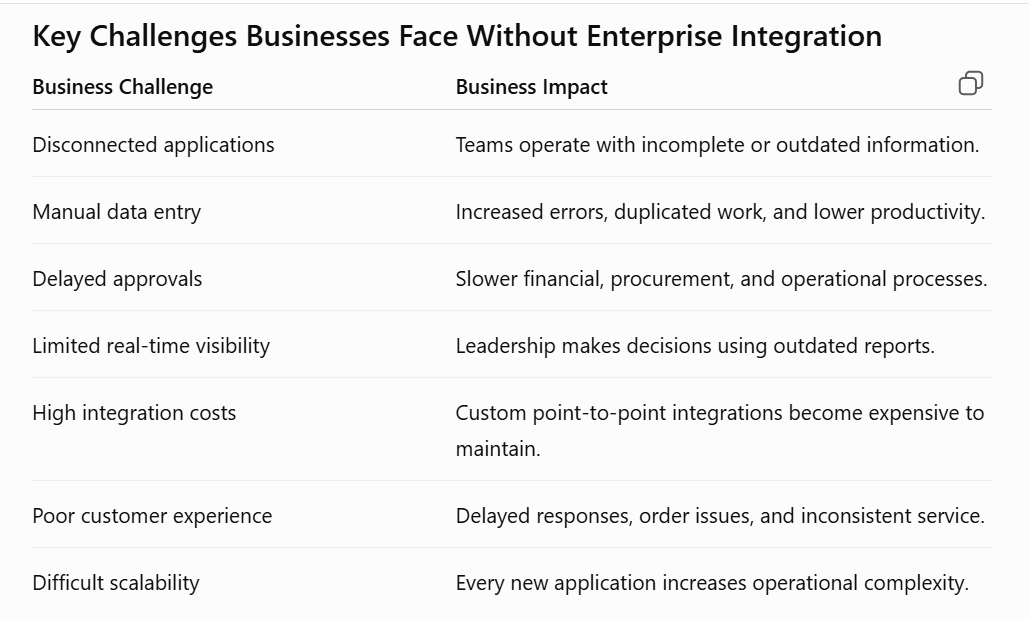
Every growing business reaches a point where adding new software no longer solves operational challenges—it starts creating them.
What begins with a single ERP system gradually expands into a technology ecosystem. Finance adopts Oracle Fusion Cloud ERP for better financial management. Sales teams rely on Salesforce to manage customer relationships. HR moves to Workday for talent management, while collaboration happens through Microsoft 365. E-commerce platforms, logistics providers, banking applications, customer support tools, and industry-specific solutions all become part of the business.
Individually, each application improves productivity.
Collectively, they often create data silos.
Without a unified integration strategy, information becomes trapped inside individual applications, forcing employees to manually bridge the gaps. Orders have to be entered multiple times. Customer information becomes inconsistent across departments. Inventory updates are delayed. Financial reports require manual reconciliation. Leadership teams spend more time validating data than making strategic decisions.
As businesses continue to scale, these disconnected processes don't just reduce efficiency—they slow down growth.
Today's organizations are expected to respond to customers in real time, automate operations, and make decisions based on accurate, enterprise-wide data. None of that is possible when business-critical applications operate in isolation.
The challenge becomes even greater as companies embrace AI, automation, and cloud-first strategies. Artificial intelligence is only as effective as the data it can access. Workflow automation only succeeds when applications communicate seamlessly. Digital transformation stalls when integration becomes an afterthought.
The question is no longer whether businesses should integrate their systems.
The question is how they can do it securely, efficiently, and at scale.
This is precisely why enterprise integration has evolved from an IT initiative into a strategic business capability—and why Oracle Integration Cloud (OIC) has become a cornerstone of modern digital transformation.

Imagine if every business application in your organization could communicate with each other instantly—without manual intervention, spreadsheets, or complex custom coding.
That's exactly what Oracle Integration Cloud (OIC) is designed to do.
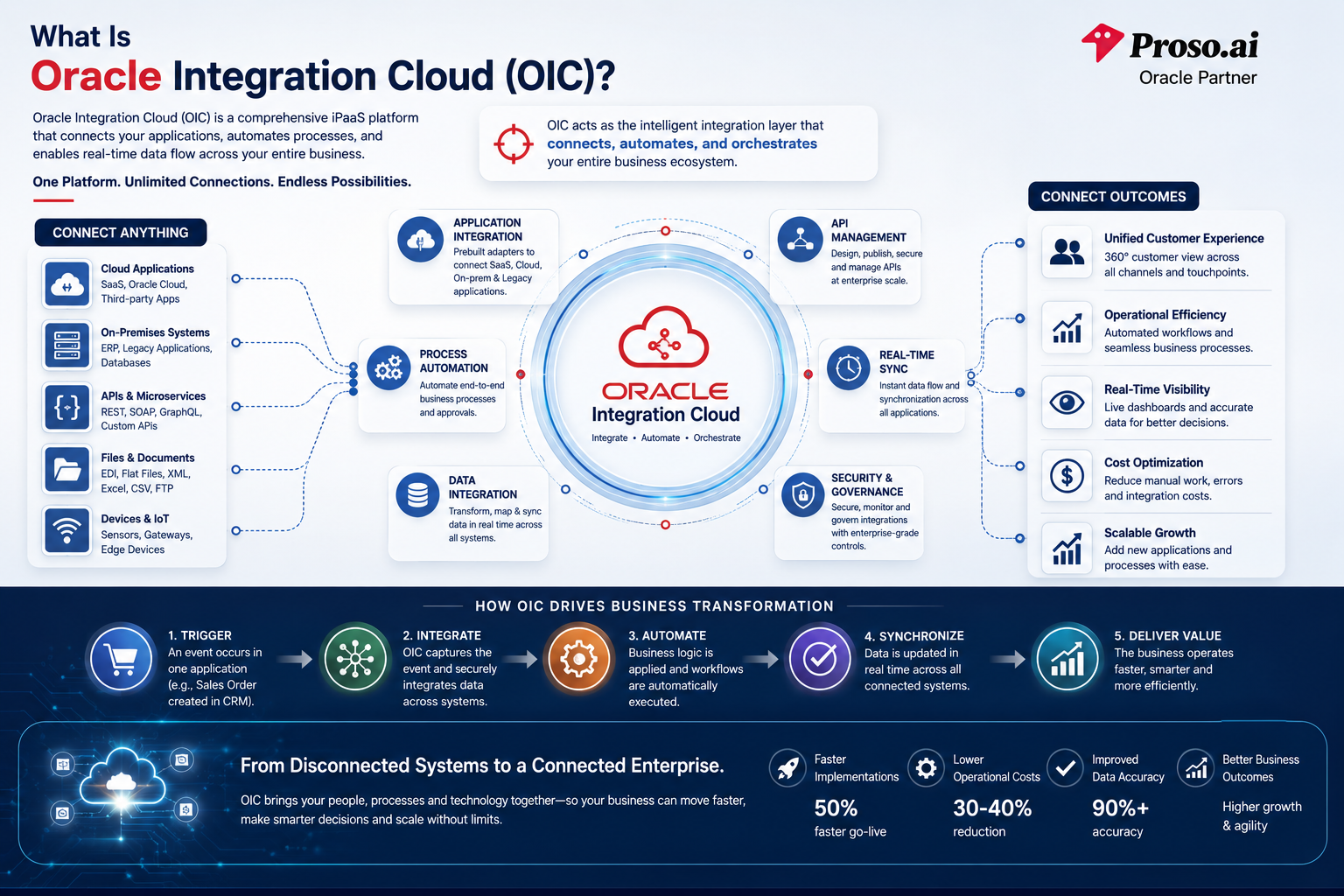
Oracle Integration Cloud is Oracle's enterprise-grade Integration Platform as a Service (iPaaS) that enables organizations to securely connect cloud applications, on-premises systems, databases, APIs, and third-party platforms into one intelligent, automated ecosystem.
Rather than replacing your existing technology investments, OIC enhances them by ensuring every application shares information in real time.
Whether you're using Oracle Fusion Cloud ERP, Salesforce, Microsoft 365, Workday, SAP, Shopify, banking platforms, or custom-built applications, OIC acts as the secure integration layer that allows these systems to work together as one connected enterprise.
The result isn't just connected software—it's connected business processes.
An order created by your sales team can automatically update inventory, trigger procurement workflows, notify finance, generate invoices, inform logistics partners, and update customer records—all without anyone manually moving data between systems.
This level of automation eliminates repetitive work, improves data accuracy, accelerates decision-making, and allows employees to focus on higher-value activities instead of administrative tasks.
In today's AI-driven business landscape, Oracle Integration Cloud has evolved beyond middleware. It has become the digital backbone that enables automation, intelligent workflows, and enterprise-wide visibility across every department.
Think of Oracle Integration Cloud as the central nervous system of your business.
Instead of creating dozens of complex, point-to-point integrations between applications, every system connects once to OIC.
From there, OIC intelligently manages how information flows across your organization.
The platform offers several powerful capabilities that work together:
Prebuilt connectors allow businesses to integrate Oracle applications with leading enterprise platforms such as Salesforce, Microsoft Dynamics 365, Microsoft 365, SAP, Workday, ServiceNow, Shopify, databases, REST APIs, and hundreds of other business applications.
Business workflows can be automated end-to-end without manual intervention.
For example:
OIC enables organizations to securely publish, monitor, and manage APIs, making enterprise integrations scalable, secure, and reusable across teams.
Instead of waiting for scheduled imports or nightly batch jobs, OIC ensures that information is updated instantly across connected systems.
Everyone works with the same data.
At the same time.
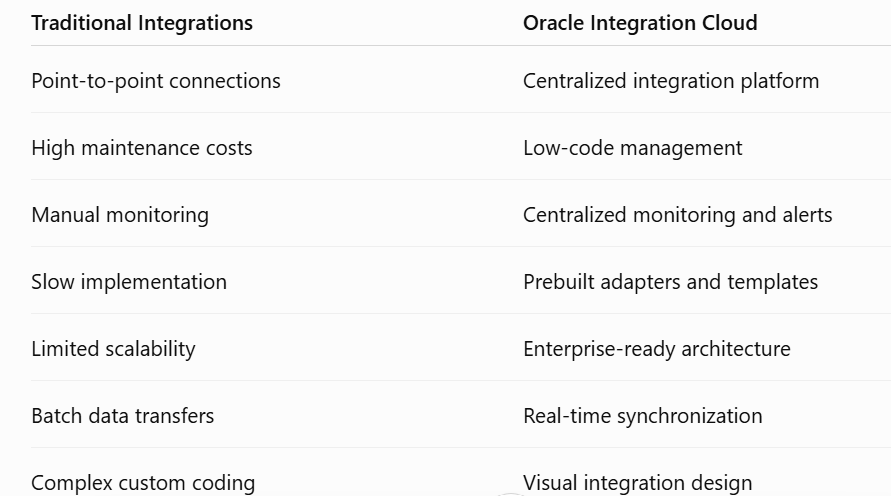
Traditional integrations often create a web of custom connections that become increasingly difficult and expensive to maintain.
Every new application requires additional development.
Every software update risks breaking existing integrations.
Every business change introduces more complexity.
Oracle Integration Cloud replaces this fragmented approach with a centralized integration platform that is scalable, secure, and built for continuous innovation.
Every organization has unique business processes, but the challenges are surprisingly similar—disconnected applications, delayed information, manual work, and limited visibility.
Oracle Integration Cloud helps organizations eliminate these bottlenecks by creating seamless communication between enterprise applications. The result is faster operations, better customer experiences, and a business that's ready to scale.
Let's explore how businesses across different functions are using Oracle Integration Cloud to transform their operations.
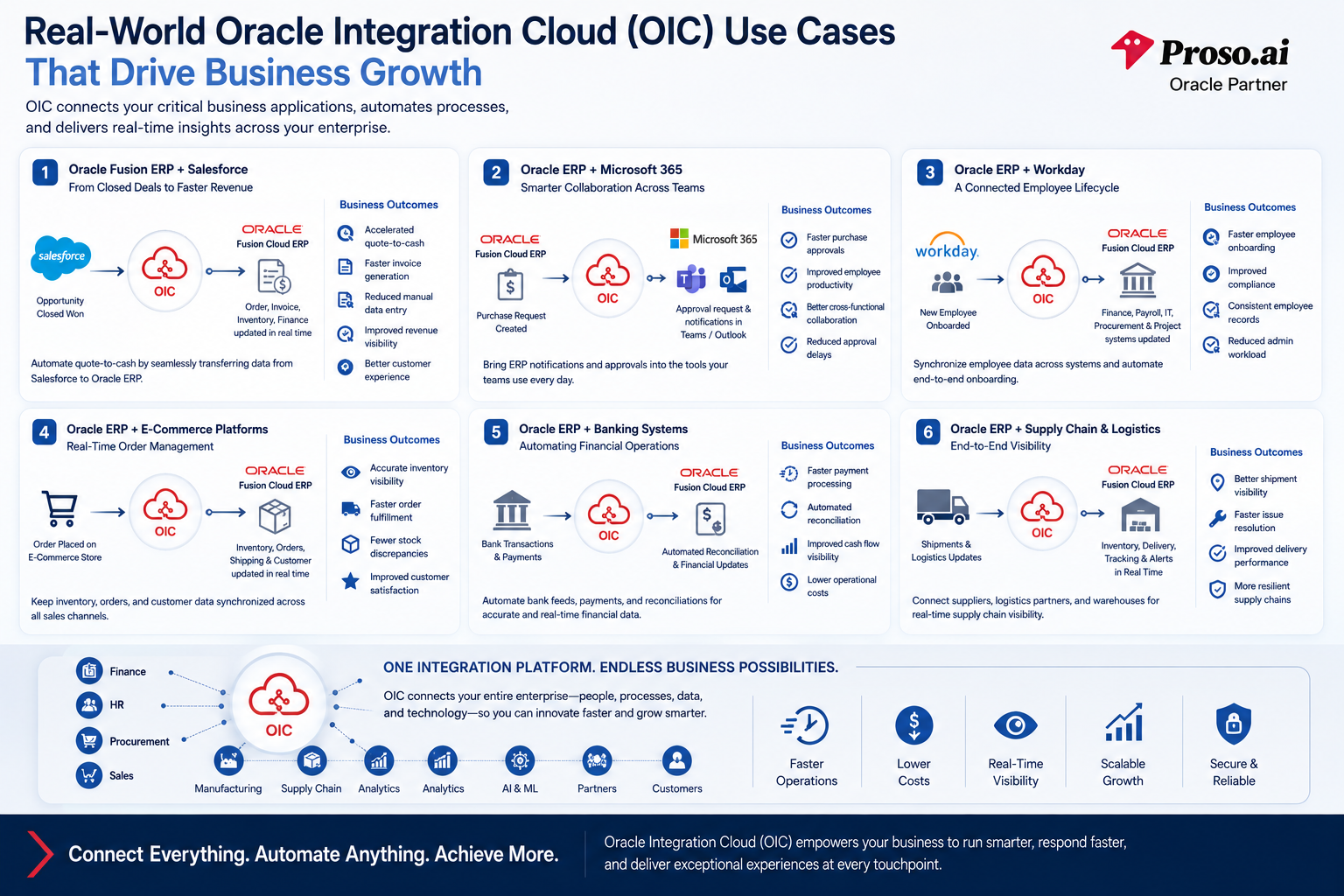
For many organizations, sales teams work entirely inside Salesforce, while finance relies on Oracle Fusion Cloud ERP.
Without integration, once a deal is closed, someone manually creates customer records, sales orders, invoices, and payment schedules inside the ERP.
Besides being time-consuming, this process introduces duplicate records, invoicing delays, and avoidable errors.
With Oracle Integration Cloud, the entire process becomes automated.
As soon as a sales opportunity reaches the "Closed Won" stage in Salesforce, OIC securely transfers the relevant customer and order information into Oracle ERP, triggering invoicing, inventory allocation, and financial workflows in real time.
Business approvals often become bottlenecks because employees constantly switch between applications.
Managers receive purchase requests in Oracle ERP but spend most of their day inside Microsoft Teams or Outlook.
Oracle Integration Cloud bridges this gap.
Instead of requiring users to log into multiple systems, OIC can automatically send approval requests, notifications, and workflow updates directly through Microsoft Teams, Outlook, or SharePoint.
Decision-makers stay productive without leaving the collaboration tools they already use.
Employee onboarding affects far more than HR.
A single new hire often requires user accounts, payroll setup, expense approvals, procurement access, project allocation, and IT provisioning.
Without integration, every department repeats the same work.
Oracle Integration Cloud synchronizes employee information between Workday and Oracle applications automatically.
When HR completes onboarding, the required updates happen across finance, payroll, IT, procurement, and project management without manual intervention.
Growing retailers often struggle to keep online storefronts synchronized with inventory and fulfillment systems.
Customers place orders online only to discover products are unavailable because inventory wasn't updated in time.
Oracle Integration Cloud connects Oracle ERP with leading commerce platforms, ensuring orders, inventory levels, shipping updates, and customer information stay synchronized across every sales channel.
The result is a smoother shopping experience and greater operational efficiency.
Finance teams spend countless hours reconciling payments, validating bank transactions, and matching invoices.
Oracle Integration Cloud securely integrates Oracle ERP with banking systems, enabling automated payment processing, transaction updates, reconciliation, and financial reporting.
This significantly reduces manual effort while improving financial accuracy.
Modern supply chains depend on constant communication between suppliers, logistics providers, warehouses, and customers.
Oracle Integration Cloud connects ERP systems with logistics providers, warehouse management systems, IoT devices, and transportation platforms to provide real-time shipment tracking and operational visibility.
Instead of reacting to disruptions after they happen, businesses can identify issues early and take proactive action.
While these examples focus on specific departments, the real strength of Oracle Integration Cloud lies in its ability to connect the entire enterprise.
From finance and HR to procurement, customer experience, manufacturing, analytics, AI, and partner ecosystems, OIC creates a unified digital foundation where information flows securely and instantly across every business function.
This connected approach doesn't just improve operational efficiency—it empowers organizations to innovate faster, respond to market changes more effectively, and build a business that's ready for future growth.
Every organization has unique business processes, but the challenges are surprisingly similar—disconnected applications, delayed information, manual work, and limited visibility.
Oracle Integration Cloud helps organizations eliminate these bottlenecks by creating seamless communication between enterprise applications. The result is faster operations, better customer experiences, and a business that's ready to scale.
Let's explore how businesses across different functions are using Oracle Integration Cloud to transform their operations.
For many organizations, sales teams work entirely inside Salesforce, while finance relies on Oracle Fusion Cloud ERP.
Without integration, once a deal is closed, someone manually creates customer records, sales orders, invoices, and payment schedules inside the ERP.
Besides being time-consuming, this process introduces duplicate records, invoicing delays, and avoidable errors.
With Oracle Integration Cloud, the entire process becomes automated.
As soon as a sales opportunity reaches the "Closed Won" stage in Salesforce, OIC securely transfers the relevant customer and order information into Oracle ERP, triggering invoicing, inventory allocation, and financial workflows in real time.
Business approvals often become bottlenecks because employees constantly switch between applications.
Managers receive purchase requests in Oracle ERP but spend most of their day inside Microsoft Teams or Outlook.
Oracle Integration Cloud bridges this gap.
Instead of requiring users to log into multiple systems, OIC can automatically send approval requests, notifications, and workflow updates directly through Microsoft Teams, Outlook, or SharePoint.
Decision-makers stay productive without leaving the collaboration tools they already use.
Employee onboarding affects far more than HR.
A single new hire often requires user accounts, payroll setup, expense approvals, procurement access, project allocation, and IT provisioning.
Without integration, every department repeats the same work.
Oracle Integration Cloud synchronizes employee information between Workday and Oracle applications automatically.
When HR completes onboarding, the required updates happen across finance, payroll, IT, procurement, and project management without manual intervention.
Growing retailers often struggle to keep online storefronts synchronized with inventory and fulfillment systems.
Customers place orders online only to discover products are unavailable because inventory wasn't updated in time.
Oracle Integration Cloud connects Oracle ERP with leading commerce platforms, ensuring orders, inventory levels, shipping updates, and customer information stay synchronized across every sales channel.
The result is a smoother shopping experience and greater operational efficiency.
Finance teams spend countless hours reconciling payments, validating bank transactions, and matching invoices.
Oracle Integration Cloud securely integrates Oracle ERP with banking systems, enabling automated payment processing, transaction updates, reconciliation, and financial reporting.
This significantly reduces manual effort while improving financial accuracy.
Modern supply chains depend on constant communication between suppliers, logistics providers, warehouses, and customers.
Oracle Integration Cloud connects ERP systems with logistics providers, warehouse management systems, IoT devices, and transportation platforms to provide real-time shipment tracking and operational visibility.
Instead of reacting to disruptions after they happen, businesses can identify issues early and take proactive action.
While these examples focus on specific departments, the real strength of Oracle Integration Cloud lies in its ability to connect the entire enterprise.
From finance and HR to procurement, customer experience, manufacturing, analytics, AI, and partner ecosystems, OIC creates a unified digital foundation where information flows securely and instantly across every business function.
This connected approach doesn't just improve operational efficiency—it empowers organizations to innovate faster, respond to market changes more effectively, and build a business that's ready for future growth.
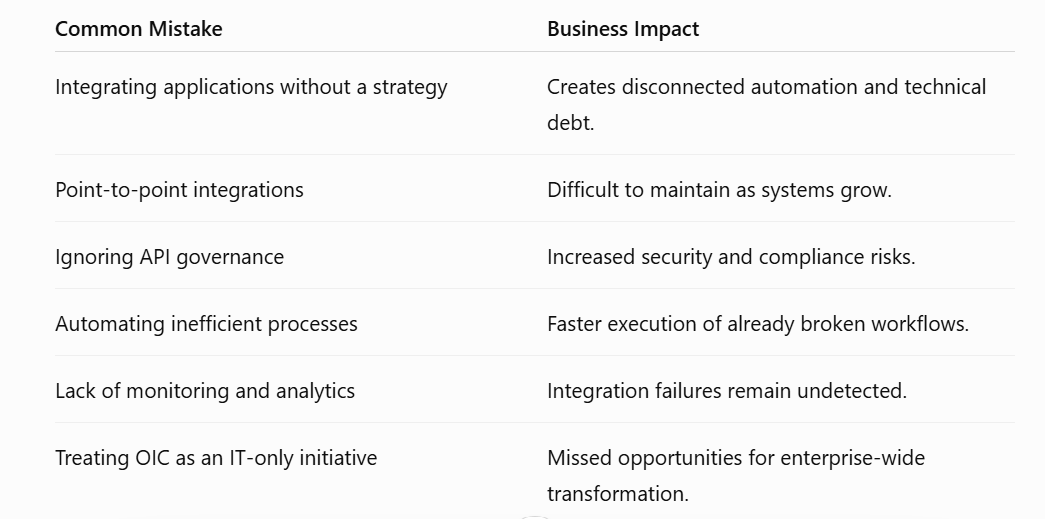
Oracle Integration Cloud offers tremendous flexibility—but unlocking its full value requires more than technical expertise.
It requires an understanding of business processes, enterprise architecture, security, governance, and long-term digital transformation.
This is where working with an experienced Oracle Partner becomes valuable.
Rather than simply implementing integrations, the right partner helps organizations:
At Proso, we believe integration should create business value—not technical complexity.
As an Oracle Partner, we help organizations design and implement scalable Oracle Integration Cloud solutions that connect ERP, CRM, HR, finance, supply chain, analytics, and third-party applications into a single intelligent ecosystem.
Our approach goes beyond implementation.
We work alongside your teams to understand your business processes, identify automation opportunities, design secure integration architectures, and ensure every integration supports long-term growth.
Whether you're modernizing Oracle Fusion Cloud, connecting legacy applications, enabling AI-driven workflows, or building an enterprise-wide integration strategy, our Oracle-certified consultants help you move faster with confidence.
Because the goal isn't simply to connect systems.
It's to build a business that's connected, agile, and ready for what's next.
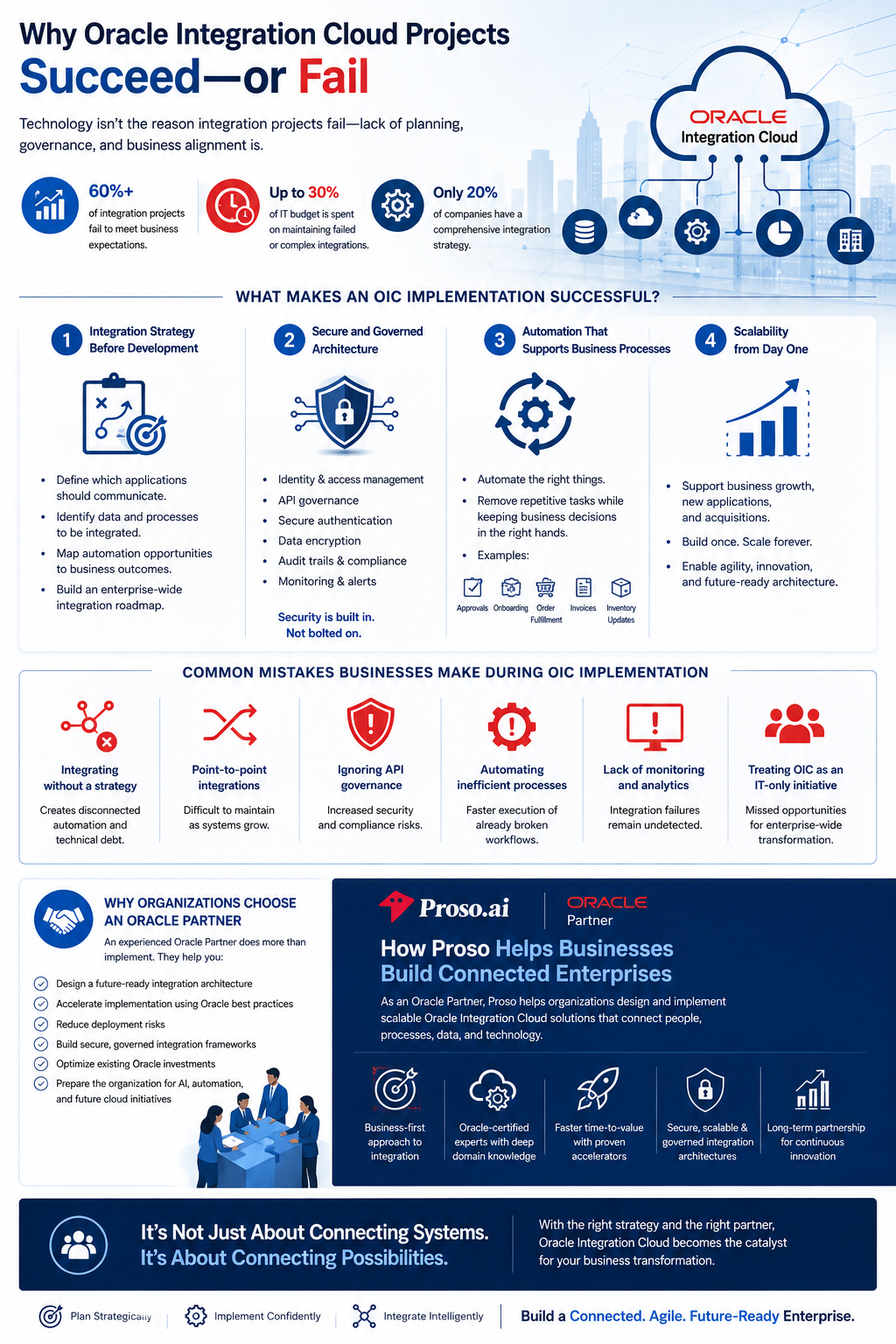
Enterprise technology is evolving faster than ever.
Artificial Intelligence is transforming decision-making. Hyperautomation is redefining business operations. Cloud-native applications continue to replace legacy systems, while organizations increasingly adopt best-of-breed solutions across every department.
Yet one challenge remains constant.
No matter how advanced individual applications become, they only create business value when they work together.
This is why integration has become one of the most strategic investments organizations can make. It is no longer just about connecting systems—it is about enabling agility, innovation, and intelligent decision-making across the enterprise.
Oracle Integration Cloud is at the center of this transformation.
By providing a secure, scalable, and intelligent integration platform, OIC allows businesses to connect applications, automate workflows, synchronize data in real time, and build the digital foundation required for AI-driven operations.
As Oracle continues to invest in artificial intelligence, predictive automation, API management, and cloud-native innovation, organizations with a strong integration strategy will be better positioned to embrace future technologies without rebuilding their entire IT ecosystem.
Businesses that invest in connected architectures today won't just respond to change faster.
They'll be the ones leading it.
At Proso, we believe enterprise integration should accelerate business growth—not introduce unnecessary complexity.
As an Oracle Partner, we help organizations design, implement, and optimize Oracle Integration Cloud solutions that connect every critical business application into a secure, scalable, and future-ready ecosystem.
Whether you're modernizing Oracle Fusion Cloud ERP, integrating Salesforce, Microsoft 365, Workday, custom applications, or legacy systems, our Oracle-certified consultants work alongside your team to ensure every integration delivers measurable business value.
Our engagement goes beyond implementation.
We help organizations:
1. Design enterprise integration roadmaps
2. Modernize legacy integration architectures
3. Build secure API ecosystems
4. Automate end-to-end business workflows
5. Enable AI-ready enterprise connectivity
6. Optimize existing Oracle investments
7. Scale confidently as the business grows
Because successful digital transformation doesn't happen by adding more technology.
It happens by making every technology investment work together.
Disconnected systems slow innovation.
Connected enterprises create it.
Whether you're planning an Oracle Fusion implementation, modernizing legacy integrations, or building an enterprise-wide automation strategy, Oracle Integration Cloud provides the foundation to move faster, operate smarter, and scale with confidence.
With the right integration strategy—and the right Oracle Partner—you can transform isolated applications into a connected ecosystem that supports every stage of your business growth.
At Proso, we're committed to helping organizations unlock the full value of Oracle technologies through intelligent integration, automation, and enterprise transformation.
The future of business isn't built on more applications.
It's built on better connections.
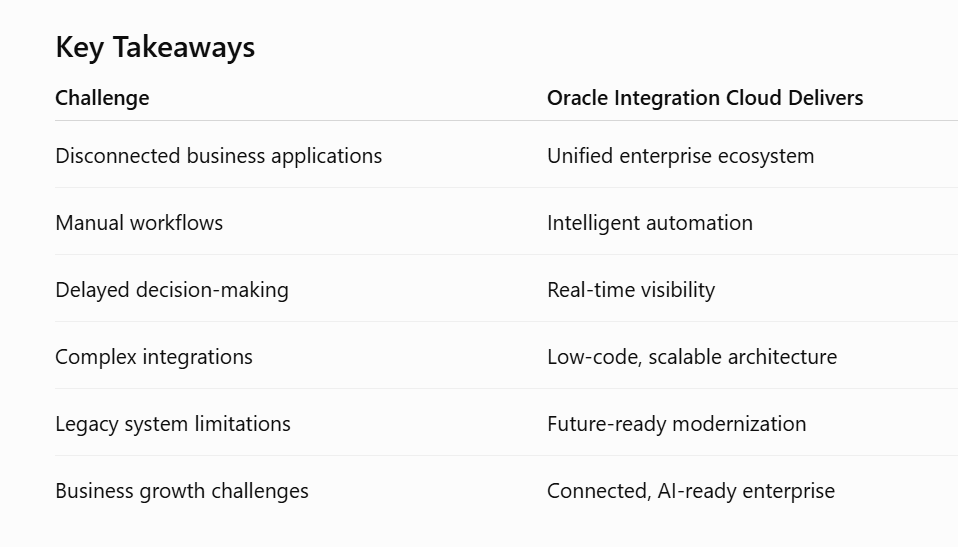
Ready to unlock the full potential of Oracle Integration Cloud?
Whether you're planning your first enterprise integration or modernizing an existing Oracle ecosystem, Proso's Oracle-certified experts can help you design, implement, and optimize an integration strategy that scales with your business.
Let's build a connected, intelligent enterprise—together.
.jpg)

.png)
.png)