“We invested in AI. It keeps asking us for data we don’t have.”
Across boardrooms, AI has moved from experiment to expectation. Predictive forecasts, intelligent agents, automated operations — the ambition is everywhere. But in delivery reviews, the same blocker appears: the AI is ready. The data is not.
Most AI initiatives don’t stall at the model. They stall at the seams — between ERP and HCM, between CRM and finance, between the bank file and the ledger. Systems that each work perfectly… and together, work slowly.
This usually isn’t an AI problem. It’s a flow problem.
The research points the same way. Gartner predicts that through 2026, organisations will abandon 60% of AI projects that aren’t supported by AI-ready data, and its survey found that 63% of organisations either lack, or are unsure they have, the right data management practices for AI.
This blog is designed to help business leaders understand:
Before discussing patterns, it’s worth understanding why this problem compounds every year. Four things show up again and again.
Systems of record that don’t speak. Worker data lives in HCM, cost centres in ERP, accounts in CRM. Every sync is a manual export, a nightly batch, or a prayer — and AI models inherit every gap, duplicate, and delay.
Point-to-point spaghetti. Every new tool adds another custom connector, and one schema change breaks five downstream flows. IT spends its budget maintaining glue, not building value.
Stale data, confident dashboards. Reports look precise but reflect last night’s batch — or last week’s. Leaders make AI-assisted decisions on data the AI has never truly seen. Confidence rises. Accuracy doesn’t.
Governance gaps AI can’t fix. There is no single view of who moves what data, where, and why, and security and audit requirements land after the build, not before. AI without governed flow is risk at machine speed.
Before the patterns, let’s simplify the term.
AI-ready integration is when clean, governed, real-time data flows automatically between every system that produces it and every AI that consumes it.
Instead of teams stitching exports and reconciling spreadsheets, the integration layer:
In short: AI-ready integration replaces data plumbing with business flow.
Oracle Integration Cloud (OIC), which Oracle now calls simply Oracle Integration, is built for exactly this job. It offers a large library of prebuilt adapters, B2B capabilities for EDI and secure file transfer, and native access to events in Oracle Cloud ERP, HCM, and CX. It also sits alongside API Management, GoldenGate, and event streaming in Oracle’s wider integration portfolio.
That matters because the patterns below only work at scale when they are built once, governed centrally, and reused. Each one includes a short note on how OIC delivers it.
Synchronise worker, position, cost centre, and payroll master data between Oracle Fusion HCM and ERP — so every financial and operational process runs on the same people data.
How OIC does it: The Oracle HCM Cloud and ERP Cloud adapters connect both sides through business objects, REST APIs, and event subscriptions, with prebuilt recipes to jump-start the flow.
Business value: Every AI use case in workforce planning, costing, and analytics finally has consistent inputs.
Flow quotes, orders, invoices, and revenue events between CRM and ERP in real time — with status visible to both sales and finance.
How OIC does it: Adapters for Oracle CX Sales and B2B Service, Salesforce, and Oracle ERP Cloud, plus business-event subscriptions such as account and activity events, carry each step both ways.
Business value: Forecasts match the ledger. Sales stops rekeying. Revenue AI sees the true cycle.
Integrate bank statements, payment files, and reconciliation events through OIC — replacing file drops and manual matching with governed, automated flows.
How OIC does it: Secure file transfer capabilities, orchestrated with the ERP Cloud adapter and monitored in one place, replace manual file drops.
Business value: Cash positions update continuously — the foundation every predictive cash model needs.
Move from nightly batches to business events: a hire, a shipment, an approval, a payment triggers the right downstream actions instantly.
How OIC does it: Native access to events in Oracle Cloud ERP, HCM, and CX, plus connectivity to Apache Kafka and OCI Streaming, lets one event start the next step as it happens.
Business value: AI acts on what just happened, not what happened last night.
Standardise purchase orders, invoices, and logistics messages with suppliers and partners — managed, monitored, and exception-handled in one place.
How OIC does it: B2B capabilities for EDI and secure file transfer bring partner messages into the same governed layer as everything else.
Business value: Partner volumes scale without scaling the ops team that chases them.
Publish governed, well-modelled data streams from OIC into your analytics platform and data lake — the curated layer every model is trained and scored on.
How OIC does it: Adapters for platforms such as Snowflake, machine-learning recommendations that speed up data mapping, and GoldenGate for real-time replication where streaming isn’t enough.
Business value: Data scientists stop cleaning data and start shipping outcomes.
Expose reusable, versioned APIs for the capabilities the business needs most — so each new initiative composes on what exists instead of rebuilding it.
How OIC does it: Oracle API Management covers the full lifecycle: design, build, promote, and secure internal and external APIs.
Business value: The second project costs a fraction of the first. AI initiatives move at library speed.
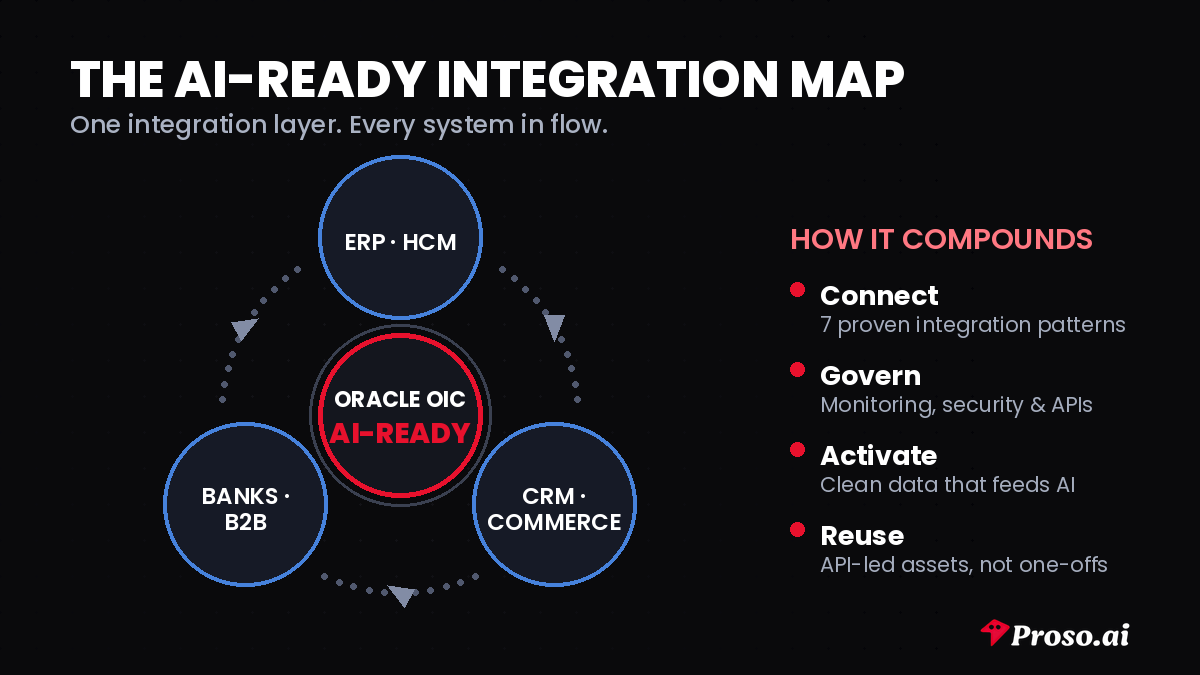
AI agents are only as useful as the systems they can reach. An agent that can call a governed, versioned API — the same one your teams already use — can check an order status, look up a worker record, or confirm a payment without scraping screens or guessing. Oracle itself positions Oracle Integration as the connectivity layer that makes AI agents work.
Governed flow also means every action is monitored and auditable. That is the difference between an agent you can trust in production and a demo you can’t.
The scenarios below are composites based on typical enterprise setups, not a single client.
Before:
With connected flow:
Result: Forecast-to-ledger variance shrinks, and revenue AI trains on the real cycle.
Before:
With connected flow:
Result: Close cycles compress, continuous reconciliation becomes realistic, and cash forecasts refresh from current data.
Before:
With connected flow:
Result: Day-one productivity, zero duplicate records, audit-ready by design, and workforce-planning AI that reads one source of truth.
Integration programmes often fail the credibility test because nobody baselined the starting point. Before the first flow goes live, agree on a handful of measures and track them from day one:
Those numbers tell you whether AI initiatives are moving off the plumbing and onto outcomes. They also give you the evidence to fund the next flow.
Integration strategy alone doesn’t create results. Disciplined implementation does.
At Proso.ai, we approach OIC as a business flow layer — not just middleware. As an Oracle Partner, we combine platform depth with business context:
What clients gain:
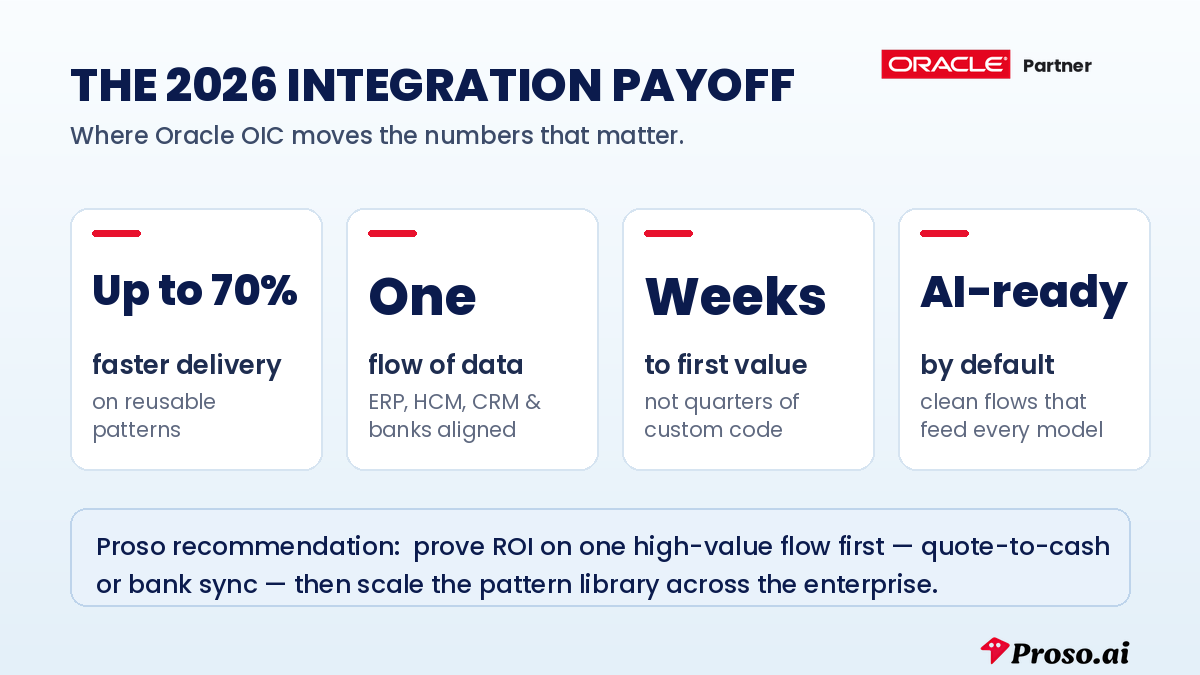
Our recommendation: Start with one high-value flow — quote-to-cash or bank reconciliation — prove the pattern, then grow the pattern library across the enterprise.
As enterprises move through 2026:
Without AI-ready integration, every AI initiative restarts at the plumbing. With it, each initiative compounds on the last. Oracle Integration Cloud, used as a pattern platform rather than a connector tool, is how that advantage gets built.
Oracle Integration Cloud, now called Oracle Integration, is Oracle’s platform for connecting applications and automating end-to-end processes. It offers prebuilt adapters, native access to events in Oracle Cloud ERP, HCM, and CX, and B2B capabilities for EDI and secure file transfer.
It means clean, governed, real-time data flows automatically between every system that produces it and every AI that consumes it, so models and agents work from current, consistent data instead of exports and spreadsheets.
Most stall at the data layer, not the model. Gartner predicts that through 2026, organisations will abandon 60% of AI projects that aren’t supported by AI-ready data. Disconnected systems, stale batches, and weak governance are the usual causes.
Start with one high-value flow, such as quote-to-cash or bank reconciliation. Prove the pattern, baseline the results, and then reuse it across ERP, HCM, CRM, banks, and partners.
If your AI ambitions keep stalling because:
— then integration is your next step.
AI-ready integration isn’t plumbing. It’s the flow the business runs on.
At Proso.ai, we help enterprises turn scattered systems into one flowing business.
Discuss your technology strategy and secure your future success.
Let’s Talk → www.proso.ai/contact-us