.png)
Over the past few years, running a business in the United States has become mentally and operationally exhausting for many leaders. What once felt manageable now feels unpredictable. Every few months bring a new wave of headlines—interest rate hikes, policy revisions, regulatory debates, workforce shifts, or election-driven uncertainty. For small and mid-sized business owners, it often feels like stability is constantly being postponed.
This constant churn creates a sense of unease. Even businesses that are performing reasonably well on paper feel pressure beneath the surface. Decisions take longer. Risks feel heavier. Confidence is harder to maintain. Leaders who once planned two or three years ahead now find themselves hesitating to commit beyond the next quarter.
In this environment, it is only natural to look outward for explanations.
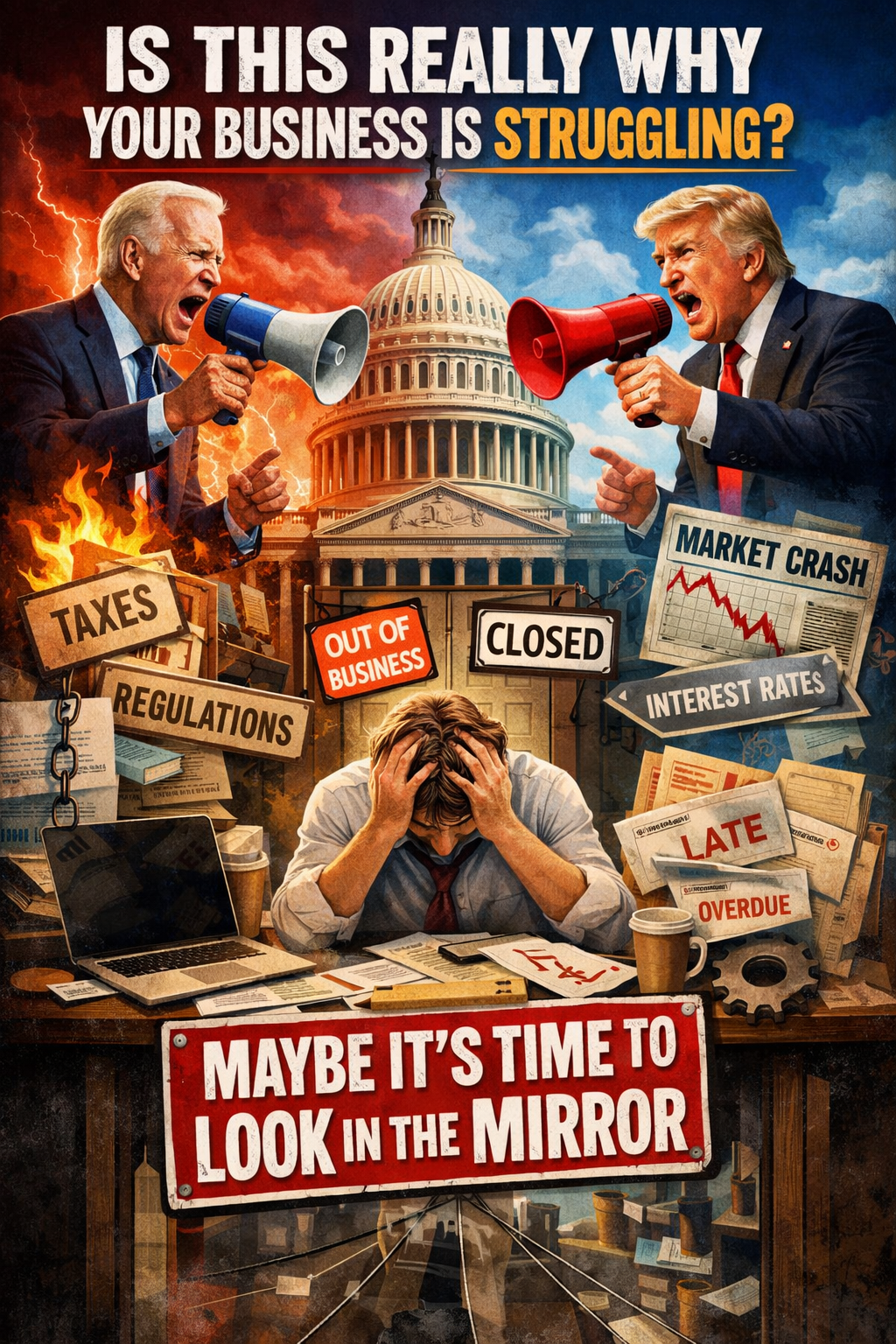
Many business owners believe their struggles are rooted in forces far beyond their control. Economic conditions feel hostile. Policies feel confusing or inconsistent. Political leadership becomes a frequent topic of conversation—not because business owners want to be political, but because they are searching for reasons. Some point to the policies of Joe Biden, while others worry about what might change if leadership shifts again under figures like Donald Trump. These names often become symbols—representing either hope for relief or fear of disruption.
In boardrooms, leadership meetings, and founder conversations, politics quietly becomes a proxy for frustration. When margins tighten, when hiring becomes harder, when compliance feels overwhelming, it is comforting to believe that the root cause is external. After all, external problems don’t require internal change. They only require patience.
But beneath the noise of headlines and debates lies a quieter reality—one that many businesses avoid confronting.
The truth is that most businesses struggling today were not broken by politics. They were already operating with fragile foundations. Their processes depended too heavily on individuals. Their systems had grown organically rather than intentionally. Their operations were held together by effort instead of structure.
Periods of uncertainty do not create these weaknesses. They reveal them.
When conditions are stable, fragility can hide behind growth and momentum. But when pressure increases—whether from political shifts, economic tightening, or regulatory scrutiny—weak systems surface quickly. What once felt like flexibility begins to feel like chaos. What once felt like resilience begins to feel like exhaustion.
Uncertainty didn’t cause the cracks.
It simply made them impossible to ignore.
To understand why so many businesses feel strained today, it’s important to look beyond headlines and into daily operations. The current U.S. business environment is not defined by collapse or crisis. It is defined by constant pressure.
For small and mid-sized businesses, the challenge is rarely one dramatic event. Instead, it is the accumulation of many smaller forces acting at the same time. Costs are rising steadily—labor, benefits, compliance, technology, and operations all demand more investment than they did just a few years ago. At the same time, customers expect faster responses, better service, and greater transparency, regardless of a business’s size or resources.
This creates a difficult imbalance. Businesses are expected to operate with enterprise-level efficiency while still functioning with limited teams, tighter budgets, and fewer buffers.
Political leadership—whether under Joe Biden, Donald Trump, or any future administration—inevitably influences regulations, tax structures, labor policies, and market sentiment. But for most business owners, these changes are felt indirectly. They appear as new reporting requirements, revised compliance rules, shifts in hiring practices, or increased scrutiny from partners and regulators.
What makes this environment especially challenging is speed.
Policies evolve faster than internal processes can keep up. Workforce models change quickly, with more businesses relying on contractors, freelancers, and distributed teams. Technology adoption accelerates, but implementation often lags behind intention. Leaders are forced to make decisions quickly, often without full visibility into their own operations.
Consider a mid-sized professional services firm operating across multiple states. On the surface, the business is healthy. Clients are steady. Revenue is growing modestly. But internally, leadership struggles to answer basic questions quickly. Financial data is delayed because information lives in multiple systems. Contractor payments require manual intervention. Compliance checks slow down onboarding. Decisions that should take hours stretch into weeks.
None of these problems appear in headlines. Yet they define the daily reality of running the business.
This is where many leaders begin to feel overwhelmed. The pressure doesn’t come from one source—it comes from everywhere at once. Economic uncertainty, regulatory change, workforce complexity, and operational inefficiency converge, creating a sense that the business is constantly reacting rather than progressing.
What makes this especially dangerous is that it feels normal.
When everyone around you is experiencing similar stress, it’s easy to assume this is simply how business works now. Leaders begin to accept friction as inevitable. Firefighting becomes routine. Long-term improvements are postponed in favor of short-term survival.
But the most successful businesses are responding differently.
They recognize that while external conditions are unpredictable, internal readiness is not. They understand that volatility is not temporary—it is structural. And instead of waiting for clarity from the outside world, they focus on strengthening what they can control.
The current U.S. business environment does not reward perfection.
It rewards preparedness.
Businesses that invest in clarity, structure, and visibility are not shielded from uncertainty—but they are far less vulnerable to it. They move faster, adapt better, and recover quicker because their foundations are designed to absorb change.
For everyone else, the environment feels hostile not because it truly is, but because their systems were never built for this level of pressure.
For many small and mid-sized businesses, improvisation was never a strategy. It was a necessity.
In the early stages of growth, speed matters more than structure. Decisions are made quickly. Processes are informal. Everyone does a bit of everything. When something breaks, a person—not a system—steps in to fix it. This flexibility often becomes a point of pride. It feels efficient, adaptive, and entrepreneurial.
Spreadsheets replace formal financial systems.
Emails and messages replace workflows.
Trusted employees become walking repositories of knowledge.
For a long time, this approach works.
Revenue grows. Customers are satisfied. Problems are solved as they appear. From the outside, the business looks agile. From the inside, it feels manageable—if occasionally hectic.
The issue is not that improvisation is wrong.
The issue is that it was never meant to scale.
As businesses grow, complexity increases quietly. More customers mean more transactions. More team members mean more coordination. More contractors mean more compliance and oversight. What once felt simple now requires consistency. What once relied on memory now demands documentation.
Yet many businesses continue operating as if they are still small.
Consider a growing logistics company that started with five people and a handful of clients. In its early days, everyone knew everything. Invoices were tracked manually. Contractor payments were approved through email. Compliance checks were handled case by case. It worked—until it didn’t.
As the company expanded, small inefficiencies multiplied. One missed payment created distrust. One delayed report slowed decision-making. One employee leaving disrupted an entire workflow. None of these issues were catastrophic on their own, but together they created constant friction.
Leadership responded by working harder, not differently.
This is the trap of improvisation. It gives the illusion of control while quietly increasing dependency. Over time, businesses become dependent on specific people, unwritten rules, and heroic effort. When those elements fail—as they eventually do—the system collapses.
Uncertainty accelerates this collapse.
When external pressure increases, there is no room for guesswork. Regulatory changes require consistency. Workforce shifts demand clear ownership. Financial tightening exposes inaccuracies. Improvised systems struggle under scrutiny because they were never designed to be examined closely.
What once felt flexible now feels fragile.
The hardest part is that many leaders don’t realize this shift is happening. Improvisation feels familiar. It’s how the business survived before. Letting go of it can feel like losing control, even when it’s the very thing holding the business back.
But growth changes the rules.
At a certain point, businesses must choose between continuing to rely on effort—or investing in structure. One path leads to exhaustion. The other leads to resilience.
Improvisation can help you start.
It cannot help you scale.
Political volatility does not directly damage a business’s internal operations. It doesn’t decide whether your data is accurate, whether your contractors are paid on time, or whether your teams know who owns which decisions. What it does is apply pressure—often suddenly and without warning.
Under pressure, weak systems reveal themselves.
In stable environments, inefficiencies can remain hidden for years. Manual workarounds compensate for missing processes. People step in to fill gaps. Problems are patched instead of fixed. As long as conditions remain predictable, these cracks don’t demand attention.
Volatility changes that.
When policies shift or regulatory scrutiny increases, businesses are forced to respond quickly. New reporting requirements demand accurate data. Workforce regulations require consistent documentation. Financial uncertainty demands real-time visibility. Businesses with clear systems adapt. Businesses without them struggle.
The difference is not intelligence or effort.
It is preparedness.
Consider a technology services firm that relies heavily on independent contractors. For years, onboarding was informal. Contracts were customized manually. Payment schedules varied. It worked—until labor rules tightened and clients began asking more questions about compliance.
Suddenly, leadership needed answers they couldn’t access easily. Who was onboarded under which terms? Which contracts complied with new guidelines? Which payments were at risk? The data existed, but it was scattered across emails, spreadsheets, and individual inboxes.
What felt like a regulatory problem was, in reality, an operational one.
Political volatility amplifies these moments. It forces businesses to confront how decisions are made, how information flows, and how accountability is defined. When systems are unclear, leaders are pulled into operational detail. Strategic thinking takes a back seat to damage control.
This creates a dangerous cycle.
The more uncertain the environment becomes, the more leaders rely on improvisation. The more they improvise, the less resilient the business becomes. Over time, this leads to burnout—not just for leaders, but for teams who are constantly adapting to unclear processes.
Meanwhile, businesses with structured operations experience the same external pressure very differently. They may not like regulatory changes or market shifts, but they can respond calmly. Data is accessible. Responsibilities are defined. Adjustments are made systematically rather than emotionally.
Political volatility does not reward optimism or alignment.
It rewards clarity.
This is the moment many business leaders misunderstand. They believe stability will return once the political climate settles. But modern business environments rarely do. Volatility is no longer an exception—it is a constant.
The real question is not whether external conditions will improve.
It is whether your business is built to function when they don’t.
When uncertainty increases, most business leaders instinctively turn to strategy. They gather their teams, review numbers, and ask big questions about direction. Should the company expand or slow down? Should hiring continue or pause? Should new markets be explored, or should focus shift to protecting existing revenue?
On the surface, these are the right questions to ask. Strategy feels like control. It feels proactive. It gives leaders the sense that they are responding intelligently to changing conditions.
But in many businesses today, strategy is being asked to solve problems it was never meant to fix.
The mistake leaders make—often without realizing it—is trying to think their way out of structural weakness.
They assume that better decisions, sharper forecasts, or smarter positioning will compensate for unclear operations. They believe that if they choose the right direction, the organization will somehow catch up behind them. In reality, strategy depends entirely on execution. And execution depends on systems.
Without strong operational foundations, even the best strategy collapses under its own weight.
Take the example of a growing consulting firm that decides to expand into a new region. The strategy is sound. Demand exists. The market opportunity is real. But internally, billing processes vary by client, contractor onboarding is inconsistent, and financial reporting lags by weeks. As the expansion begins, these issues multiply. Invoices are delayed. Margins become unclear. Leadership steps in more frequently to resolve issues that should never reach them.
The expansion doesn’t fail because the strategy was wrong.
It fails because the organization wasn’t ready to execute it.
This pattern repeats across industries. Leaders respond to uncertainty by changing direction—new tools, new hires, new initiatives—without first stabilizing the core. Over time, this creates confusion. Teams struggle to keep up with shifting priorities. Accountability blurs. Progress slows.
What makes this mistake especially persistent is that it feels productive. Strategic discussions are visible. They signal leadership. Structural work, on the other hand, is quieter. It happens behind the scenes. It doesn’t always produce immediate results.
So it gets postponed.
But postponing structure has a cost.
When systems are unclear, leaders are pulled deeper into operations. Instead of setting direction, they approve payments, resolve conflicts, and answer basic questions. Decision-making becomes centralized by necessity, not design. As a result, leadership bandwidth shrinks just when it’s needed most.
Over time, this creates frustration. Leaders feel overworked. Teams feel constrained. Growth feels risky instead of exciting.
The irony is that many leaders believe they are being cautious—waiting for stability before investing in systems. In reality, they are increasing risk by continuing to operate without them.
Strategy is important.
But without structure, it has nowhere to land.
Weak business architecture rarely announces itself as a major problem. It doesn’t arrive as a sudden failure or dramatic collapse. Instead, it shows up in small, recurring moments that slowly drain time, energy, and confidence.
On a day-to-day level, it often looks like delay.
Financial reports take longer than expected, not because people aren’t working hard, but because information lives in multiple places. Numbers need to be reconciled manually. By the time leadership reviews them, the data already feels outdated. Decisions are made based on partial visibility rather than clarity.
It also shows up as dependency.
Certain people become indispensable—not because they are uniquely talented, but because they hold informal knowledge. They know which spreadsheet is correct, which client requires special handling, or which contractor agreement deviates from the standard. When these individuals are unavailable, work slows or stops altogether. The business becomes fragile without realizing it.
Another common symptom is excessive escalation.
Routine decisions that should be handled within teams repeatedly move upward. Leaders are asked to approve payments, resolve basic operational questions, or clarify responsibilities. This isn’t because teams lack capability, but because processes are unclear. When ownership is ambiguous, everything becomes a leadership issue.
Over time, this creates silent inefficiency.
Employees spend more time navigating systems than doing meaningful work. Contractors experience delays and confusion. Clients sense inconsistency, even if they can’t name it directly. Trust erodes slowly, often without a single obvious cause.
Consider a mid-sized marketing agency managing dozens of clients and freelancers. Each project is tracked slightly differently. Invoicing varies by account manager. Payments depend on manual follow-ups. Individually, these differences seem manageable. Collectively, they create friction at every step.
When the business tries to grow—add more clients, onboard more contractors, expand services—the friction multiplies. What once felt like flexibility becomes a bottleneck. Leadership feels the strain but struggles to identify the root cause.
This is because weak architecture hides behind activity.
Work is happening. Emails are sent. Meetings are held. Problems are addressed as they arise. From the outside, the business looks busy and engaged. But busyness is not the same as effectiveness.
The most dangerous part of weak architecture is normalization. Over time, teams accept inefficiency as “just the way things work.” Firefighting becomes routine. Long-term improvements are postponed because there’s always something more urgent.
Under stable conditions, this may be tolerable.
Under pressure, it becomes unsustainable.
When external stress increases—economic tightening, regulatory scrutiny, workforce shifts—these weaknesses accelerate. Small delays turn into missed opportunities. Minor errors become compliance risks. Leadership bandwidth is consumed by operational detail.
At this stage, many businesses believe they are facing external failure.
In reality, they are facing the limits of their internal design.
To understand the impact of structure, it helps to look at two businesses that appear similar on the surface.
Both are mid-sized companies operating in the same industry.
Both have comparable revenue.
Both rely on a mix of full-time employees and independent contractors.
Both operate in the same regulatory and economic environment.
Yet their experiences under pressure are very different.
The first business grew quickly by relying on people and momentum. Processes evolved informally. Systems were added when needed, often without integration. Decisions flowed upward because leadership wanted to stay close to the details. The business felt flexible and fast-moving, especially in its early years.
When uncertainty increased—policy changes, tighter compliance expectations, economic pressure—this flexibility began to work against them. Leaders were pulled into daily operations. Data had to be manually verified. Teams waited for approvals. Every change required effort and attention. Growth slowed not because demand disappeared, but because the business struggled to absorb complexity.
The second business took a different path.
Early on, it invested in defining how work should move through the organization. Financial data was centralized. Contractor onboarding followed a consistent process. Responsibilities were clearly assigned. Systems were designed to support decisions rather than depend on memory.
When external conditions became uncertain, this business still felt the pressure—but it didn’t panic. Leaders had access to accurate information. Teams knew what they owned. Adjustments were made deliberately rather than reactively. The organization continued operating, even as others hesitated.
The difference between these two businesses was not talent, ambition, or effort.
It was architecture.
The first business relied on adaptability alone.
The second combined adaptability with structure.
This comparison highlights an important truth: resilience is not about avoiding uncertainty. It’s about being built to function within it. Businesses that invest in structure do not become rigid. They become reliable.
And reliability, in uncertain environments, becomes a competitive advantage.
Many business leaders believe that once the external environment settles, they will finally have the clarity they need to make long-term improvements. They tell themselves that system upgrades, process redesign, or structural investments can wait until after the next election cycle, the next economic shift, or the next market correction.
This belief is understandable. Stability feels like the right moment to build. Uncertainty feels like a time to conserve.
But in today’s business environment, stability is no longer something to wait for.
The pace of change has accelerated permanently. Regulatory frameworks evolve faster. Workforce models shift continuously. Customer expectations rise regardless of economic conditions. Even when one source of uncertainty fades, another quickly takes its place.
Businesses that delay structural improvements while waiting for calmer conditions often find themselves perpetually postponing change. The moment clarity seems close, a new disruption appears. Over time, “we’ll fix this later” becomes a permanent state.
There is also a hidden risk in waiting.
When systems are weak, uncertainty doesn’t just slow growth—it amplifies operational stress. Leaders become more cautious, teams hesitate to take ownership, and opportunities are missed because the organization lacks confidence in its ability to execute. What feels like prudence is often silent erosion.
Ironically, uncertainty is often the best time to invest in structure.
During volatile periods, weaknesses become visible. Pain points are clearer. Teams feel the cost of inefficiency more acutely. This awareness creates the strongest case for change. Businesses that act in these moments build resilience while others remain stuck in reaction mode.
Consider companies that strengthened their internal systems during past downturns. When conditions improved, they were ready. Their competitors were still catching up—rebuilding, rehiring, and reorganizing.
Waiting for stability assumes that the environment will eventually reward patience.
In reality, the environment rewards preparedness.
When many business leaders hear the word structure, they instinctively resist it. Structure is often associated with bureaucracy, rigidity, or loss of flexibility. It can feel like something that slows businesses down rather than helping them move forward.
But in practice, the opposite is true.
Well-designed structure does not restrict businesses.
It liberates them.
When systems are clear, leaders no longer need to be involved in every decision. Teams know what they own. Processes move forward without constant oversight. Information flows to the right people at the right time. Confidence replaces hesitation.
This confidence is subtle, but powerful.
Leaders stop reacting to every headline because they understand their internal position. They don’t need to guess how a policy change might affect cash flow—they can see it. They don’t fear workforce shifts because onboarding, compliance, and payments are governed by defined processes. They don’t panic when demand fluctuates because operational visibility allows them to adjust calmly.
Structure creates psychological safety.
It allows leaders to step back from daily firefighting and focus on direction, relationships, and long-term value creation. It allows teams to make decisions without fear of stepping on invisible boundaries. It allows the business to function even when individuals are unavailable.
This is especially important in uncertain environments.
When the outside world feels unstable, internal clarity becomes an anchor. Businesses with strong foundations don’t feel immune to uncertainty—but they feel capable of navigating it. They trust their systems. They trust their data. They trust their teams.
Over time, this trust compounds.
Customers experience consistency.
Contractors experience reliability.
Employees experience clarity.
And clarity, more than optimism, is what sustains growth.
Importantly, structure does not mean over-engineering. It does not require perfection. It requires intention. Thoughtful systems that reflect how the business actually operates—not how it wishes it did.
Businesses that embrace structure are not betting on stability.
They are designing for uncertainty.
At some point, every business reaches a crossroads. One path leads toward continued reaction—responding to external pressure as it appears, adjusting plans frequently, and relying on effort to compensate for unclear systems. The other path leads toward resilience—building a business that can absorb change without losing momentum.
The difference between these paths is not ambition or intelligence. It is intention.
Resilient businesses do not assume uncertainty will disappear. They accept it as a permanent condition of modern commerce. Instead of trying to predict every shift, they focus on strengthening what they can control. They invest in clarity, consistency, and visibility—not as a one-time project, but as an ongoing discipline.
This shift is often subtle. It begins with small but meaningful changes: documenting processes that previously lived in people’s heads, integrating systems that were once disconnected, clarifying ownership where ambiguity existed. Over time, these choices compound, creating an organization that functions smoothly even when conditions outside are unstable.
What makes resilience powerful is that it reduces emotional decision-making. Leaders are no longer forced to react out of fear or urgency. They can evaluate changes thoughtfully, knowing their business has the foundation to support adjustment. Teams feel the difference too. Clear systems reduce confusion, increase accountability, and allow people to focus on meaningful work rather than constant correction.
Resilience does not eliminate risk.
It transforms how risk is managed.
Politics will continue to dominate headlines. Economic conditions will rise and fall. Regulations will evolve. These forces will always influence business, but they do not have to define it.
What ultimately determines whether a business struggles or adapts is not who holds power or which policies pass next. It is whether the business has been designed with enough intention to withstand pressure.
For many organizations, the hardest realization is not that external conditions are challenging—but that internal fragility has gone unnoticed for too long.
The good news is that fragility is not permanent.
With clarity, structure, and thoughtful systems, businesses can move from reaction to resilience. They can stop waiting for stability and begin building for it—internally.
The real crisis facing many businesses today is not political.
It is operational.
And that is a problem leaders can actually solve.
This article is part of an ongoing discussion about how businesses can design systems that support growth, governance, and resilience in uncertain environments.
👉 Read the original Substack article

.jpg)

.png)
.png)