

.png)
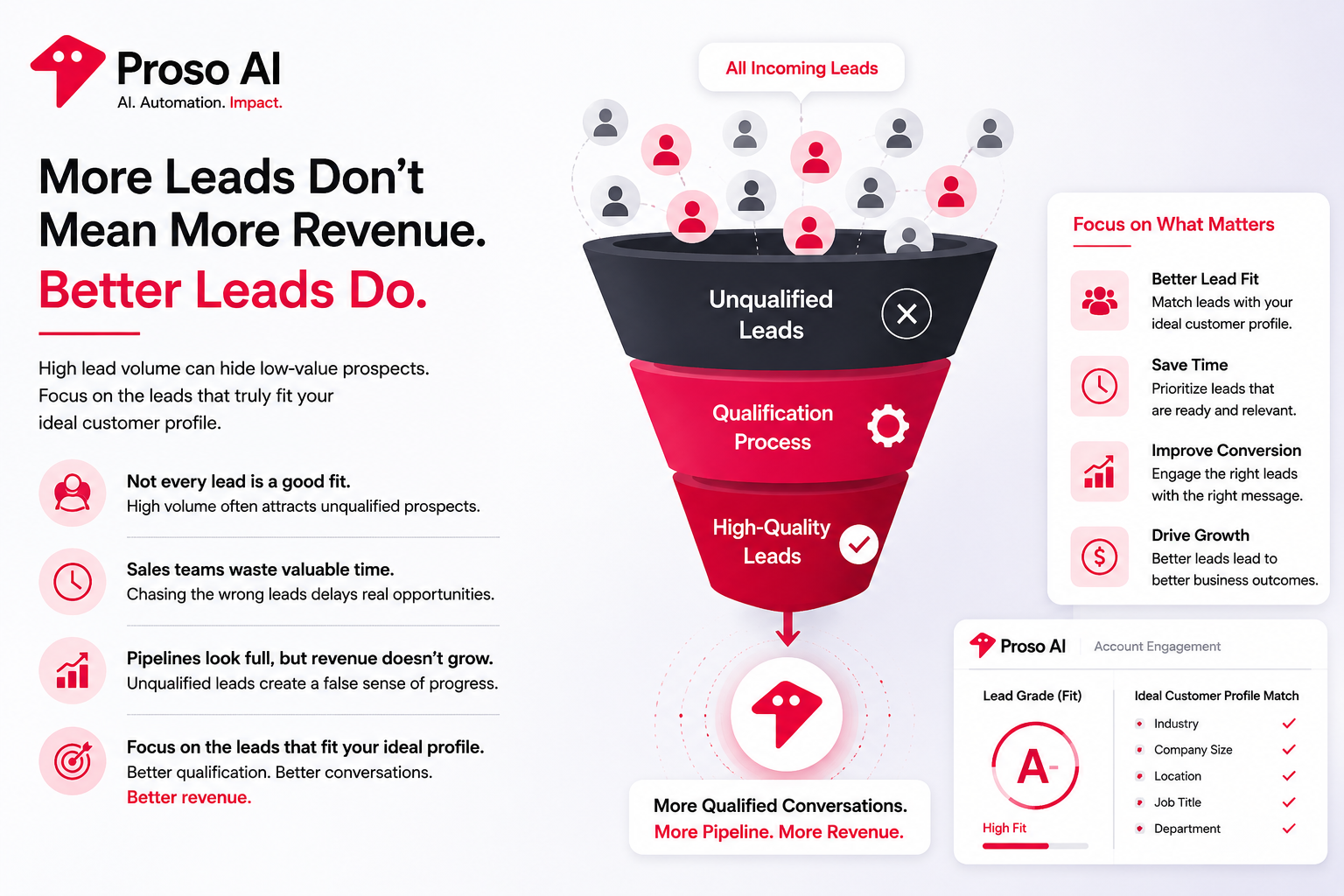
For many growing businesses, success is often measured by one number—the number of leads generated.
Marketing celebrates website traffic, webinar registrations, ebook downloads, and contact form submissions. Dashboards show an increasing pipeline, campaigns report impressive conversion metrics, and every month the organization appears to be attracting more potential customers than ever before.
Yet despite this growth, many founders and sales leaders find themselves asking the same question:
"If we're generating more leads than ever, why isn't revenue growing at the same pace?"
The answer often lies in lead quality, not lead quantity.
Not every prospect who enters your CRM represents a genuine business opportunity. A student downloading a whitepaper, a small business that falls outside your target market, and a decision-maker from one of your ideal enterprise accounts may all appear as "new leads." Without a structured qualification process, they are frequently treated with the same level of priority.
This creates a ripple effect across the business.
Sales teams spend valuable hours following up with prospects who are unlikely to convert. Marketing teams focus on increasing lead volume instead of improving lead quality. Revenue forecasts become less reliable because pipelines are filled with contacts that don't match the company's ideal customer profile.
As businesses scale, this problem becomes even more significant. A startup managing 100 leads a month might be able to manually assess each opportunity. But an organization generating thousands of leads across multiple campaigns, regions, and product lines simply can't rely on intuition or spreadsheets to determine where its sales team should invest time.
What growing companies need isn't more leads—they need a reliable way to identify which leads deserve immediate attention.
That's where Salesforce Account Engagement (formerly Pardot) Grading becomes a strategic advantage.
Rather than evaluating prospects solely on how active they are, Account Engagement Grading measures how closely each lead aligns with your ideal customer profile (ICP). It enables businesses to distinguish between prospects who are merely interested and those who are genuinely likely to become valuable customers.
When implemented correctly, grading helps organizations prioritize sales efforts, strengthen collaboration between marketing and sales, improve conversion rates, and build a scalable revenue engine.
In this guide, we'll explore how Salesforce Account Engagement Grading works, why it has become an essential capability for growth-focused businesses, and how a well-designed grading strategy can help your teams focus on the opportunities that matter most.
Most organizations don't have a lead generation problem.
They have a lead prioritization problem.
Every day, marketing teams work hard to attract new prospects through campaigns, webinars, content marketing, paid advertising, and events. The CRM fills with new contacts, dashboards show growing pipelines, and the sales team receives a steady flow of leads to follow up on.
At first glance, this looks like progress.
But beneath the surface, many businesses are investing significant time and resources into prospects who are unlikely to become customers.
Imagine two prospects entering your CRM on the same day.
The first is a Chief Information Officer at a 2,000-employee healthcare company actively evaluating enterprise solutions.
The second is a student downloading an educational guide for research purposes.
If both prospects are treated with the same priority, your sales team spends valuable time pursuing opportunities that have little chance of generating revenue while delaying conversations with decision-makers who are ready to buy.
This isn't just inefficient—it's expensive.
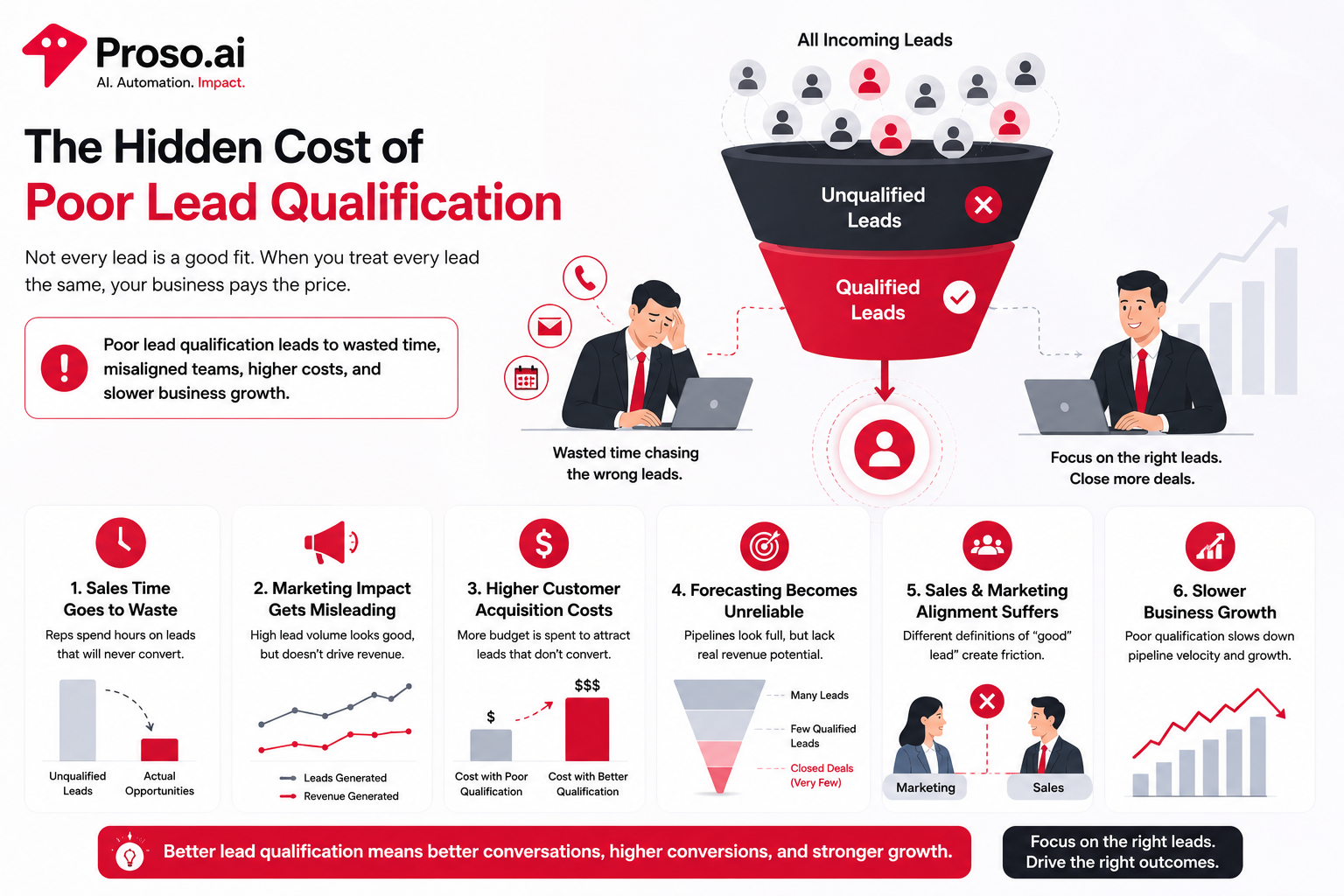
As businesses grow, the cost of poor lead qualification becomes increasingly visible across sales, marketing, and operations.
Sales representatives have one resource they can never recover—time.
Every call, email, product demonstration, and follow-up invested in an unqualified lead is time that could have been spent nurturing a high-value opportunity.
Without a structured qualification framework, sales teams often rely on assumptions, manual reviews, or individual judgment to decide which prospects deserve attention. While experienced sales professionals can identify patterns over time, this approach becomes inconsistent and difficult to scale.
The result is predictable:
Instead of focusing on closing deals, sales teams become occupied with filtering through large volumes of contacts to find genuine opportunities.
Marketing teams are often evaluated on metrics such as website traffic, campaign engagement, and lead generation.
While these indicators are valuable, they don't always reflect business impact.
A campaign that generates 5,000 leads may appear highly successful on paper. However, if only a small percentage of those leads match your ideal customer profile, the campaign contributes little to revenue growth.
This disconnect creates a common challenge between sales and marketing.
Marketing believes it is delivering enough leads.
Sales believes the leads aren't qualified.
Without a shared definition of what makes a high-quality prospect, both teams work toward different objectives, making collaboration more difficult and reducing confidence in marketing performance.
Every unqualified lead increases the cost of acquiring new customers.
Marketing budgets are spent attracting prospects.
Sales resources are allocated to outreach.
Managers review pipeline performance.
Customer success teams prepare for opportunities that may never materialize.
When these investments are directed toward poorly qualified prospects, customer acquisition costs increase without producing corresponding revenue.
By focusing sales and marketing efforts on prospects that genuinely fit the business's ideal customer profile, organizations can improve conversion rates while making better use of existing resources.
A pipeline filled with poorly qualified leads creates a false sense of confidence.
Leadership may see hundreds—or even thousands—of prospects in the CRM and assume future revenue is secure.
In reality, many of those contacts may never progress beyond the initial stages of the buying journey.
This makes forecasting increasingly difficult.
Revenue projections become less accurate.
Resource planning becomes reactive.
Hiring decisions become harder to justify.
Business growth becomes unpredictable.
Reliable forecasting depends not only on the number of opportunities in the pipeline but also on the quality of those opportunities.
The impact of poor lead qualification extends beyond sales metrics.
It affects how quickly businesses respond to market opportunities, how effectively teams collaborate, and how confidently leaders make strategic decisions.
Organizations that continue treating every lead equally often experience:
Over time, these inefficiencies limit the company's ability to scale.
The solution isn't generating more leads—it's identifying the right ones earlier in the customer journey.
This is exactly why modern businesses are adopting Salesforce Account Engagement Grading. Rather than asking sales teams to manually determine which prospects deserve attention, grading automatically evaluates how closely each lead matches the organization's ideal customer profile, allowing teams to focus on opportunities with the greatest potential for conversion.
In the early stages of a business, lead qualification is relatively straightforward.
A founder receives a demo request, reviews the company's website, checks LinkedIn, and decides whether the opportunity is worth pursuing. Sales conversations are personal, lead volumes are manageable, and decisions are often based on experience rather than structured processes.
For a company handling 20 or 30 leads each month, this approach may work well.
But growth changes everything.
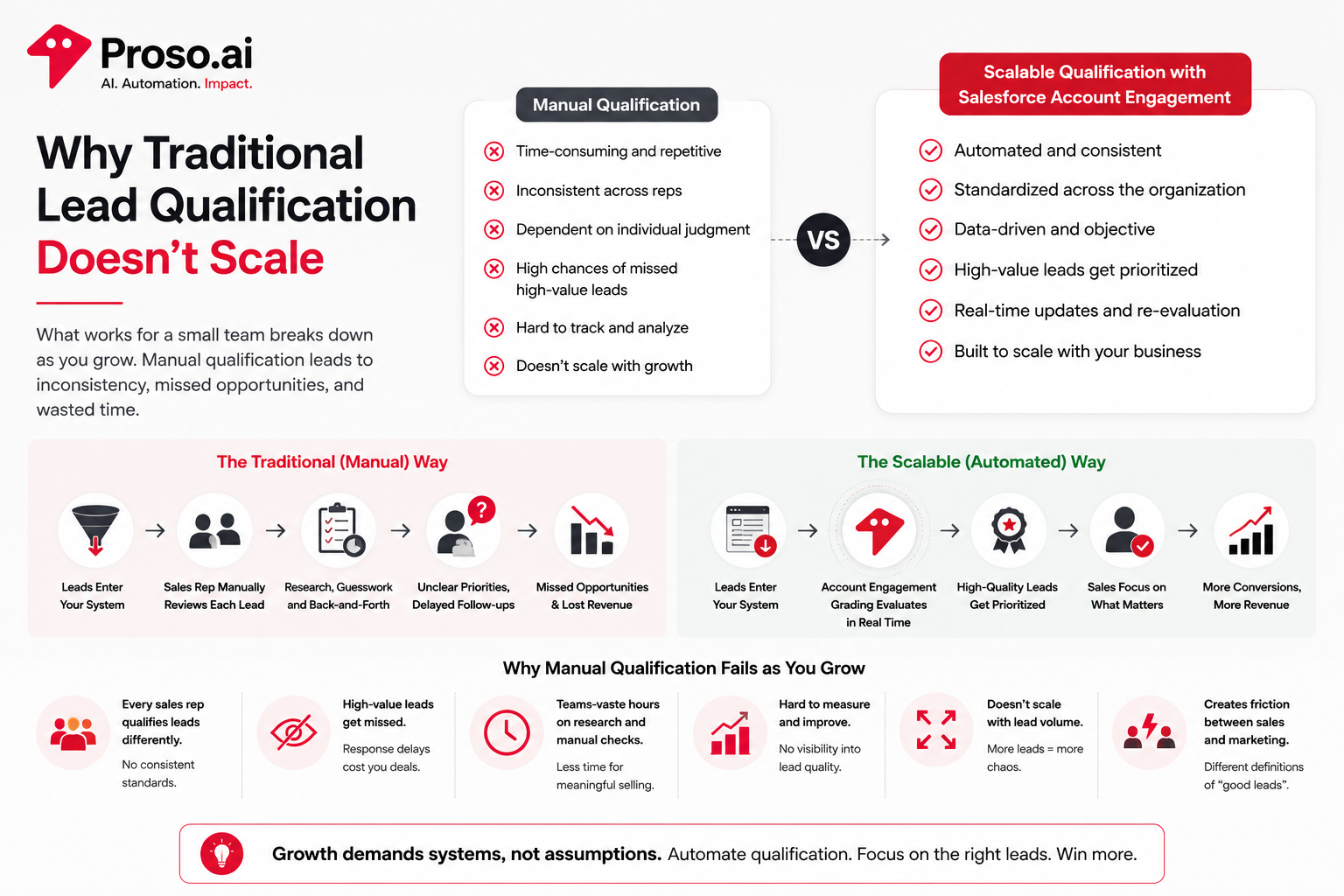
As marketing campaigns expand, new products are introduced, and customer acquisition channels multiply, businesses begin receiving hundreds—or even thousands—of leads every month. At this scale, manual qualification quickly becomes inconsistent, time-consuming, and difficult to manage.
What once felt like a practical process becomes a significant operational bottleneck.
One of the biggest challenges with manual qualification is inconsistency.
Without a standardized framework, each sales representative develops their own way of determining whether a lead is worth pursuing.
One representative may prioritize company size.
Another may focus on job title.
Someone else may value recent website activity over industry or location.
While each approach may seem reasonable, the result is a pipeline where qualification depends more on individual judgment than on business strategy.
This creates confusion across the organization.
Marketing believes it is generating qualified leads because prospects meet campaign objectives.
Sales disagrees because those prospects don't fit the company's ideal customer profile.
Leadership struggles to understand why conversion rates vary so widely across teams.
Without a common qualification framework, every department operates with a different definition of what makes a "good lead."
Manual processes don't just waste time—they also increase the risk of overlooking high-value prospects.
Imagine two leads entering your CRM within minutes of each other.
The first downloads multiple resources but works for a company outside your target market.
The second requests a product demo and happens to be a senior decision-maker at one of your ideal enterprise accounts.
If both leads enter the same queue without prioritization, there is no guarantee that the second prospect receives immediate attention.
In competitive markets, delayed responses can mean missed opportunities.
Decision-makers often evaluate multiple vendors simultaneously, and the company that responds first with the right message frequently gains the advantage.
When every lead receives equal attention, your best opportunities can easily get lost in the crowd.
As organizations grow, successful sales processes become less dependent on individual experience and more dependent on repeatable systems.
Businesses need a qualification model that:
This isn't about replacing human judgment.
It's about ensuring that every sales representative begins with the same reliable information before investing time in outreach.
A structured qualification framework enables teams to spend less time deciding who to contact and more time focusing on how to win the opportunity.
Today's revenue teams can't afford to manually review every new contact that enters the CRM.
Businesses collect prospect data from websites, webinars, email campaigns, paid advertising, referrals, partner programs, social media, and events—all generating leads continuously.
Without automation, maintaining consistent qualification becomes nearly impossible.
This is why modern organizations are turning to Salesforce Account Engagement (formerly Pardot).
Instead of asking sales teams to manually determine which prospects deserve attention, Account Engagement automatically evaluates every lead against predefined qualification criteria. As new information is captured or updated, lead quality is reassessed in real time, ensuring that sales teams always work with the most relevant opportunities.
Automation doesn't replace sales expertise—it amplifies it by eliminating repetitive qualification tasks and allowing teams to focus on meaningful customer conversations.
By the time a prospect enters your CRM, they've already taken a step toward your business.
They may have downloaded an eBook, attended a webinar, filled out a contact form, or requested a product demonstration.
These actions indicate interest, but they don't necessarily indicate business potential.
A prospect might engage heavily with your content yet never become a customer because they don't fit your target market. At the same time, another prospect may interact only once—but represent a decision-maker at a company that perfectly matches your ideal customer profile.
Treating these two prospects as equally valuable creates confusion, slows sales, and weakens pipeline quality.
This is exactly the challenge Salesforce Account Engagement Grading is designed to solve.
Salesforce Account Engagement (formerly Pardot) Grading is a qualification framework that evaluates how closely a prospect matches your Ideal Customer Profile (ICP).
Instead of relying on intuition or manual reviews, the platform measures a prospect against predefined business criteria established by your sales and marketing teams.
These criteria typically include factors such as:
Each prospect is evaluated against these attributes and assigned a grade that reflects how well they align with your ideal customer profile.
Rather than asking your sales representatives to determine whether every lead is worth pursuing, Salesforce performs this evaluation automatically and consistently.
One of the most common misconceptions in lead management is assuming that highly engaged prospects are automatically high-quality prospects.
In reality, engagement and customer fit measure two very different things.
Consider these examples:
Prospect A
Prospect B
If qualification is based only on activity, Prospect A may receive more attention.
If qualification is based on customer fit, Prospect B becomes the higher priority.
For growing businesses, this distinction can significantly improve sales efficiency and conversion rates.
Lead qualification often becomes a point of friction between marketing and sales.
Marketing may believe a campaign has been successful because it generated thousands of new leads.
Sales may disagree because many of those leads don't fit the company's target audience.
Account Engagement Grading creates a common qualification framework that both teams can trust.
Instead of debating whether a prospect is "good" or "bad," every lead is evaluated using the same predefined business criteria.
This shared approach improves collaboration, strengthens lead handoffs, and enables both teams to focus on opportunities with the highest potential for revenue.
At its core, Account Engagement Grading helps businesses answer one fundamental question:
"Does this prospect look like the kind of customer we want to win?"
By answering this question consistently and automatically, organizations can:
Instead of filling the pipeline with every available lead, businesses begin building a pipeline filled with the right leads.
One of the most common mistakes businesses make is assuming that every engaged prospect is a qualified prospect.
A lead may visit your website multiple times, download every available resource, attend webinars, and frequently open marketing emails. These actions suggest genuine interest, but they don't necessarily indicate that the prospect is a good fit for your business.
On the other hand, a decision-maker from one of your target enterprise accounts may interact with only a single campaign before requesting a product demonstration. Their level of engagement may appear lower, yet they could represent a significantly higher revenue opportunity.
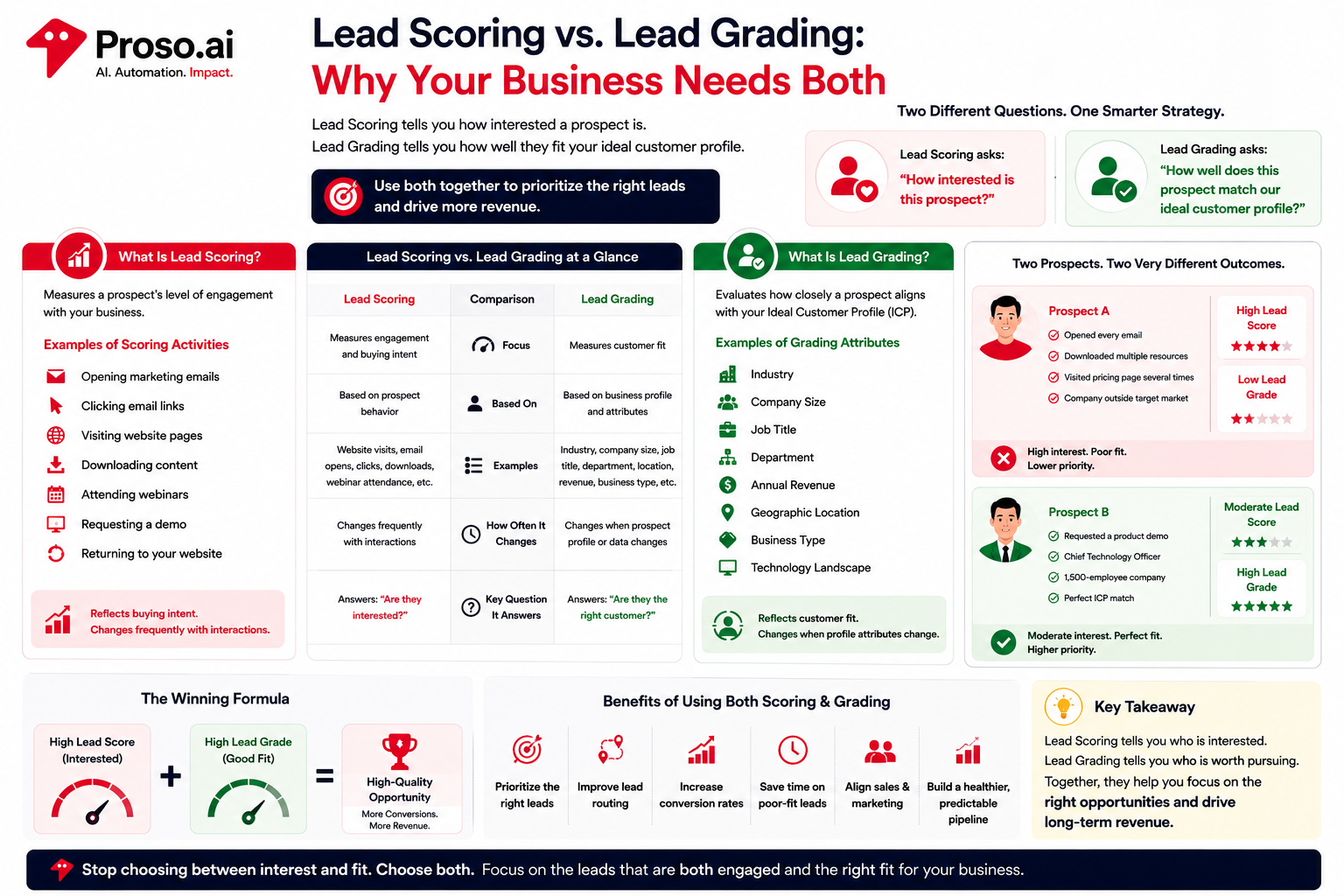
This is why modern revenue teams rely on both Lead Scoring and Lead Grading.
Although they work together, they answer two very different business questions.
Understanding this distinction is essential for building a predictable and scalable sales process.
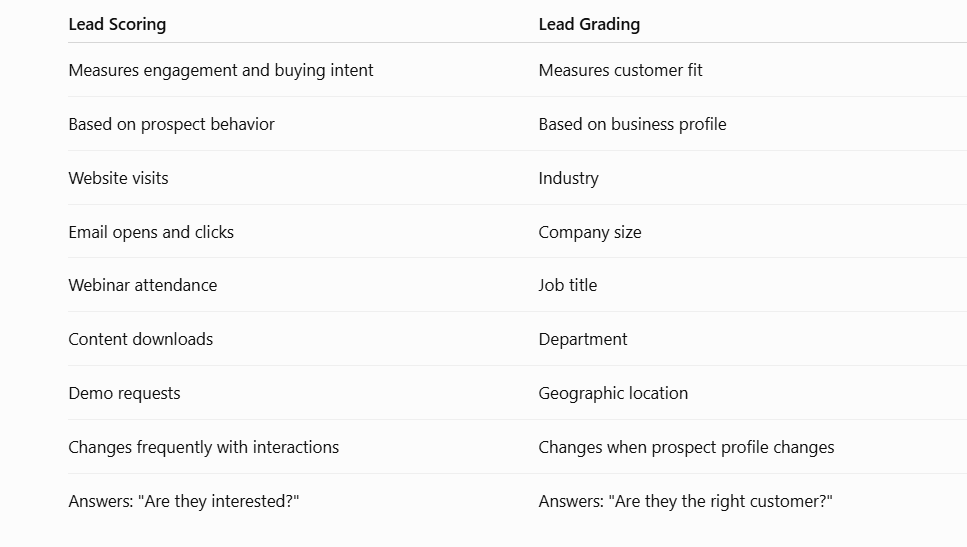
Lead Scoring measures a prospect's level of engagement with your business.
Every interaction a prospect has with your brand—such as visiting your website, opening emails, downloading content, attending webinars, or requesting a demo—contributes to their score.
The more meaningful the interaction, the higher the score.
Lead Scoring helps sales teams identify prospects who are actively researching solutions and may be ready for a conversation.
Typical activities that influence Lead Scoring include:
Scoring reflects buying intent, not customer suitability.
Lead Grading focuses on something entirely different.
Rather than measuring interest, it evaluates how closely a prospect aligns with your Ideal Customer Profile (ICP).
Instead of analyzing behavior, grading considers business characteristics such as:
A prospect receives a higher grade when these attributes closely match the customers your business is best equipped to serve.
This allows sales teams to prioritize prospects based not only on activity, but also on long-term business value.
Imagine these two prospects.
Result:
High Lead Score, Low Lead Grade.
Result:
Moderate Lead Score, High Lead Grade.
If your sales team only follows Lead Scores, Prospect A might receive immediate attention while Prospect B waits in the queue.
If they rely only on Lead Grades, they may contact prospects who match the ideal profile but have shown little buying intent.
Neither approach is complete on its own.
The strongest sales strategies evaluate both dimensions simultaneously.
The most valuable opportunities are prospects who demonstrate both:
When Lead Scoring and Lead Grading work together, revenue teams can:
Instead of asking, "Who downloaded our eBook?", businesses begin asking, "Which engaged prospects are most likely to become long-term customers?"
That shift in perspective is what drives better sales outcomes.
Every business has an idea of what its ideal customer looks like.
It may be a mid-sized healthcare organization looking to modernize its operations, a financial institution investing in digital transformation, or an enterprise manufacturer seeking to automate complex workflows. Sales teams instinctively recognize these opportunities because they align with the company's experience, expertise, and long-term growth strategy.
The challenge is ensuring that every new lead is evaluated against the same standards.
As lead volumes grow, relying on manual judgment becomes inconsistent and difficult to scale. Different sales representatives may prioritize different characteristics, resulting in uneven qualification and missed opportunities.
Salesforce Account Engagement Grading solves this by converting your Ideal Customer Profile (ICP) into an automated grading framework that evaluates every prospect consistently.
Instead of asking individual sales representatives to decide whether a lead is a good fit, the system applies predefined business criteria and assigns a grade based on how closely the prospect matches your ideal customer profile.
In Salesforce Account Engagement, every newly created prospect begins with a default grade of D.
This doesn't indicate whether the lead is good or bad. Instead, it acts as a neutral starting point.
From there, the system adjusts the prospect's grade based on how well their profile aligns with your qualification criteria.
As additional information becomes available—through forms, CRM updates, integrations, or enrichment tools—the grade automatically increases or decreases.
Over time, the prospect moves closer to an A+ if they closely match your ideal customer profile or toward an F if they fall outside your target audience.
Rather than relying on assumptions, businesses gain a dynamic qualification system that evolves as customer data changes.
The effectiveness of Account Engagement Grading depends on how well your grading model reflects your business.
Instead of using generic qualification rules, organizations define the characteristics of their ideal customers and use those attributes to evaluate every incoming lead.
Common grading criteria include:
For example, a company that primarily serves enterprise healthcare organizations may assign higher grades to prospects from the healthcare industry with senior leadership roles in medium-to-large organizations.
Conversely, prospects outside the target market may receive lower grades, ensuring that sales efforts remain focused on the opportunities most likely to convert.
One of the biggest advantages of Salesforce Account Engagement Grading is flexibility.
Businesses can assign different levels of importance to different qualification criteria instead of treating every attribute equally.
For example:
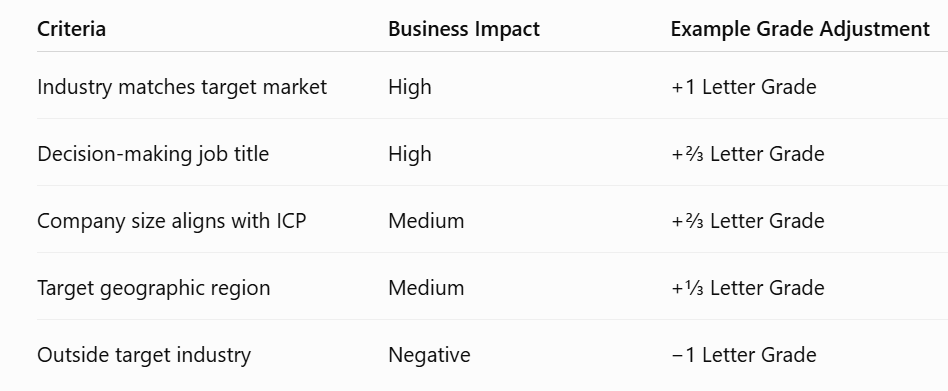
This weighted approach allows organizations to build a qualification model that reflects their actual sales priorities rather than applying a one-size-fits-all scoring system.
The result is a more accurate representation of customer fit and a stronger foundation for sales prioritization.
One of the greatest strengths of Account Engagement Grading is that it is dynamic, not static.
Prospects change roles.
Companies grow.
Business information is updated.
New firmographic data becomes available.
Instead of requiring manual review, Salesforce automatically recalculates a prospect's grade whenever relevant profile information changes.
This ensures that sales teams always work with the most current and accurate qualification data.
For growing businesses, this continuous evaluation eliminates outdated lead assessments and keeps pipelines aligned with evolving customer information.
Once grading is configured, every incoming prospect is automatically evaluated against the same business standards.
Sales representatives no longer need to spend valuable time researching whether a lead fits the company's target audience.
Instead, they can immediately identify:
By replacing manual reviews with automated qualification, businesses create a faster, more consistent, and scalable sales process.
Salesforce Account Engagement provides the technology to grade prospects, but the quality of those grades depends entirely on one thing:
The grading model you create.
Many businesses make the mistake of treating lead grading as a simple configuration exercise. They define a few basic rules, assign values to standard fields, and assume the system will automatically identify their best opportunities.
In reality, effective lead grading begins long before any automation is configured.
It starts with a clear understanding of your Ideal Customer Profile (ICP)—the characteristics shared by customers who generate the greatest long-term value for your business.
Rather than asking "What information do we have about this lead?", successful organizations ask a far more important question:
"What characteristics do our most successful customers have in common?"
The answers to that question become the foundation of an effective grading model.
Every growing business has customers who consistently generate stronger outcomes than others.
They close faster.
They stay longer.
They expand their relationship over time.
They require fewer resources to support.
Instead of building your grading model around assumptions, build it around these proven customers.
Review your highest-performing accounts and look for common patterns such as:
These insights help define the profile of customers your sales team should prioritize.
When your grading model reflects these real-world characteristics, every new lead is evaluated against what has already proven successful.
One of the most common mistakes businesses make is assigning the same value to every qualification criterion.
In reality, some characteristics are much stronger indicators of buying potential than others.
For example, if your organization specializes in enterprise Salesforce implementations, a prospect's industry or company size may have a much greater impact on qualification than their geographic location.
Similarly, a Chief Information Officer or VP of Digital Transformation may represent a more valuable opportunity than a junior coordinator, even if both work for the same company.
An effective grading model recognizes these differences by assigning meaningful weight to the factors that genuinely influence purchasing decisions.
This creates a more accurate representation of lead quality and helps sales teams focus on the opportunities most likely to convert.
Lead grading shouldn't be designed by marketing alone.
Nor should it be based solely on sales intuition.
The strongest grading models are built collaboratively.
Marketing contributes insights from campaign performance, customer behavior, and lead generation trends.
Sales provides direct feedback from customer conversations, objections, buying patterns, and successful deals.
Together, these perspectives create qualification criteria that both teams understand and trust.
This shared framework reduces friction, improves lead handoffs, and ensures that every qualified lead represents a genuine business opportunity—not just a marketing metric.
Your ideal customer profile today may not be the same a year from now.
Markets evolve.
Products expand.
New industries emerge.
Business priorities change.
A grading model should never be treated as a one-time implementation.
Instead, it should be reviewed regularly to ensure it continues reflecting your most valuable customers.
Organizations that periodically refine their grading criteria based on closed-won opportunities, sales feedback, and market changes are better positioned to maintain pipeline quality and adapt to new growth opportunities.
Lead grading works best when it evolves alongside the business it supports.
Once your grading criteria have been clearly defined, Salesforce Account Engagement can automatically apply them to every incoming prospect.
Rather than relying on manual reviews, the platform evaluates each lead against your qualification framework, adjusts grades dynamically as profile information changes, and helps sales teams focus on opportunities with the highest strategic value.
The result is a qualification process that is:
Instead of spending time deciding who deserves attention, sales teams can focus on building relationships and closing deals.
To maximize the value of Salesforce Account Engagement Grading, consider these best practices:
As businesses grow, lead qualification becomes increasingly difficult to manage manually.
A company receiving 20 inquiries a month may be able to review every prospect individually. But when that number grows to hundreds or thousands of leads across multiple campaigns, regions, and channels, manual qualification quickly becomes unsustainable.
Every new lead requires someone to verify company details, assess industry relevance, identify the decision-maker, and determine whether the opportunity deserves immediate attention. Multiply this process by hundreds of prospects, and valuable selling time is lost before the first conversation even begins.
This is where automation becomes a strategic advantage.
Salesforce Account Engagement enables businesses to automate lead qualification by continuously evaluating prospect data against predefined grading criteria. Instead of relying on manual reviews, the platform automatically identifies which prospects align with your Ideal Customer Profile and updates their grades as new information becomes available.
The result is a faster, more consistent qualification process that allows sales teams to focus on conversations—not administration.
One of the greatest benefits of Salesforce Account Engagement is its ability to apply the same qualification logic to every prospect.
Whenever a prospect's information changes—whether through a website form, CRM update, third-party enrichment tool, or integration—the platform automatically reassesses that prospect against your grading model.
For example:
Each update happens automatically, ensuring that every lead is evaluated using the same objective criteria.
Instead of asking sales representatives to remember qualification rules, Salesforce applies them consistently across the entire organization.
Prospect information rarely stays the same.
Companies grow.
Employees receive promotions.
Departments change.
Organizations expand into new markets.
A lead that wasn't a strong fit six months ago may become an ideal opportunity today.
Without automation, these changes often go unnoticed, leaving outdated qualification data inside the CRM.
Salesforce Account Engagement continuously monitors these profile updates and automatically recalculates grades whenever relevant information changes.
This ensures that your sales team is always working with current, accurate data instead of outdated assumptions.
Lead qualification becomes a living process rather than a one-time assessment.
Many organizations make the mistake of updating grades only when a prospect matches a criterion—but never when they stop matching it.
For example, imagine a prospect originally worked at a company with 150 employees, making them an excellent fit for your Ideal Customer Profile.
A year later, that company grows significantly or the prospect moves to a different organization that no longer fits your target market.
If the grading model isn't designed to account for these changes, the prospect may continue carrying an outdated grade that no longer reflects reality.
This creates inaccurate pipelines, misleading reports, and misplaced sales priorities.
A well-designed automation strategy doesn't just reward matching criteria—it also adjusts grades when those criteria no longer apply.
Keeping qualification dynamic ensures that your pipeline always reflects your current business priorities.
Automation isn't just about saving time.
It creates consistency.
When every lead is evaluated using the same rules:
Instead of debating lead quality, every team works from the same source of truth.
This alignment becomes increasingly valuable as businesses expand into new markets, launch new products, or manage larger sales teams.
Modern revenue teams don't succeed because they review more leads.
They succeed because they focus on the right leads at the right time.
By automating lead qualification, businesses eliminate repetitive administrative work while ensuring that every prospect is evaluated fairly, consistently, and objectively.
Sales representatives spend less time researching.
Marketing gains confidence that qualified leads reach the right people.
Leadership gains greater visibility into pipeline quality.
Most importantly, customers receive faster responses from teams that understand their value from the very beginning.
Automation transforms lead qualification from a manual task into a strategic capability that supports sustainable business growth.
Automation is what turns Salesforce Account Engagement Grading from a useful feature into a scalable revenue engine. By continuously evaluating prospect data, updating grades in real time, and maintaining consistent qualification standards, businesses can improve sales efficiency, strengthen marketing alignment, and create a more predictable path to revenue growth.
Salesforce Account Engagement Grading is designed to help businesses prioritize the right opportunities, improve sales efficiency, and strengthen marketing alignment.
However, simply enabling lead grading doesn't guarantee better results.
Many organizations invest in Salesforce Account Engagement but continue to experience poor lead quality, inconsistent qualification, and low conversion rates—not because the platform isn't capable, but because the grading strategy wasn't designed around the business.
The most successful organizations treat lead grading as an evolving revenue strategy rather than a one-time CRM configuration.
Avoiding a few common mistakes can significantly improve the accuracy of your qualification model and the effectiveness of your sales pipeline.
One of the biggest mistakes businesses make is defining qualification criteria based on opinions rather than evidence.
For example, a team may assume that prospects from a specific industry are always their best customers. However, a review of historical sales data might reveal that another industry consistently generates higher contract values, shorter sales cycles, and better customer retention.
An effective grading model should be built using real business insights.
Analyze your highest-performing customers and identify the characteristics they share. Let your existing success stories shape your qualification framework instead of relying on assumptions.
Not every characteristic contributes equally to purchasing decisions.
Yet many businesses assign equal weight to every field in their grading model.
For instance, treating a prospect's job title and geographic location as equally important may produce misleading results if buying authority has a much greater impact on conversions.
Instead, prioritize the factors that have the strongest influence on sales outcomes.
Decision-making authority, industry alignment, company size, and business needs often deserve greater weight than secondary attributes.
A balanced grading model reflects the real priorities of your sales strategy.
Businesses evolve—and so do prospects.
People change roles.
Companies expand.
Organizations merge.
New information becomes available.
If grading rules don't account for these changes, prospects may continue carrying outdated grades that no longer represent their true value.
For example, a lead that once matched your ideal customer profile may no longer qualify after moving to a different company or changing responsibilities.
Salesforce Account Engagement should continuously re-evaluate prospect data to ensure grades remain accurate throughout the customer journey.
Lead qualification should never be treated as a one-time event.
It's tempting to include every available field when creating grading criteria.
More rules.
More conditions.
More exceptions.
But complexity doesn't always produce better qualification.
In fact, overly complicated grading models often become difficult to understand, maintain, and trust.
Sales representatives may lose confidence in the grades, while administrators spend unnecessary time updating rules that add little business value.
A simple, transparent grading model based on the most influential qualification criteria is often far more effective than an overly engineered system.
The goal isn't to grade everything—it's to grade what matters.
Lead grading is often introduced by marketing teams because Salesforce Account Engagement is primarily a marketing automation platform.
However, qualification affects the entire revenue organization.
If sales, marketing, RevOps, and leadership don't agree on what defines a qualified lead, the grading model quickly loses credibility.
The strongest implementations involve cross-functional collaboration.
Marketing contributes campaign insights.
Sales provides feedback from customer conversations.
Revenue Operations ensures consistency across systems.
Leadership aligns the grading strategy with business objectives.
When every team contributes to the qualification framework, lead grading becomes a shared revenue strategy instead of an isolated marketing initiative.
Some organizations focus exclusively on customer fit.
Others focus only on engagement.
Neither approach provides the full picture.
A prospect who perfectly matches your Ideal Customer Profile but has shown little buying intent may not be ready for sales outreach.
Likewise, a highly engaged prospect who falls outside your target market may never become a profitable customer.
The highest-quality opportunities combine strong customer fit with meaningful engagement.
Businesses that use Lead Grading and Lead Scoring together create a more balanced qualification strategy, helping sales teams prioritize prospects who are both interested and likely to convert.
A successful grading model isn't something you configure once and forget.
It should evolve alongside your business.
Review your grading criteria regularly.
Analyze closed-won and closed-lost opportunities.
Gather feedback from sales teams.
Monitor conversion rates across different customer segments.
As your market changes and your ideal customer profile evolves, your grading model should evolve as well.
Continuous refinement ensures your qualification framework remains aligned with business goals and continues delivering meaningful results.
Before finalizing your grading strategy, ask yourself:
✔ Is our grading model based on actual customer data?
✔ Do our grading weights reflect real buying priorities?
✔ Are grades updated automatically when prospect information changes?
✔ Is our grading model simple enough for sales teams to trust?
✔ Have sales and marketing agreed on qualification criteria?
✔ Are we using Lead Grading alongside Lead Scoring?
If the answer to any of these questions is "no," there's an opportunity to strengthen your revenue operations.
Lead grading isn't just about assigning letters to prospects—it's about building a qualification system that reflects your business strategy. Organizations that regularly review, refine, and align their grading models with real customer data create stronger pipelines, improve sales productivity, and achieve more predictable revenue growth.
Investing in Salesforce Account Engagement is an important step toward modernizing your sales and marketing operations. But the platform alone doesn't guarantee better lead quality, stronger conversions, or faster revenue growth.
The real value comes from how well the platform is aligned with your business strategy.
Many organizations implement marketing automation successfully from a technical perspective but struggle to achieve meaningful business outcomes. Lead grading becomes inconsistent, automation rules grow increasingly complex, and sales teams lose confidence in the qualification process because it doesn't accurately reflect their ideal customer profile.
This is where strategic implementation makes all the difference.
At Proso AI, we believe Salesforce Account Engagement should do more than automate marketing activities—it should become the foundation of a smarter, more predictable revenue engine.
Every organization has a different sales process, customer profile, and growth strategy.
A B2B SaaS company targeting mid-market organizations has different qualification criteria than a healthcare technology provider selling to enterprise hospitals. Likewise, a manufacturing business serving global distributors requires a different grading framework than a financial services company focused on regional decision-makers.
Rather than applying a one-size-fits-all approach, Proso AI works closely with sales, marketing, and RevOps teams to understand:
These insights become the foundation for a grading strategy tailored to your business—not just your CRM.
One of the biggest reasons lead grading initiatives fail is a lack of confidence from the sales team.
If sales representatives don't believe the grading accurately reflects customer quality, they'll ignore it and return to manual qualification.
Our approach focuses on creating qualification models that are transparent, data-driven, and aligned with real sales outcomes.
By combining historical customer insights with industry best practices, we help organizations build grading frameworks that sales teams understand, trust, and use every day.
The result is greater consistency, better collaboration between sales and marketing, and a qualification process that scales as the business grows.
Automation is only valuable when it supports better decisions.
At Proso AI, we help businesses design intelligent automation that continuously evaluates prospect information, updates lead grades in real time, and ensures that sales teams always focus on the most valuable opportunities.
This approach enables organizations to:
Instead of spending time sorting through leads, your teams can spend more time building relationships and closing business.
Markets evolve.
Customer expectations change.
Products expand.
Your Ideal Customer Profile today may look very different a year from now.
That's why we view Salesforce Account Engagement as an ongoing business capability rather than a one-time implementation.
Proso AI helps organizations continuously review grading models, analyze conversion data, refine automation strategies, and optimize qualification criteria to ensure Salesforce continues supporting long-term growth.
By treating lead qualification as a continuously evolving strategy, businesses can maintain high-quality pipelines while adapting to changing market conditions.
Organizations partner with Proso AI because they need more than technical implementation—they need measurable business outcomes.
Our Salesforce experts help businesses:
Whether you're implementing Salesforce Account Engagement for the first time or optimizing an existing environment, our focus remains the same: helping your teams identify better opportunities, accelerate sales, and drive sustainable business growth.
Salesforce Account Engagement is a powerful platform, but its greatest value comes from a strategy built around your business—not just your technology. By combining deep Salesforce expertise with a focus on revenue operations, Proso AI helps organizations transform lead qualification into a competitive advantage that supports long-term growth.
Every growing business reaches a point where generating more leads is no longer the biggest challenge.
The real challenge is identifying which prospects deserve your team's time, attention, and resources.
Without a structured qualification process, even the strongest marketing campaigns can produce crowded pipelines filled with opportunities that never convert. Sales teams spend valuable hours chasing poor-fit prospects, marketing struggles to prove campaign impact, and leadership is left making strategic decisions based on incomplete or misleading pipeline data.
This is why modern revenue organizations are moving beyond traditional lead management.
They are adopting intelligent qualification strategies that combine customer fit with buyer intent, ensuring every prospect is evaluated consistently, prioritized accurately, and nurtured appropriately throughout the buying journey.
Salesforce Account Engagement Grading plays a critical role in this transformation.
By measuring how closely each prospect aligns with your Ideal Customer Profile—and combining that insight with engagement data—businesses can improve sales productivity, strengthen marketing and sales alignment, shorten sales cycles, and create a more predictable path to revenue growth.
But technology alone isn't enough.
A successful lead qualification strategy requires a clear understanding of your customers, well-defined grading criteria, intelligent automation, and continuous optimization as your business evolves.
That's where the right Salesforce partner makes all the difference.
At Proso AI, we help organizations move beyond platform implementation to build scalable revenue operations that support long-term growth. From designing qualification frameworks and automating lead grading to optimizing Salesforce Account Engagement for measurable business outcomes, our experts ensure your technology works as a strategic growth engine—not just another business application.
Because in today's competitive market, success doesn't belong to the companies with the biggest pipelines.
It belongs to the companies that know which opportunities matter most—and act on them first.
Whether you're implementing Salesforce Account Engagement for the first time or looking to improve an existing lead qualification strategy, Proso AI can help you build a smarter, more scalable revenue engine.
Our Salesforce specialists work with businesses to:
Ready to transform your lead qualification strategy? Connect with Proso AI and discover how Salesforce Account Engagement can help your business scale with confidence.
.jpg)

.png)
.png)