.png)
"The best systems aren't the ones that never fail—they're the ones that recover before anyone notices."
Modern enterprises generate enormous volumes of data, power thousands of interconnected applications, and rely on complex cloud infrastructures that operate around the clock. As digital ecosystems continue to grow, maintaining system reliability has become increasingly challenging. Even a minor software fault, infrastructure bottleneck, or security vulnerability can trigger service disruptions, financial losses, and poor customer experiences.
Traditionally, organizations have relied on IT teams to monitor systems, identify failures, and restore services manually. While monitoring tools have become more sophisticated, they remain largely reactive—alerting teams only after a problem has already occurred.
This reactive model is no longer sufficient for businesses that demand continuous availability.
Enter Self-Healing AI.
Powered by artificial intelligence, machine learning, automation, and real-time analytics, self-healing AI systems are designed to continuously monitor digital environments, detect anomalies, identify root causes, and automatically execute corrective actions with little or no human intervention.
Rather than simply notifying engineers that something has gone wrong, these intelligent systems can resolve many issues autonomously—often before users even notice an interruption.
From cloud infrastructure and enterprise applications to cybersecurity and manufacturing, organizations are increasingly adopting self-healing AI to improve operational resilience, reduce downtime, optimize costs, and build more autonomous digital ecosystems.
As enterprises accelerate their digital transformation initiatives, self-healing capabilities are emerging as a critical component of next-generation IT operations.
In this article, we'll explore how self-healing AI systems work, where they're delivering measurable business value today, the challenges organizations should consider, and why autonomous infrastructure is becoming a strategic priority for the future of enterprise technology.
.png)
As organizations continue to modernize their digital infrastructure, maintaining uninterrupted system performance has become more challenging than ever. Enterprise environments now span cloud platforms, on-premises data centers, IoT devices, APIs, microservices, and AI-driven applications—all generating vast amounts of operational data every second.
Monitoring such complex ecosystems manually is no longer sustainable.
This is where self-healing AI systems come into play.
A self-healing AI system is an intelligent software ecosystem capable of continuously monitoring its environment, detecting anomalies, diagnosing the root cause of issues, and automatically executing corrective actions—often without requiring human intervention.
Unlike traditional monitoring tools that simply generate alerts when something goes wrong, self-healing AI goes a step further. It doesn't just identify problems—it actively resolves them and continuously learns from each incident to improve future responses.
At its core, self-healing AI combines several advanced technologies, including:
Working together, these technologies enable systems to become increasingly autonomous, reducing dependence on manual troubleshooting while improving reliability and operational resilience.
Rather than waiting for users to report issues or IT teams to investigate failures, self-healing AI follows a continuous closed-loop process that keeps enterprise systems healthy.
The system continuously collects telemetry from applications, servers, cloud infrastructure, networks, databases, and user interactions.
This real-time visibility allows AI models to detect subtle performance deviations long before they become business-critical incidents.
Machine learning algorithms analyze incoming data to distinguish normal operating behavior from unusual patterns.
Instead of relying solely on predefined thresholds, AI identifies anomalies based on historical behavior, reducing false alarms while improving detection accuracy.
Once an anomaly is detected, AI correlates logs, metrics, infrastructure dependencies, and historical incidents to determine the underlying cause.
Rather than spending hours manually tracing failures across distributed systems, organizations can identify the source of issues within seconds.
After diagnosing the problem, the system initiates corrective actions automatically.
Depending on the scenario, this may include:
These automated responses significantly reduce mean time to resolution (MTTR) while minimizing operational disruption.
Perhaps the most valuable characteristic of self-healing AI is its ability to learn.
Every incident provides new data that improves future decision-making. As the system encounters more scenarios, its predictive models become increasingly accurate, enabling faster detection, smarter remediation, and greater resilience over time.
The result is an intelligent infrastructure that doesn't simply recover from failures—it continuously evolves to prevent similar issues from occurring again.
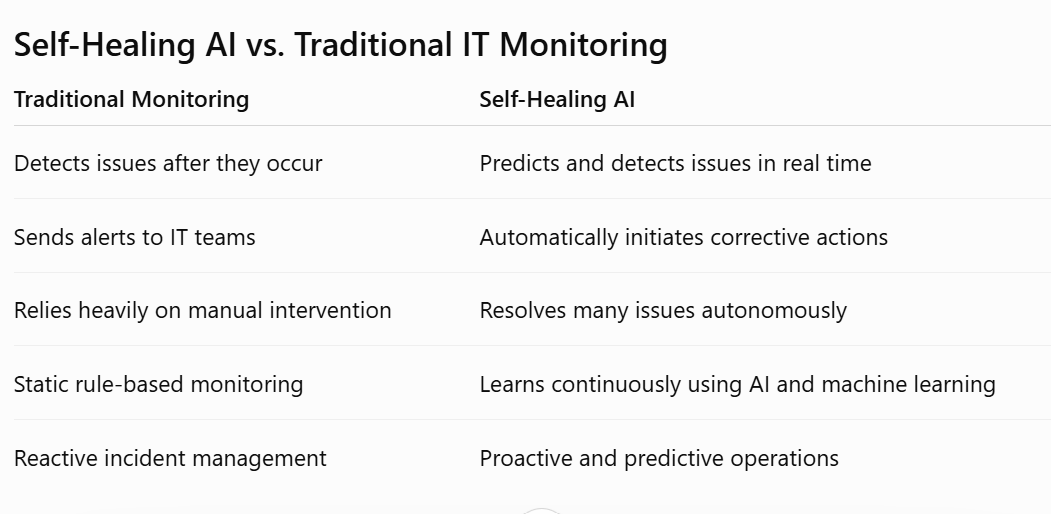
As enterprise environments become increasingly distributed and data-intensive, the ability to move from reactive monitoring to autonomous operations is becoming a critical competitive advantage.
Self-healing AI is not simply another automation tool—it represents the next evolution of intelligent IT operations, where systems can monitor, adapt, recover, and optimize themselves with minimal human involvement.
.png)
For years, businesses have relied on monitoring tools to keep applications, networks, and infrastructure running smoothly. These platforms collect logs, generate alerts, and notify IT teams whenever system performance falls below predefined thresholds.
While this approach has served organizations well, today's enterprise environments have become far more complex than traditional monitoring solutions were designed to handle.
Modern businesses operate across hybrid cloud environments, distributed applications, microservices, containers, APIs, edge devices, and increasingly AI-powered workloads. Each component generates thousands of operational events every minute, creating an overwhelming volume of alerts for IT teams to manage.
The result is a growing gap between detecting problems and resolving them efficiently.
Instead of preventing disruptions, many organizations spend valuable time reacting to incidents after they have already impacted business operations.
Traditional monitoring platforms are designed to notify teams when something goes wrong—but notifications alone don't solve problems.
This reactive approach introduces several operational challenges:
Large enterprises can generate thousands of monitoring alerts every day. Many of these alerts are repetitive, low-priority, or false positives, making it increasingly difficult for IT teams to identify genuine business-critical incidents.
As alert volumes continue to rise, engineers spend more time filtering notifications than solving high-impact issues.
Once an issue is detected, teams must manually investigate logs, analyze infrastructure dependencies, identify the root cause, and determine the appropriate corrective action.
This process can take minutes—or even hours—depending on the complexity of the environment.
For customer-facing applications, every additional minute of downtime can translate into lost revenue, reduced productivity, and diminished customer trust.
Digital transformation has fundamentally changed enterprise architecture.
Applications are no longer hosted on a single server or data center. Instead, they operate across multiple cloud providers, containerized environments, Kubernetes clusters, SaaS platforms, and third-party integrations.
Managing this interconnected ecosystem manually has become increasingly difficult.
Without intelligent automation, even experienced operations teams struggle to maintain complete visibility across distributed environments.
Cyber threats continue to evolve in both sophistication and frequency.
Traditional monitoring tools can detect suspicious activity, but they often depend on security teams to investigate incidents and apply remediation manually.
The longer vulnerabilities remain unresolved, the greater the risk of data breaches, compliance violations, and operational disruption.
Organizations need systems capable of responding at machine speed—not human speed.
Self-healing AI addresses these challenges by fundamentally changing how enterprise systems respond to operational issues.
Instead of simply generating alerts, intelligent systems continuously monitor performance, identify anomalies, determine the underlying cause, and automatically execute corrective actions before users experience significant disruption.
This shift enables organizations to move from reactive IT management to autonomous operations, where AI works alongside IT teams to maintain system health around the clock.
Rather than replacing engineers, self-healing AI empowers them to focus on strategic initiatives such as innovation, architecture modernization, and digital transformation, while repetitive operational tasks are handled automatically.
As enterprise environments continue to grow in scale and complexity, autonomous operations are becoming less of a competitive advantage—and more of a business necessity.
The challenge facing modern enterprises isn't a lack of monitoring tools—it's the growing inability to respond to increasing system complexity at the speed the business demands.
Self-healing AI bridges this gap by transforming monitoring from a passive alerting mechanism into an intelligent, autonomous capability that keeps critical systems resilient, secure, and continuously available.
.png)
Self-healing AI is no longer confined to research labs or experimental projects. Enterprises across industries are embedding autonomous intelligence into their IT operations to improve system reliability, minimize downtime, and enhance operational resilience.
As organizations accelerate digital transformation, self-healing AI is becoming a foundational capability that enables systems to detect, respond to, and recover from disruptions with minimal human intervention.
Here are five areas where the technology is already making a significant impact.
Modern enterprises depend on highly distributed cloud environments that span multiple regions, providers, and services. Managing these environments manually has become increasingly difficult as workloads scale and infrastructure grows more complex.
Self-healing AI enables cloud platforms to continuously monitor system health, identify abnormal behavior, and automatically execute corrective actions before service disruptions occur.
Common use cases include:
By automating routine operational tasks, organizations can significantly reduce downtime while improving service availability.
Cyberattacks are becoming faster, more sophisticated, and increasingly automated. Traditional security operations often rely on analysts to investigate alerts manually—a process that may take valuable minutes or even hours.
Self-healing AI introduces autonomous security capabilities by continuously monitoring network behavior, identifying suspicious activity, and initiating immediate response actions.
Examples include:
Instead of simply detecting threats, intelligent security systems actively contain incidents before they escalate into major breaches.
Manufacturing environments rely heavily on uninterrupted production. Unexpected equipment failures can halt operations, disrupt supply chains, and result in significant financial losses.
Self-healing AI enables predictive maintenance by continuously analyzing machine performance through IoT sensors and operational data.
This allows manufacturers to:
As smart factories continue to evolve, self-healing AI is helping organizations improve productivity while reducing maintenance costs.
Banks and financial institutions process millions of transactions every day, where even brief service interruptions can affect customer trust and regulatory compliance.
Self-healing AI enhances operational resilience by continuously monitoring transaction systems, payment gateways, APIs, and digital banking platforms.
Key applications include:
For financial institutions, maintaining uninterrupted digital services is essential—and self-healing AI helps ensure those services remain resilient.
Healthcare organizations increasingly depend on digital platforms for patient care, diagnostics, electronic health records (EHRs), and connected medical devices.
System failures can directly affect patient safety, making reliability a top priority.
Self-healing AI helps healthcare providers by:
By reducing downtime and improving system reliability, healthcare organizations can focus more on delivering quality patient care while minimizing operational disruptions.
Although these industries operate in very different environments, they all face the same underlying challenge: keeping increasingly complex digital systems available, secure, and resilient.
Self-healing AI addresses this challenge by shifting organizations from reactive problem-solving to proactive, autonomous operations. Instead of waiting for failures to occur, intelligent systems continuously monitor their environment, anticipate issues, and take corrective action before business performance is affected.
As AI capabilities continue to mature, self-healing systems are expected to become a standard component of enterprise infrastructure—helping organizations improve operational efficiency, strengthen resilience, and free IT teams to focus on innovation rather than routine maintenance.
Rather than simply stating that self-healing AI reduces downtime or saves costs, this section demonstrates how organizations across multiple industries are applying the technology today. It keeps the discussion practical, business-focused, and aligned with the interests of enterprise leaders evaluating AI-driven operational transformation.
The value of self-healing AI extends far beyond automatically fixing system failures. For modern enterprises, it represents a strategic shift toward intelligent, autonomous operations that improve business continuity, strengthen security, and enable IT teams to focus on innovation instead of repetitive maintenance.
As organizations continue to modernize their digital ecosystems, self-healing AI is emerging as a key driver of operational excellence and long-term business resilience.
Here are some of the most significant business benefits.
Business continuity depends on systems remaining available even when unexpected issues arise.
Self-healing AI continuously monitors infrastructure, identifies anomalies in real time, and executes corrective actions before they escalate into major incidents. This proactive approach helps organizations maintain high availability across mission-critical applications and services.
Instead of reacting to outages, businesses can prevent many disruptions before they affect customers or operations.
Manual incident management consumes valuable engineering time and increases operational expenses.
By automating repetitive troubleshooting tasks, organizations can reduce the need for manual intervention while improving overall efficiency.
Self-healing AI helps lower costs by:
The result is a more efficient IT operation capable of supporting business growth without proportionally increasing operational overhead.
Cyber threats evolve faster than traditional response processes.
Self-healing AI strengthens security by continuously monitoring systems for suspicious activity, detecting vulnerabilities, and initiating predefined remediation workflows automatically.
These capabilities may include:
By responding at machine speed, organizations can significantly improve their overall security posture.
For digital businesses, system availability directly impacts customer satisfaction.
Whether it's an online banking platform, an e-commerce website, a healthcare portal, or a SaaS application, users expect seamless experiences with minimal interruptions.
Self-healing AI helps maintain consistent service availability by resolving many issues before customers even become aware of them.
This translates into:
Reliable systems ultimately contribute to stronger customer retention and improved business outcomes.
As businesses expand, their technology environments become increasingly complex.
Managing larger infrastructures manually is neither practical nor sustainable.
Self-healing AI enables organizations to scale confidently by automatically adapting to changing workloads, infrastructure demands, and operational conditions without requiring constant human oversight.
This allows enterprises to support business growth while maintaining operational efficiency.
One of the greatest advantages of self-healing AI is not replacing IT professionals—but enabling them to work more strategically.
Instead of spending valuable hours investigating routine alerts and performing repetitive maintenance tasks, engineering teams can focus on initiatives that create long-term business value, such as:
By automating operational complexity, organizations unlock the full potential of their technical talent.
Self-healing AI is more than an automation capability—it's a strategic investment in operational resilience, business continuity, and enterprise agility.
Organizations adopting self-healing technologies aren't simply reducing downtime; they're building intelligent systems that continuously monitor, adapt, recover, and improve. As digital ecosystems become increasingly complex, these autonomous capabilities will play a critical role in helping businesses remain secure, scalable, and competitive.
While self-healing AI offers significant opportunities to improve operational resilience and reduce manual intervention, successful implementation requires more than deploying AI-powered automation tools.
Organizations must establish the right technology foundation, governance frameworks, and operational strategies to fully realize the benefits of autonomous systems.
Here are some of the key considerations enterprises should evaluate before adopting self-healing AI.
Many organizations continue to operate a mix of legacy systems alongside modern cloud-native applications. These environments often lack standardized APIs, observability capabilities, or automation frameworks required for autonomous operations.
Integrating self-healing AI into such ecosystems can be complex and may require phased modernization rather than a complete infrastructure overhaul.
A hybrid approach that combines existing systems with modern AI-driven operations often delivers the most practical path forward.
Self-healing AI relies heavily on accurate, real-time operational data.
Incomplete logs, inconsistent monitoring practices, or fragmented data sources can reduce the effectiveness of AI models, leading to inaccurate diagnoses or ineffective remediation.
Organizations should invest in comprehensive observability by unifying logs, metrics, traces, and infrastructure telemetry to provide AI systems with the visibility needed for reliable decision-making.
Simply put, better data leads to better autonomous decisions.
For many organizations, one of the biggest challenges isn't the technology itself—it's trusting AI to take corrective actions without human approval.
Enterprises must establish governance policies that define:
Human oversight remains essential, particularly in highly regulated industries such as healthcare, banking, and government.
The goal isn't to eliminate human expertise but to augment it with intelligent automation.
As self-healing AI gains greater control over enterprise infrastructure, organizations must ensure that automation aligns with security and regulatory requirements.
Every automated action should be:
Strong governance helps organizations balance automation with accountability.
Adopting self-healing AI is not solely a technology initiative—it also requires cultural and organizational transformation.
IT teams need expertise in areas such as:
Upskilling existing teams and fostering collaboration across operations, security, and development functions are essential for long-term success.
Organizations that invest in both technology and talent are better positioned to maximize the value of autonomous operations.
Rather than attempting enterprise-wide deployment from day one, successful organizations typically begin with targeted use cases where the business impact is both measurable and immediate.
Examples include:
These early successes help build organizational confidence while creating a foundation for broader adoption across the enterprise.
Self-healing AI represents a significant step toward autonomous enterprise operations, but its success depends on thoughtful implementation rather than technology alone.
Organizations that combine modern infrastructure, high-quality operational data, robust governance, and skilled teams will be best positioned to unlock the full potential of self-healing AI.
As enterprise environments continue to grow in complexity, the question is no longer whether autonomous systems will become part of IT operations—but how quickly organizations can prepare to adopt them responsibly and effectively.
Artificial intelligence has already transformed how organizations analyze data, automate workflows, and make business decisions. The next phase of this evolution is moving beyond automation toward autonomous enterprise operations—where systems not only identify problems but also adapt, optimize, and recover with minimal human involvement.
Self-healing AI is expected to play a central role in this transformation.
As enterprises continue to embrace cloud-native architectures, edge computing, artificial intelligence, and hyperautomation, intelligent systems will increasingly become capable of managing their own health, performance, and security in real time.
While fully autonomous enterprises are still evolving, the building blocks are already taking shape.
Modern IT operations are shifting away from reactive incident management toward intelligent operational ecosystems.
Future AI systems will not only resolve incidents automatically but also anticipate infrastructure bottlenecks, optimize workloads, rebalance resources, and continuously improve system performance without waiting for human intervention.
Instead of responding to failures, enterprise infrastructure will increasingly prevent them.
Cybersecurity is becoming one of the most promising applications of self-healing AI.
Future security platforms are expected to move beyond traditional threat detection by autonomously:
This continuous adaptation will help organizations strengthen cyber resilience while reducing response times from hours to seconds.
As billions of connected devices become part of enterprise ecosystems, managing them manually will become increasingly impractical.
From manufacturing facilities and smart cities to connected healthcare devices and autonomous vehicles, edge environments require intelligent systems capable of operating with minimal human supervision.
Self-healing AI will enable edge devices to:
This capability will be essential for industries where uninterrupted operations directly impact safety, productivity, and customer experience.
Organizations are increasingly adopting digital twins—virtual representations of physical assets, systems, or processes—to simulate performance and predict future outcomes.
When combined with self-healing AI, digital twins can identify potential failures before they occur and recommend—or even execute—the most effective corrective actions automatically.
This combination enables enterprises to move from predictive maintenance to truly autonomous optimization, improving efficiency while minimizing operational risk.
Generative AI is opening new possibilities for intelligent operations.
Future self-healing systems may leverage large language models (LLMs) and AI assistants to:
Rather than replacing IT professionals, generative AI will act as an intelligent collaborator, accelerating troubleshooting and supporting faster decision-making.
The future of enterprise technology lies in systems that are not only intelligent but also adaptive, resilient, and capable of managing themselves.
Self-healing AI is a critical step toward this vision.
By combining artificial intelligence, automation, cloud computing, observability, and predictive analytics, organizations can create digital ecosystems that continuously monitor, optimize, secure, and recover without constant human oversight.
While complete autonomy will take time, businesses investing in these capabilities today are laying the foundation for more resilient, efficient, and future-ready operations.
The journey toward autonomous enterprises has already begun—and self-healing AI is at the heart of that transformation.
As digital transformation accelerates, enterprise success will increasingly depend on systems that can do more than process information—they must also understand, adapt, and improve themselves.
Self-healing AI represents more than an operational enhancement; it signals a shift toward a future where technology becomes increasingly autonomous, enabling organizations to innovate faster, respond more effectively, and build resilient businesses capable of thriving in an ever-changing digital landscape.
As enterprise environments become increasingly distributed and complex, the ability to maintain system reliability through manual intervention alone is no longer sustainable. Organizations need technology that can do more than detect problems—they need systems capable of anticipating issues, responding intelligently, and continuously improving over time.
Self-healing AI represents a significant step toward this future.
By combining artificial intelligence, machine learning, automation, predictive analytics, and observability, self-healing systems enable organizations to move beyond reactive IT operations and embrace autonomous, resilient infrastructure. The result is faster issue resolution, improved system availability, stronger cybersecurity, lower operational costs, and more productive IT teams.
While the journey toward fully autonomous enterprises is still evolving, businesses don't need to wait for the technology to mature completely. Many organizations are already implementing self-healing capabilities within cloud infrastructure, cybersecurity operations, manufacturing, healthcare, and financial services—delivering measurable business value today while preparing for tomorrow.
For enterprise leaders, the opportunity is clear: start with focused use cases, build a strong foundation of observability and automation, and scale intelligent operations strategically. Those who invest early will be better positioned to innovate, adapt, and compete in an increasingly digital economy.
The future of enterprise technology isn't simply automated—it's intelligent, adaptive, and capable of healing itself.
At Proso AI, we help organizations transform emerging technologies into measurable business outcomes. From Artificial Intelligence and Intelligent Automation to Cloud, Data Engineering, Enterprise Applications, and Digital Transformation, we work with businesses to build secure, scalable, and future-ready technology ecosystems.
Whether you're modernizing legacy infrastructure, implementing AI-powered automation, or exploring next-generation innovations like self-healing AI, our experts can help you identify high-impact opportunities and develop solutions aligned with your business objectives.
Innovation isn't just about adopting new technologies—it's about applying them strategically to create long-term value.
A self-healing AI system is an intelligent software platform that can automatically monitor, detect, diagnose, and resolve software or infrastructure issues without requiring manual intervention. It continuously learns from past incidents to improve future performance and reliability.
Self-healing AI is being adopted across multiple industries, including:
Any organization operating complex digital infrastructure can benefit from autonomous monitoring and remediation.
Traditional monitoring tools primarily detect issues and generate alerts for IT teams. Self-healing AI goes a step further by identifying root causes, initiating automated corrective actions, and continuously learning from incidents to improve future responses.
No. Self-healing AI is designed to augment—not replace—IT teams. By automating repetitive operational tasks, it allows engineers to focus on strategic initiatives such as innovation, infrastructure modernization, security, and digital transformation.
Not at all. While large enterprises often lead adoption, cloud-based AI platforms and automation tools have made self-healing capabilities increasingly accessible to mid-sized organizations as well. Businesses can start with targeted use cases and expand as their digital operations grow.
A practical approach includes:
Ready to build more resilient, intelligent, and autonomous digital operations?
Whether you're exploring AI adoption, cloud modernization, intelligent automation, or emerging technologies like self-healing AI, Proso AI can help you accelerate your digital transformation journey with enterprise-grade expertise and innovative solutions.
Have questions or want to discuss your next AI initiative? We'd love to hear from you.
📩 Reach out to us at: info@proso.ai

.jpg)

.png)
.png)