.png)
The way enterprises build technology teams has changed dramatically.
A single digital transformation initiative today rarely depends on full-time employees alone. Modern projects bring together software engineers, cloud architects, implementation partners, freelancers, consultants, managed service providers, and specialized vendors—all working toward a common business objective.
While this blended workforce provides access to broader expertise and greater flexibility, it also introduces a new level of operational complexity.
Many organizations continue to manage workforce planning through disconnected HR systems, spreadsheets, email approvals, and static resource plans that quickly become outdated. Project managers often struggle to identify available skills, HR teams lack visibility into contractor utilization, and business leaders find it difficult to balance workforce costs against changing project demands.
The result is delayed hiring decisions, underutilized talent, unnecessary contractor costs, and project bottlenecks that slow business growth.
The challenge isn't simply finding more talent.
It's knowing who is available, where the skills exist, and how to allocate the right people at the right time.
As enterprises accelerate cloud adoption, AI initiatives, and global technology programs, workforce management must become more dynamic. Organizations need the ability to view employees, freelancers, vendors, and consultants as part of one connected workforce—not separate groups managed through isolated systems.
This shift is driving the adoption of hybrid staffing platforms that combine workforce intelligence, real-time resource visibility, and enterprise integrations to help organizations make faster, data-driven staffing decisions.
Rather than reacting to staffing shortages after they occur, enterprises can proactively forecast resource needs, optimize workforce utilization, and build agile teams capable of responding to changing business priorities with confidence.

The modern enterprise workforce is no longer made up of full-time employees alone. Organizations increasingly rely on a blend of permanent staff, freelancers, consulting partners, contractors, and specialized vendors to execute digital transformation initiatives, accelerate product development, and deliver customer projects.
Managing this diverse workforce through disconnected systems creates unnecessary complexity. Teams struggle to track availability, match the right skills to business needs, monitor utilization, and coordinate collaboration across multiple platforms.
A hybrid staffing platform brings all these workforce segments together into one connected ecosystem.
Instead of managing employees in one system, contractors in spreadsheets, vendors through procurement tools, and freelancers across multiple marketplaces, organizations gain a unified platform that provides complete visibility into workforce availability, skills, utilization, project assignments, and business performance.
By integrating with enterprise applications such as Workday, collaboration platforms like Microsoft Teams and Slack, and project management tools including Jira and Asana, hybrid staffing platforms eliminate manual coordination and enable organizations to make workforce decisions based on real-time data.
The result is a more agile workforce where employees and external talent collaborate seamlessly, managers gain instant visibility into capacity and skills, and business leaders can respond quickly to changing priorities without disrupting delivery.
Hybrid staffing is no longer simply a hiring strategy—it's a workforce operating model designed for enterprises that need flexibility, speed, and continuous innovation.
View employees, freelancers, vendors, and consultants from a single platform instead of managing multiple disconnected systems.
Track workforce availability, utilization, skill distribution, project assignments, and capacity through live dashboards that support faster planning.
Assign the right people to the right projects based on skills, availability, certifications, location, and business priorities.
Connect workforce planning with Workday, Microsoft Teams, Slack, Jira, Asana, ERP platforms, and business applications to create seamless operational workflows.
Whether expanding engineering teams, supporting global client engagements, or delivering enterprise implementations, organizations can scale resources quickly while maintaining governance and visibility.
Organizations embracing hybrid workforce models are achieving measurable business benefits:

The way organizations deliver technology projects has fundamentally changed.
Today's enterprises are launching cloud migrations, AI initiatives, ERP implementations, cybersecurity programs, and digital transformation projects at an unprecedented pace. These initiatives require specialized expertise that often cannot be sourced through traditional hiring alone.
As a result, organizations are increasingly building hybrid workforces—combining full-time employees with freelancers, contractors, consulting partners, and managed service providers to create agile, project-ready teams.
This shift isn't driven solely by talent shortages. It reflects a broader need for workforce flexibility, faster execution, and smarter resource utilization.
Traditional staffing models were designed around fixed headcount planning and long-term hiring cycles. While effective for stable operations, they struggle to support modern enterprises where project priorities change rapidly, specialized skills are needed on demand, and distributed teams have become the norm.
Hybrid workforce models solve this challenge by giving organizations the flexibility to scale resources up or down based on business needs while maintaining operational visibility and governance. Instead of waiting months to recruit niche talent, businesses can access specialized expertise when projects demand it, integrate external professionals into existing workflows, and deliver outcomes without disrupting internal teams.
More importantly, hybrid staffing enables enterprises to optimize workforce utilization. Internal employees can focus on strategic initiatives while external specialists contribute targeted expertise, helping organizations accelerate delivery without permanently increasing headcount.
For enterprise leaders, hybrid staffing is no longer just a hiring strategy—it has become a competitive advantage that enables faster innovation, greater resilience, and more efficient workforce planning.
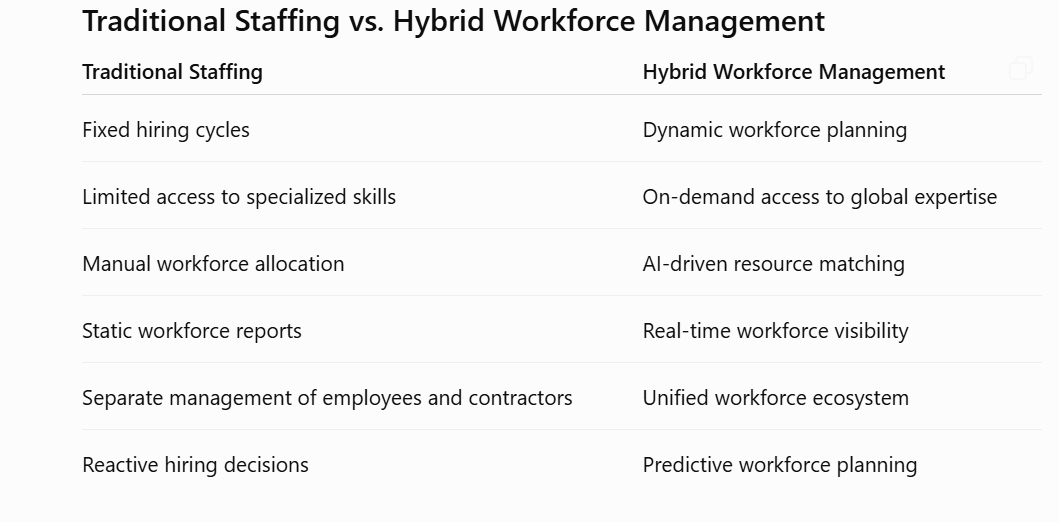
Organizations adopting hybrid workforce models are experiencing measurable advantages:
Enterprise Insight:
The most successful organizations are no longer asking, "How many people should we hire?" They're asking, "How can we build the right team for every project?"
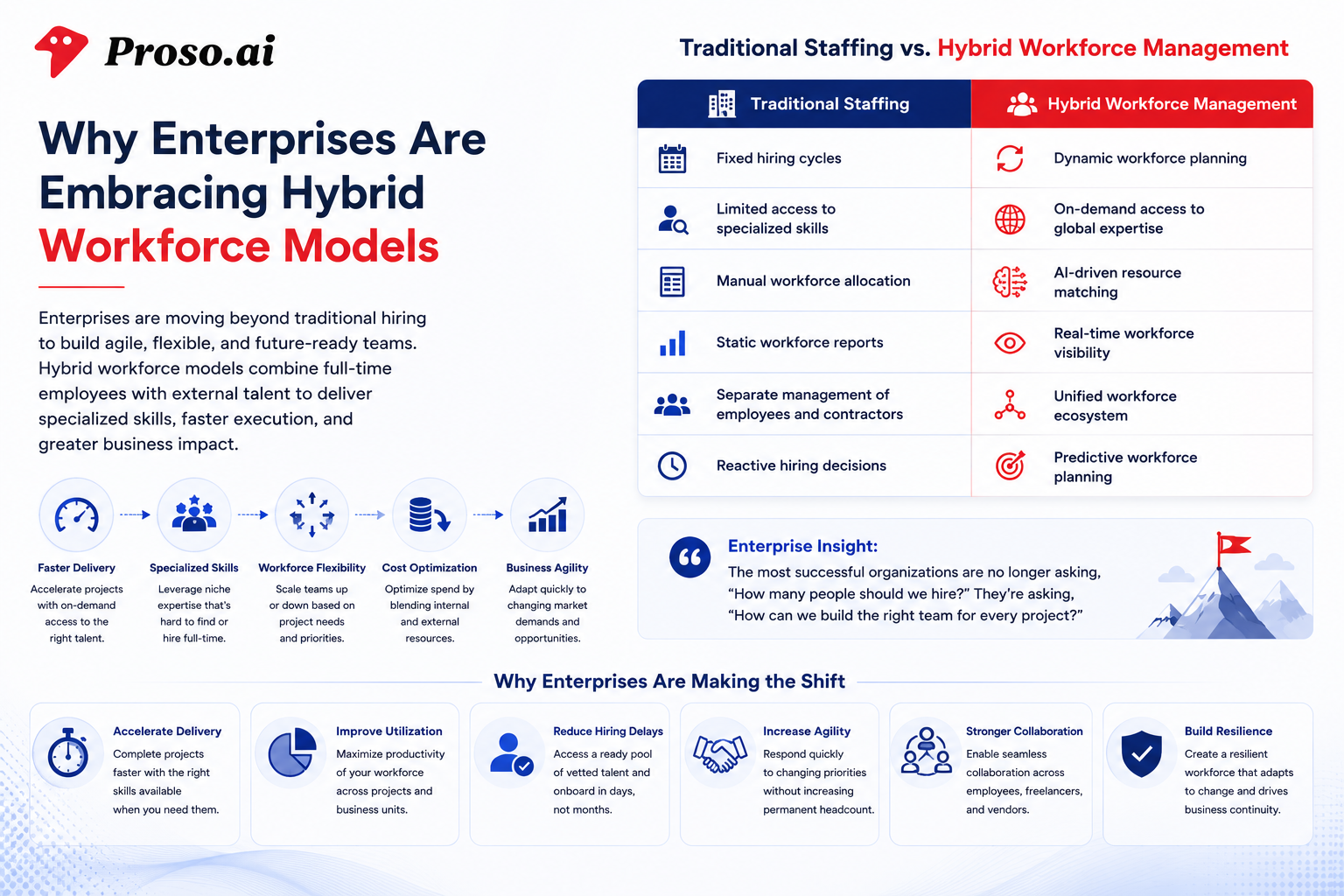
Enterprise workforce decisions are only as effective as the data behind them.
Many organizations still rely on historical reports, disconnected spreadsheets, and manual resource planning to make staffing decisions. By the time those reports reach decision-makers, workforce availability, project priorities, and business demands have already changed.
Modern enterprises require workforce intelligence that operates in real time.
This is where Workday transforms workforce management.
As a leading Human Capital Management (HCM) platform, Workday provides organizations with a centralized view of employees, contingent workers, contractors, skills, availability, utilization, and workforce capacity. Instead of relying on assumptions, business leaders gain access to live workforce insights that support faster, more informed staffing decisions.
However, implementing Workday is only the first step.
Unlocking its full business value requires seamless integration with project management platforms, collaboration tools, vendor ecosystems, and workforce marketplaces. That's where Proso AI helps organizations move beyond implementation to create a connected workforce ecosystem.
By integrating Workday with platforms such as Jira, Microsoft Teams, Slack, Asana, and enterprise staffing solutions, Proso AI enables organizations to automate workforce planning, improve resource allocation, and connect internal employees with external talent—all from a unified operational framework.
Instead of reacting to staffing shortages, enterprises can forecast workforce demand, identify skill gaps before they affect delivery, optimize utilization, and scale project teams with confidence.
Workforce intelligence is no longer about reporting what happened yesterday.
It's about giving leaders the insights they need to make smarter workforce decisions today.
Gain a real-time view of workforce availability, skills, certifications, utilization, and project assignments across employees, contractors, and external partners.
Use intelligent analytics to anticipate resource demand, identify future skill gaps, and plan hiring before delivery risks emerge.
Integrate Workday with Jira, Microsoft Teams, Slack, Asana, ERP platforms, and workforce marketplaces to eliminate operational silos.
Match the right people to the right projects using skills, availability, certifications, location, and business priorities.
Support enterprise growth with automated workforce planning, streamlined onboarding, and centralized governance across global teams.
Organizations leveraging Workday with Proso AI can:
Enterprise Insight:
Workday provides the workforce intelligence. Proso AI transforms that intelligence into connected, scalable workforce operations.
Hybrid staffing isn't simply changing how organizations hire talent—it's transforming how enterprises execute projects, respond to market demands, and build resilient delivery teams.
As technology initiatives become increasingly complex, organizations need workforce models that are flexible enough to scale with business priorities while maintaining visibility, governance, and operational efficiency.
Hybrid staffing platforms make this possible by creating a connected workforce ecosystem where employees, contractors, freelancers, consulting partners, and vendors work together through unified processes rather than disconnected systems.
Instead of managing multiple hiring channels, resource spreadsheets, and fragmented communication tools, enterprises gain one centralized view of workforce capacity, skills, project allocation, and resource utilization.
This enables leaders to make faster staffing decisions, optimize workforce investments, and ensure the right expertise is available exactly when it's needed.
Beyond improving workforce planning, hybrid staffing also enhances collaboration across departments. HR teams gain better visibility into talent availability, project managers can allocate resources more effectively, finance teams gain greater control over workforce costs, and business leaders receive real-time insights into delivery capacity.
The result is a workforce strategy built for agility rather than administration.
Organizations spend less time coordinating resources and more time delivering business outcomes.
Quickly assemble project teams using a mix of internal employees and external specialists, reducing delays caused by lengthy hiring cycles.
Maximize the value of existing talent by matching people to projects based on skills, availability, certifications, and business priorities.
Scale teams up or down as project requirements evolve without permanently increasing operational costs.
Create a unified working environment where employees, vendors, consultants, and freelancers collaborate through standardized processes.
Optimize staffing investments by balancing permanent hiring with specialized project-based expertise.
Respond faster to changing customer demands, market conditions, and technology initiatives with a workforce that can adapt in real time.
Organizations embracing hybrid staffing platforms are able to:
Enterprise Insight:
The future of workforce management isn't about choosing between employees and freelancers. It's about building one intelligent workforce that combines the strengths of both.
Workforce intelligence is only as valuable as the platform that powers it.
As enterprises adopt hybrid workforce models, they need more than visibility into employees and projects. They require a centralized system capable of connecting workforce data, business processes, and operational insights into a single source of truth.
This is where Workday plays a transformative role.
Workday's Human Capital Management (HCM) platform enables organizations to manage employees, contingent workers, skills, organizational structures, workforce availability, and talent data from one unified environment. Rather than relying on disconnected systems and manual reporting, leaders gain access to real-time workforce intelligence that supports faster, more informed business decisions.
However, modern workforce management extends beyond HR.
Project delivery depends on collaboration between HR teams, project managers, finance, operations, procurement, and external partners. Workforce data must flow seamlessly across the enterprise to ensure the right people are assigned to the right projects at the right time.
Through intelligent integrations, Workday becomes the operational foundation that connects workforce planning with project execution, enabling organizations to respond quickly to changing priorities while maintaining governance and compliance.
Instead of simply tracking employees, Workday empowers enterprises to build a workforce strategy that is agile, data-driven, and aligned with business outcomes.
Manage employees, contractors, consultants, and contingent workers through a centralized workforce platform with complete visibility into skills, availability, utilization, and organizational capacity.
Leverage real-time workforce data to forecast staffing requirements, identify skill shortages, and proactively plan future hiring based on business demand.
Reduce manual administrative effort by automating workforce processes such as onboarding, approvals, organizational updates, workforce reporting, and talent management workflows.
Connect workforce planning with project execution, enabling HR, operations, finance, and delivery teams to make informed staffing decisions using shared, real-time data.
Maintain consistent governance, compliance, workforce policies, and auditability while supporting distributed teams across multiple business units and global locations.
Organizations investing in Workday gain the ability to:
Enterprise Insight:
Workday doesn't just help organizations manage people—it helps them manage workforce strategy with intelligence, agility, and confidence.
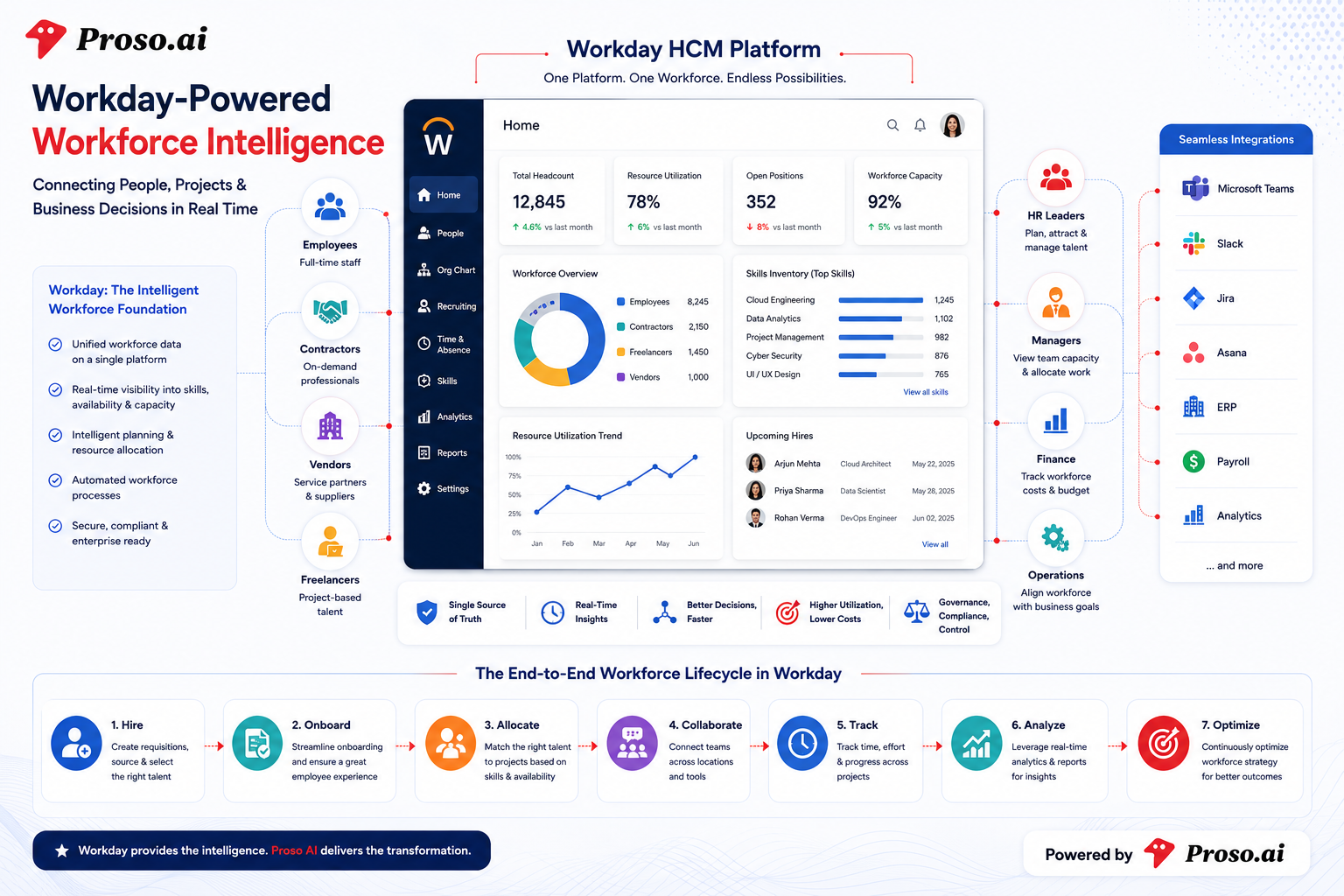
Hiring the right people is only the beginning of workforce management.
Once employees, contractors, or contingent workers join an organization, businesses must ensure they are onboarded efficiently, assigned to the right projects, equipped with the right skills, and continuously supported throughout their journey. Managing these processes across multiple departments and systems can quickly become complex, particularly for enterprises operating at scale.
Workday simplifies this complexity by bringing the entire workforce lifecycle into a single intelligent platform.
Rather than treating recruitment, onboarding, workforce planning, learning, performance, payroll, and analytics as separate functions, Workday connects them through a unified Human Capital Management (HCM) ecosystem. Every workforce event becomes part of a connected process, allowing data to flow seamlessly across HR, finance, operations, and business leadership.
This integrated approach ensures that decisions made during hiring continue to deliver value long after an employee joins the organization.
Every hiring decision starts with workforce planning.
Using organizational goals, budget forecasts, project demand, and existing workforce capacity, HR leaders and business managers can identify talent requirements before resource shortages occur. Workday enables organizations to create and approve hiring requisitions through standardized workflows, ensuring every recruitment decision aligns with business priorities.
Business Benefit: Strategic hiring replaces reactive recruitment.
Once a position is approved, recruiters can publish job openings, manage candidates, schedule interviews, collaborate with hiring managers, and monitor recruitment progress from a centralized workspace.
Candidate information remains connected throughout the hiring process, eliminating duplicate data entry and improving collaboration between recruiters and business leaders.
Business Benefit: Faster hiring with greater visibility across the recruitment pipeline.
After a candidate accepts an offer, Workday automates the onboarding experience.
New hires can complete documentation, upload required information, review company policies, and access onboarding tasks before their first day. Managers receive automated checklists for equipment requests, team introductions, training assignments, and role-specific activities.
Instead of relying on emails and spreadsheets, onboarding becomes a structured digital workflow.
Business Benefit: Improved employee experience and faster productivity.
Modern organizations need more than employee records—they need a clear understanding of workforce capabilities.
Workday maintains comprehensive talent profiles that include skills, certifications, experience, career interests, learning history, and performance insights. This allows managers to identify internal talent for future projects, succession planning, and leadership development.
Rather than searching for talent externally, organizations can often uncover expertise already within their workforce.
Business Benefit: Better utilization of existing talent while reducing unnecessary hiring.
As business priorities evolve, project managers need confidence that the right people are assigned to the right initiatives.
Workday provides visibility into workforce availability, organizational structures, skills, and capacity, enabling informed staffing decisions based on current business needs rather than assumptions.
This helps enterprises balance workloads, reduce resource conflicts, and align workforce investments with strategic objectives.
Business Benefit: Higher workforce utilization and improved project delivery.
Workforce management doesn't end with project allocation.
Organizations must continuously develop employees, measure performance, and prepare future leaders.
Workday brings together goal management, continuous feedback, performance reviews, learning programs, and career development into one connected experience, enabling employees to grow while helping organizations build critical capabilities for the future.
Business Benefit: Stronger employee engagement and a workforce prepared for long-term business growth.
Every stage of the workforce lifecycle generates valuable business data.
Workday consolidates this information into interactive dashboards and reports, allowing executives, HR leaders, and managers to monitor workforce trends, hiring performance, utilization, retention, organizational health, and future workforce requirements.
Instead of relying on historical reports, organizations gain real-time insights that support proactive workforce planning.
Business Benefit: Data-driven workforce decisions that improve agility and business performance.
A connected workforce lifecycle eliminates fragmented processes and creates a continuous flow of information from hiring through long-term employee development.
With every workforce process connected, organizations can:
Enterprise Insight:
The most successful organizations don't manage hiring, onboarding, learning, and performance as separate activities. They connect every stage of the workforce lifecycle to build a more agile, productive, and future-ready workforce.
One of Workday's biggest strengths is that it isn't built for a single department.
Unlike traditional HR systems that primarily serve human resources, Workday is designed as an enterprise platform where HR, finance, managers, executives, recruiters, employees, and IT teams work from the same trusted source of workforce data.
Every user sees a personalized dashboard based on their responsibilities, ensuring they have quick access to the information, approvals, reports, and actions that matter most to their role.
This role-based experience simplifies workforce management while improving collaboration across the organization.
For HR professionals, Workday acts as the command center for workforce management.
From a single dashboard, HR teams can monitor:
Instead of navigating multiple HR applications, recruiters, HR business partners, and talent managers work within one connected platform.
Interactive dashboards provide real-time visibility into workforce trends, enabling HR leaders to make proactive hiring and talent decisions rather than relying on static monthly reports.
Key Outcome: Better workforce planning with greater organizational visibility.
Project managers and department leaders require immediate access to workforce capacity.
Within Workday, managers can:
Rather than requesting multiple reports from HR, managers gain immediate visibility into their teams, allowing faster operational decisions.
This reduces project delays and improves workforce utilization across departments.
Key Outcome: Faster staffing decisions supported by real-time workforce insights.
Employees interact with Workday through an intuitive self-service portal available across desktop and mobile devices.
From a personalized homepage, employees can:
Giving employees direct access to these services reduces administrative work for HR while improving the overall employee experience.
Instead of waiting for manual approvals or email responses, routine workforce processes become faster and more transparent.
Key Outcome: Increased employee engagement and reduced administrative overhead.
Executives require more than operational reports—they need strategic insights that connect workforce decisions to business outcomes.
Workday's executive dashboards consolidate key workforce metrics into clear, visual reports, helping leadership monitor:
These insights help leadership align workforce investments with long-term business objectives, ensuring talent strategies support organizational growth.
Key Outcome: Data-driven workforce decisions that support business transformation.
For IT leaders, Workday offers more than workforce management—it provides a secure and extensible enterprise platform.
Organizations can integrate Workday with identity management systems, payroll solutions, ERP platforms, collaboration tools, and analytics applications, creating a connected digital workplace while maintaining governance and compliance.
Role-based permissions, audit trails, and centralized administration help ensure workforce data remains protected as organizations grow.
Key Outcome: A scalable workforce platform that integrates seamlessly into the broader enterprise technology ecosystem.
Technology adoption depends on how easily people can use it.
When HR teams, managers, employees, executives, and IT all work from the same connected platform, organizations eliminate information silos, reduce manual effort, and improve collaboration across every stage of the workforce lifecycle.
Instead of managing workforce data in disconnected systems, Workday creates a shared environment where every stakeholder has access to the information they need—when they need it.
That shared visibility leads to faster decisions, stronger governance, and a more agile organization.
Enterprise Insight:
The true value of Workday isn't just its features—it's the way it connects every stakeholder through a single, intelligent workforce platform.
Investing in Workday is an important step toward modernizing workforce management. But the true return on that investment depends on how well the platform is implemented, integrated, and aligned with your organization's unique business processes.
Many organizations deploy powerful HCM platforms but continue to face challenges such as fragmented workflows, low user adoption, disconnected enterprise applications, inconsistent reporting, and underutilized platform capabilities. As a result, they only realize a fraction of the value their technology can deliver.
That's where Proso AI makes the difference.
As a trusted digital transformation and enterprise consulting partner, Proso AI helps organizations go beyond implementation. We work alongside business leaders, HR teams, and IT departments to design workforce solutions that align technology with strategic business objectives.
Whether you're deploying Workday for the first time, expanding into new business units, integrating it with your enterprise ecosystem, or optimizing an existing environment, our consultants ensure every stage of the transformation delivers measurable business outcomes.
Rather than approaching Workday as an isolated HR platform, we help organizations build a connected workforce ecosystem where people, processes, and technology work together seamlessly.
We help organizations deploy Workday with a structured implementation strategy that aligns with business objectives, organizational policies, and future growth plans.
Our consultants configure workforce structures, security models, approval workflows, organizational hierarchies, and business processes to ensure the platform supports your operational requirements from day one.
A modern workforce platform should never operate in isolation.
Proso AI integrates Workday with ERP systems, payroll platforms, collaboration tools, finance applications, identity management solutions, analytics platforms, and third-party business applications to create a connected digital workplace.
This eliminates data silos and enables seamless information flow across the enterprise.
Technology alone doesn't improve efficiency—well-designed processes do.
We evaluate existing HR and workforce operations to identify opportunities for automation, workflow optimization, and process standardization, helping organizations reduce manual effort while improving consistency and governance.
Workforce decisions are only as strong as the insights behind them.
Proso AI develops customized dashboards, executive reports, and workforce analytics frameworks that provide leadership teams with actionable insights into hiring, retention, utilization, organizational performance, and workforce planning.
Successful digital transformation depends on people.
We support organizations with user training, change management strategies, role-based enablement, and adoption programs to ensure employees, managers, and business leaders confidently embrace new ways of working.
Business requirements continue to evolve long after implementation.
Our managed services help organizations optimize configurations, support platform updates, enhance reporting, and continuously improve workforce processes as organizational needs grow.
Organizations partner with Proso AI because we combine deep enterprise consulting expertise with practical implementation experience.
Our approach focuses on delivering long-term business value—not simply completing a software deployment.
With Proso AI, organizations gain:
The future of workforce management isn't defined by where people work—it's defined by how effectively organizations connect talent, technology, and business strategy.
As hybrid workforce models continue to evolve, enterprises need more than flexible hiring practices. They need intelligent platforms that provide real-time visibility, support data-driven decisions, and create a seamless experience for employees, managers, and business leaders alike.
Workday provides that foundation by unifying workforce data, automating core HR processes, and enabling organizations to manage the entire workforce lifecycle from a single platform.
With the right implementation partner, that foundation becomes a catalyst for transformation.
At Proso AI, we help organizations unlock the full potential of Workday through strategic consulting, seamless implementation, enterprise integration, and continuous optimization. Together, we enable businesses to build agile, connected, and future-ready workforces that are equipped to thrive in an ever-changing business landscape.
Whether you're planning a new Workday implementation, modernizing your existing HCM environment, or looking to optimize workforce operations, Proso AI can help you turn workforce management into a strategic business advantage.
Connect with Proso AI today and discover how Workday can power your next stage of workforce transformation.

.jpg)

.png)
.png)