.png)
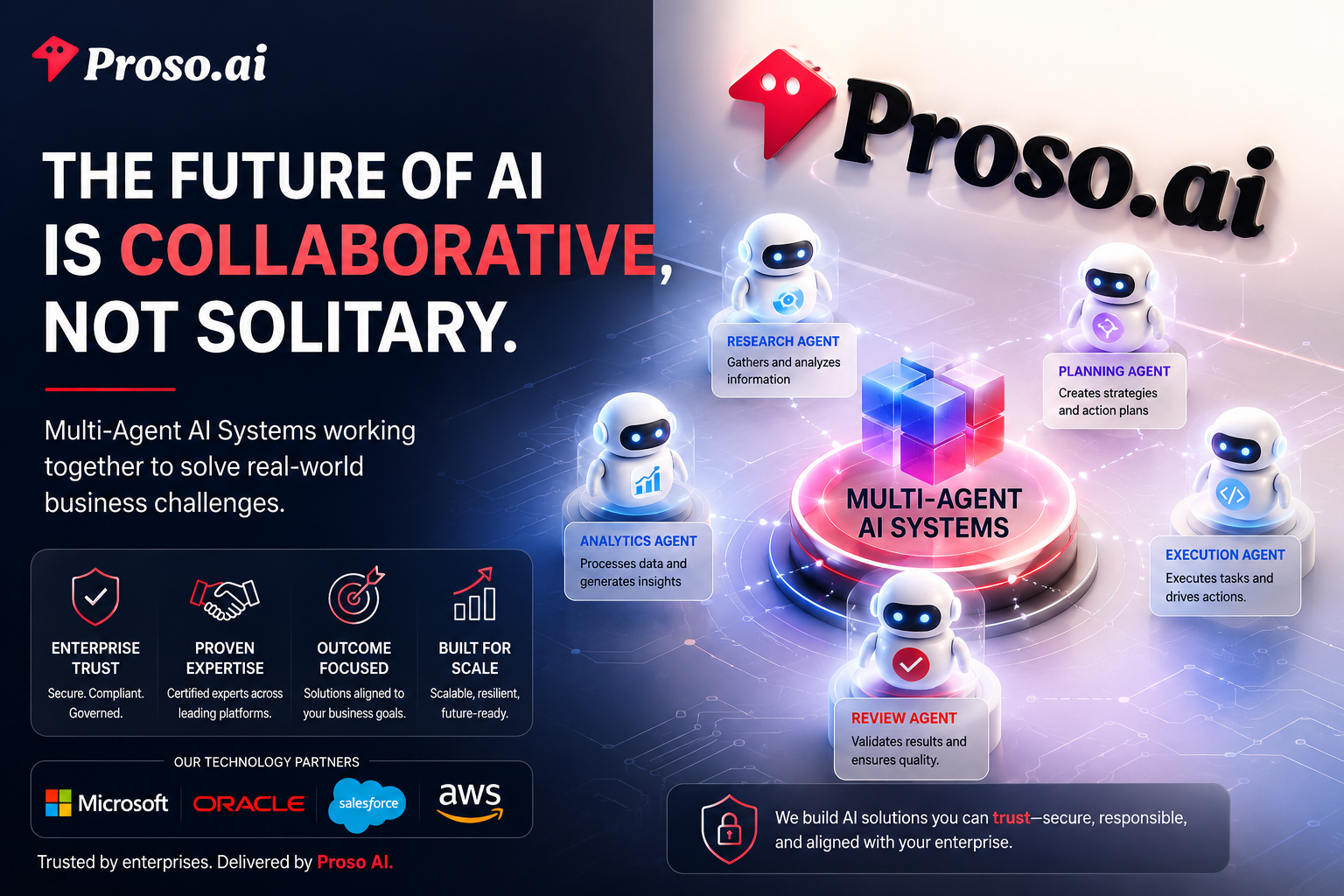
Artificial Intelligence has reached a turning point. While many organizations have successfully adopted AI for tasks like content generation, customer support, and workflow automation, enterprise leaders are beginning to realize that solving today's business challenges requires far more than a single intelligent model. As businesses scale, so do the complexities of their operations—spanning multiple teams, applications, data sources, and decision points. This is where Multi-Agent AI Systems are emerging as the next evolution of enterprise AI.
Unlike traditional AI solutions that operate independently, Multi-Agent AI Systems enable multiple specialized AI agents to collaborate, communicate, and coordinate in real time. Think of them as a high-performing team rather than a single employee—each agent is responsible for a specific task, yet together they solve complex business problems with greater speed, accuracy, and resilience. Whether it's automating customer service, optimizing supply chains, accelerating software development, or supporting strategic decision-making, this collaborative approach is reshaping how enterprises build and scale intelligent solutions.
The momentum behind this shift is impossible to ignore. Technology leaders like Microsoft, Salesforce, Oracle, and Amazon Web Services (AWS) are expanding their AI ecosystems with agent-based capabilities, orchestration frameworks, and intelligent automation designed for enterprise environments. Their investments reflect a broader industry trend: the future of AI isn't defined by a single, all-knowing model, but by interconnected systems that work together seamlessly across the business.
However, adopting Multi-Agent AI isn't simply about choosing the right framework or deploying the latest large language model. Success depends on thoughtful architecture, secure integrations, strong governance, and alignment with existing enterprise systems. Organizations need AI solutions that are scalable, compliant, and tailored to their unique operational goals—not just technically impressive.
At Proso AI, we believe technology should solve business challenges, not create new ones. With deep expertise across Microsoft, Oracle, Salesforce, cloud technologies, enterprise integration, and AI-driven transformation, we help organizations design intelligent solutions that are secure, scalable, and built for long-term value. As enterprises move from isolated AI experiments to collaborative AI ecosystems, having the right implementation and consulting partner becomes just as important as the technology itself.
In this guide, we'll explore what Multi-Agent AI Systems are, how they work, why enterprises are rapidly adopting them, and the key considerations for building AI solutions that deliver measurable business impact.
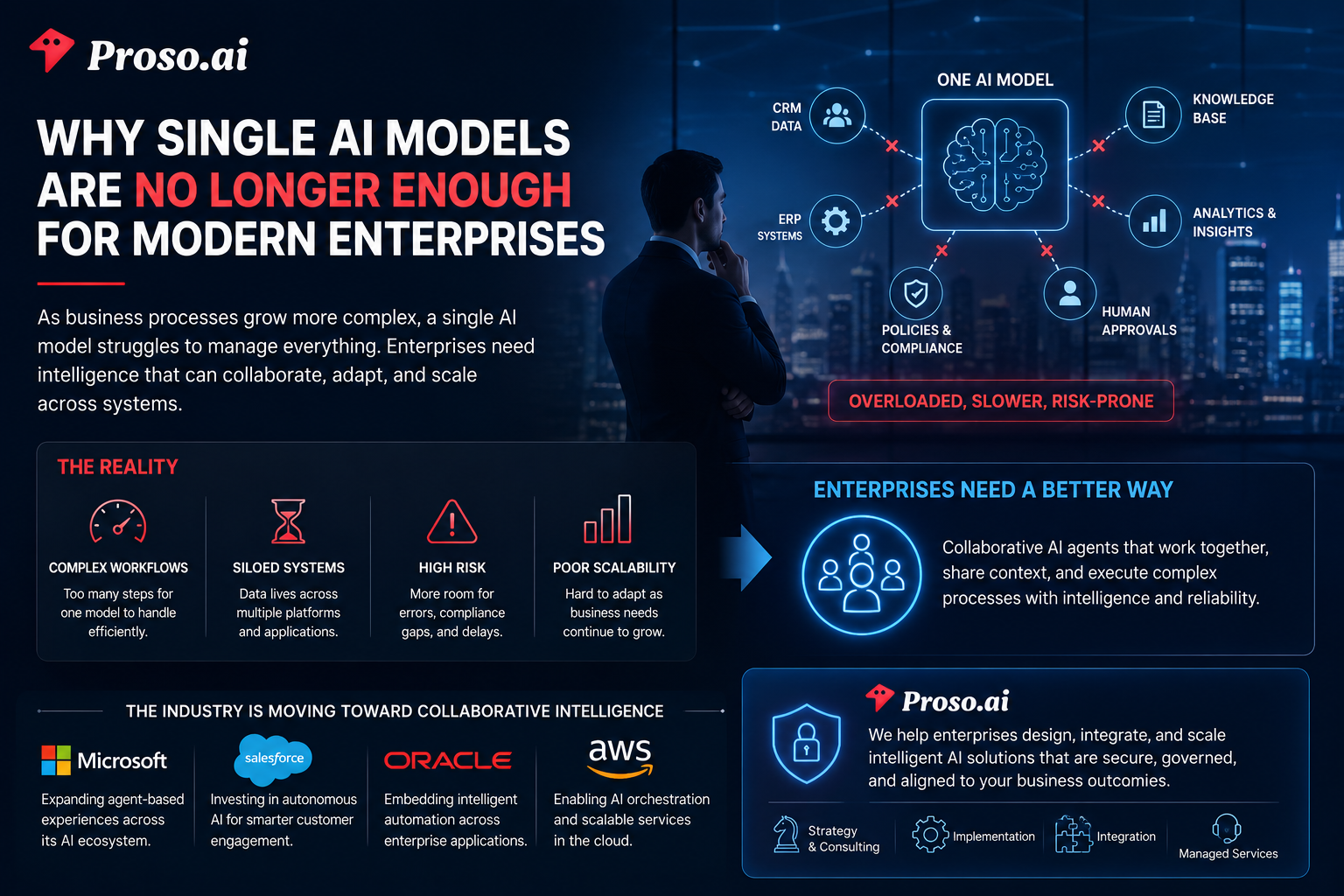
For the past few years, organizations have invested heavily in AI-powered chatbots, virtual assistants, intelligent search, and automation tools. These solutions have delivered measurable gains in productivity, helping teams reduce manual effort and accelerate routine tasks. But as enterprises expand AI beyond isolated use cases, many are discovering a common limitation: one AI model cannot effectively manage an entire business ecosystem.
Consider a typical customer support request. It doesn't begin and end with answering a question. An AI solution may need to retrieve customer information from a CRM, verify contract details stored in an ERP system, review company policies, analyze previous interactions, generate a response, and ensure the final output complies with organizational guidelines. Asking a single model to handle every stage of this workflow increases complexity, creates bottlenecks, and introduces unnecessary risk.
The same challenge exists across industries. Financial institutions process thousands of transactions that require fraud detection, regulatory validation, and risk assessment. Manufacturers rely on AI to forecast demand, monitor inventory, optimize production schedules, and coordinate with suppliers. Healthcare providers need intelligent systems that can securely analyze patient records, assist clinicians, and support operational decision-making. These aren't isolated AI tasks—they're interconnected business processes that demand collaboration across systems and functions.
This is why enterprise technology leaders are shifting their focus from individual AI capabilities to intelligent AI ecosystems. Rather than expecting one model to solve every problem, organizations are building specialized AI agents that work together, share context, and execute complex workflows with greater efficiency and reliability.
The industry's biggest technology providers are already embracing this approach. Microsoft is expanding agent-based experiences across its AI ecosystem, Salesforce is investing in autonomous AI capabilities for customer engagement, Oracle continues to embed intelligent automation into enterprise applications, and cloud providers like AWS are enabling organizations to orchestrate AI services at scale. The direction is clear: enterprise AI is evolving from standalone assistants to collaborative intelligence.
For business leaders, however, adopting this new model isn't just about choosing the latest AI framework. Success depends on integrating these intelligent systems into existing enterprise applications, securing sensitive business data, establishing governance, and ensuring every AI-driven decision aligns with operational objectives.
This is where experienced implementation partners make the difference. At Proso AI, we work with organizations to bridge the gap between AI innovation and business execution. By combining expertise across Microsoft, Oracle, Salesforce, enterprise integration, and AI consulting, we help businesses design intelligent solutions that are not only technically advanced but also secure, scalable, and aligned with long-term business goals.
Imagine trying to run an entire enterprise with just one employee. That individual would be expected to answer customer queries, analyze financial reports, monitor cybersecurity threats, optimize supply chains, review legal documents, and make strategic decisions—all at the same time. No matter how skilled they are, the workload would quickly become overwhelming.
The same principle applies to Artificial Intelligence.
Traditional AI systems are incredibly capable, but they're often designed to solve a single problem at a time. As business processes become more interconnected, organizations need AI that can think beyond isolated tasks and operate as part of a coordinated ecosystem. This is exactly what Multi-Agent AI Systems are designed to achieve.
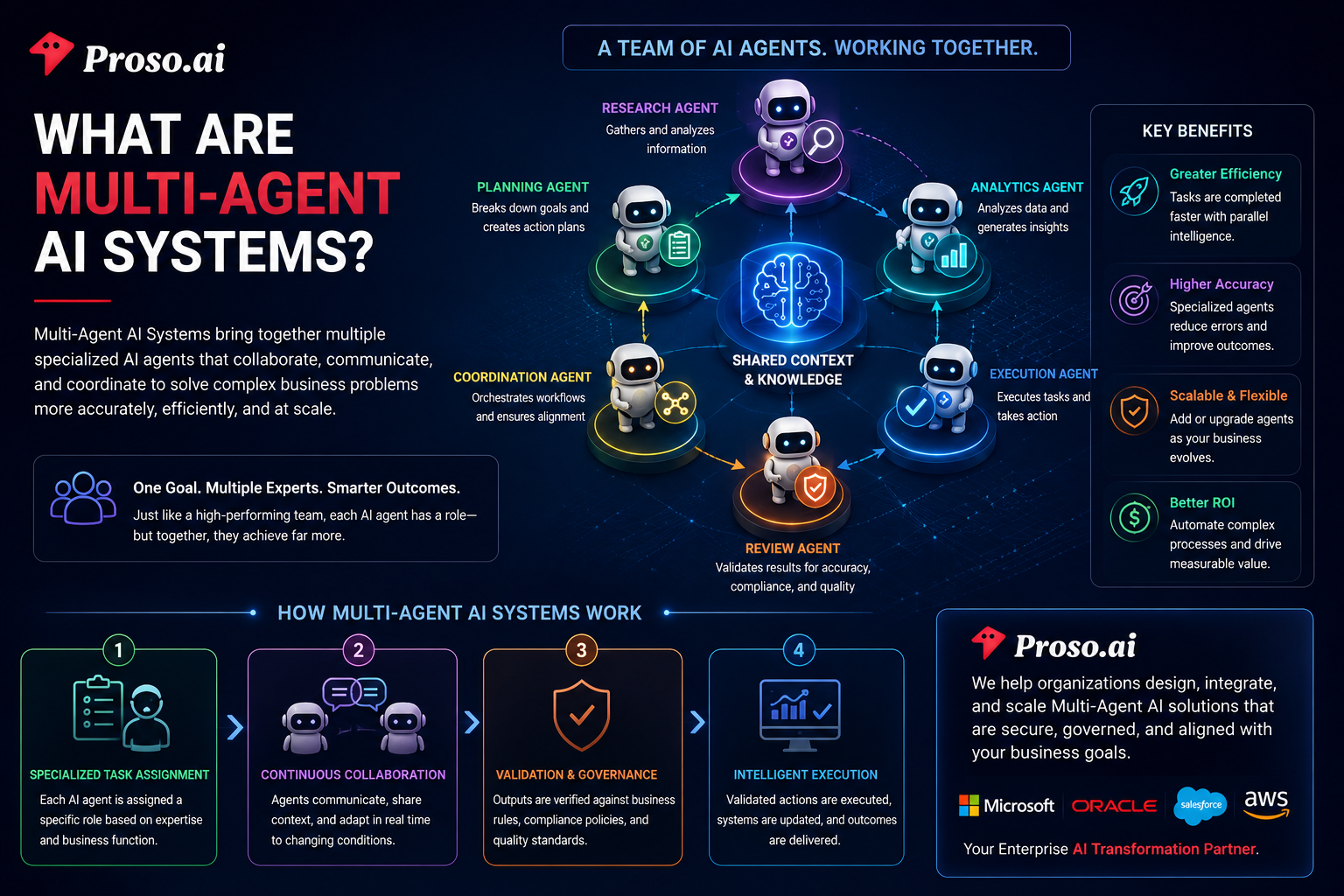
A Multi-Agent AI System consists of multiple specialized AI agents, each assigned a distinct role within a larger workflow. Rather than competing for the same task, these agents collaborate, exchange information, validate one another's outputs, and work toward a common business objective. One agent may gather information, another may analyze data, a third may generate recommendations, while a fourth reviews the results for compliance or accuracy before execution.
This collaborative approach closely mirrors how high-performing organizations operate. Finance teams work alongside operations, sales collaborate with customer support, and leadership relies on insights from multiple departments before making strategic decisions. Multi-Agent AI brings this same model of specialization and coordination into enterprise technology.
A typical Multi-Agent AI workflow follows four key stages:
Each AI agent is responsible for a specific business function based on its expertise. Instead of one model handling everything, responsibilities are distributed across specialized agents, improving efficiency and reducing unnecessary complexity.
Agents communicate with one another throughout the workflow, sharing insights, requesting additional information, and coordinating actions as business conditions evolve. This enables faster and more informed decision-making.
Before an action is executed, designated agents can verify outputs against predefined business rules, compliance requirements, and organizational policies. This additional layer of oversight helps reduce errors and supports responsible AI adoption.
Once validated, the system completes the workflow by executing the required actions, updating enterprise applications, or delivering recommendations to employees or customers—often without manual intervention.
The true advantage of Multi-Agent AI isn't simply that it uses multiple AI models—it's that it enables enterprises to build intelligent systems that are modular, resilient, and scalable.
Instead of redesigning an entire AI solution every time business requirements change, organizations can enhance individual agents, introduce new capabilities, or integrate additional enterprise systems while the rest of the architecture continues to operate seamlessly. This flexibility is becoming increasingly valuable as businesses modernize their technology landscapes and adopt cloud-native platforms.
Industry leaders such as Microsoft, Oracle, and Salesforce are already embedding agent-driven capabilities into their enterprise ecosystems because they recognize that the future of business automation depends on intelligent collaboration rather than isolated intelligence.
At Proso AI, we help organizations translate these emerging technologies into practical business solutions. From designing AI architectures and integrating enterprise platforms to implementing governance frameworks and scalable automation, our focus is on ensuring that every AI initiative delivers measurable value while maintaining security, compliance, and operational excellence.
Enterprise AI is no longer measured by how well it answers questions—it's measured by how effectively it drives business outcomes. As organizations accelerate their digital transformation initiatives, the focus has shifted from deploying isolated AI tools to building intelligent ecosystems that can automate end-to-end business processes.
This shift is fueling the rapid adoption of Multi-Agent AI Systems across industries. Rather than relying on a single AI model to manage increasingly complex operations, enterprises are building networks of specialized AI agents that collaborate, adapt, and make informed decisions together. The result is greater operational efficiency, stronger governance, and AI solutions that can evolve alongside the business.
Business decisions rarely depend on a single source of information. They require insights from multiple systems, stakeholders, and data sets.
With Multi-Agent AI Systems, specialized agents work simultaneously to gather information, validate data, analyze trends, and recommend actions. Instead of waiting for one overloaded model to process every request, organizations benefit from parallel intelligence that accelerates decision-making while improving accuracy.
For enterprises operating in fast-moving industries such as finance, healthcare, retail, and manufacturing, this speed can become a significant competitive advantage.
One of the greatest strengths of Multi-Agent AI lies in specialization.
Rather than asking one AI model to perform every function, each agent is designed for a specific responsibility—whether it's analyzing customer data, reviewing contracts, monitoring cybersecurity threats, or forecasting inventory.
This division of responsibilities reduces errors, improves output quality, and enables organizations to build AI solutions that deliver more consistent and reliable business outcomes.
Business requirements evolve continuously, and AI solutions must evolve with them.
Multi-Agent AI Systems are inherently modular, allowing organizations to introduce new AI agents, expand capabilities, or integrate additional enterprise applications without redesigning the entire architecture.
Whether an enterprise is expanding globally, adopting new cloud platforms, or modernizing legacy systems, this flexibility ensures that AI investments remain future-ready.
For enterprise leaders, innovation must never come at the expense of trust.
Multi-Agent AI architectures can incorporate dedicated governance and validation agents that verify outputs against organizational policies, regulatory requirements, and security standards before actions are executed.
This is particularly valuable for industries handling sensitive information, including banking, healthcare, government, and legal services, where transparency and accountability are essential.
At Proso AI, governance is a foundational element of every AI implementation. Our approach combines intelligent automation with secure architecture, enterprise integrations, and responsible AI practices to help organizations innovate confidently while protecting their most valuable assets.
The ultimate goal of enterprise AI is not simply automation—it's measurable business value.
By distributing workloads across specialized agents, organizations can reduce manual effort, optimize resource utilization, minimize operational delays, and improve customer experiences. These improvements translate into faster time-to-value and stronger returns on AI investments.
Organizations that treat AI as a strategic business capability rather than a standalone technology initiative will be better positioned to scale innovation and respond to changing market demands.
The world's leading technology companies are already shaping this future. Microsoft continues to advance AI agents through its enterprise ecosystem, Salesforce is redefining customer engagement with autonomous AI capabilities, while Oracle is embedding intelligent automation across enterprise applications. These innovations signal a broader transformation in how businesses will operate over the next decade.
At Proso AI, we help organizations navigate this transformation with confidence. From AI strategy and enterprise consulting to implementation, integration, and managed services, our focus is on building intelligent solutions that align with business objectives, strengthen operational resilience, and deliver sustainable growth.
The question is no longer whether enterprises should adopt Multi-Agent AI Systems. The real question is how quickly they can implement them securely, responsibly, and at scale.
The true value of Multi-Agent AI Systems isn't measured by how advanced the technology is—it's measured by the business problems it solves. Across industries, organizations are moving beyond AI experimentation and deploying collaborative AI systems that automate complex workflows, improve decision-making, and create measurable business outcomes.
Let's explore how Multi-Agent AI is transforming enterprise operations across different sectors.
Every second, financial institutions process thousands of transactions across digital channels. Detecting fraud isn't just about identifying suspicious activity—it's about analyzing customer behavior, validating transaction history, checking regulatory requirements, and assessing risk in real time.
A Multi-Agent AI System can distribute these responsibilities across specialized agents. One agent monitors transaction patterns, another evaluates customer behavior, while additional agents verify compliance and calculate risk scores before a final decision is made.
The result is faster fraud detection, fewer false positives, and improved regulatory compliance—helping financial institutions protect customers without slowing down legitimate transactions.
Healthcare organizations manage enormous volumes of sensitive information every day. Physicians, administrators, and care teams rely on accurate, timely insights to make critical decisions.
With Multi-Agent AI, one agent can analyze patient records, another can review medical literature, a third can optimize appointment scheduling, while another monitors treatment recommendations against clinical guidelines.
By enabling these AI agents to collaborate, healthcare providers can reduce administrative burden, improve operational efficiency, and support clinicians with faster, more informed decision-making—all while maintaining strict security and compliance standards.
Modern supply chains generate data from warehouses, suppliers, transportation networks, production systems, and customer demand forecasts.
Instead of relying on disconnected automation tools, Multi-Agent AI Systems allow specialized agents to monitor inventory levels, predict demand fluctuations, optimize production schedules, and coordinate logistics in real time.
This collaborative intelligence helps manufacturers reduce operational costs, minimize disruptions, and respond quickly to changing market conditions.
Today's customers expect instant, personalized support across every interaction.
A Multi-Agent AI architecture enables different agents to work together seamlessly. One identifies customer intent, another retrieves account information, a third recommends the best solution, while another ensures the response aligns with company policies and brand guidelines.
The outcome is faster response times, more personalized interactions, and a consistent customer experience that builds long-term loyalty.
Software development has become increasingly collaborative, and AI is playing a growing role throughout the software lifecycle.
Multi-Agent AI Systems can assign specialized agents to different stages of development. One agent generates code, another performs quality assurance, a third identifies security vulnerabilities, while another prepares deployment documentation.
By working together, these agents reduce development cycles, improve software quality, and allow engineering teams to focus on innovation rather than repetitive tasks.
Perhaps the most exciting opportunity lies in connecting enterprise systems that have traditionally operated in silos.
Imagine an organization where AI agents collaborate across Microsoft Dynamics 365, Oracle Cloud, Salesforce, ERP platforms, CRM systems, HR applications, and cloud services. Sales forecasts automatically influence inventory planning. Customer feedback informs product development. Finance receives real-time operational insights. Every department benefits from intelligent collaboration rather than isolated automation.
This is no longer a future vision—it's the direction enterprise AI is heading.
At Proso AI, we help organizations bring this vision to life by designing AI solutions that integrate seamlessly with existing enterprise ecosystems. Whether it's implementing AI within Microsoft technologies, Oracle Cloud, Salesforce, or other business-critical platforms, our approach focuses on creating secure, scalable, and connected solutions that deliver measurable business value—not just technical capability.
The organizations gaining the greatest value from AI aren't simply automating individual tasks—they're reimagining entire business processes through collaboration, orchestration, and intelligent decision-making.
As Multi-Agent AI Systems continue to mature, enterprises will increasingly rely on networks of specialized AI agents that work together across departments, applications, and workflows.
The future of enterprise AI won't be defined by isolated automation. It will be defined by connected intelligence.
While the benefits of Multi-Agent AI Systems are compelling, successful implementation requires far more than deploying a few AI models. Enterprise AI initiatives often fail not because of inadequate technology, but because of poor planning, fragmented data, weak governance, and disconnected business processes.
Organizations that treat Multi-Agent AI as a strategic transformation initiative—rather than just another software deployment—are significantly more likely to achieve long-term success.
Here are the most common challenges enterprises face and the strategies that help overcome them.
Most organizations already operate complex technology ecosystems that include ERP platforms, CRM solutions, cloud applications, data warehouses, and legacy systems. Introducing AI without a well-planned integration strategy can create data silos, inconsistent workflows, and operational inefficiencies.
A successful Multi-Agent AI strategy begins with understanding how AI agents will interact with existing enterprise applications—not replace them. Whether it's Microsoft Dynamics 365, Oracle Cloud, Salesforce, or other business-critical platforms, seamless integration ensures AI becomes part of everyday operations rather than another disconnected tool.
At Proso AI, we design AI architectures that integrate with your existing technology landscape, enabling organizations to maximize the value of previous investments while accelerating digital transformation.
As AI systems gain greater autonomy, ensuring security and governance becomes even more critical. Multiple AI agents often access sensitive customer information, financial records, and operational data, making strong governance essential.
Organizations must establish clear policies around data access, identity management, audit trails, and compliance with industry regulations. Every AI-driven decision should be transparent, explainable, and aligned with organizational standards.
Responsible AI isn't just about protecting data—it's about protecting trust.
Our approach at Proso AI incorporates governance and security into every stage of the implementation lifecycle, helping organizations innovate with confidence while meeting enterprise security and compliance requirements.
Many AI initiatives perform well during pilot projects but struggle as they expand across departments or business units.
Without a modular architecture, every new capability adds complexity, making systems harder to maintain and more expensive to scale.
Multi-Agent AI addresses this challenge by enabling organizations to add specialized agents as business needs evolve. However, this flexibility only delivers value when supported by thoughtful architecture, standardized processes, and effective orchestration.
Designing for scalability from day one ensures AI continues to support business growth instead of becoming another technology constraint.
Technology transformation is only one part of successful AI adoption. Employees, leadership teams, and business units must also adapt to new ways of working.
Clear communication, stakeholder alignment, and ongoing training are essential to ensure AI enhances human decision-making rather than creating uncertainty or resistance.
The most successful organizations view AI as a collaborative partner—one that empowers employees, accelerates innovation, and allows teams to focus on higher-value work.
With new frameworks, models, and platforms emerging almost every month, many organizations face an unexpected challenge: knowing where to start.
Should you build with open-source frameworks? Extend existing enterprise platforms? Deploy cloud-native AI services? Or invest in fully customized agent architectures?
The right answer depends on your business objectives, existing technology investments, regulatory requirements, and long-term growth strategy—not simply the latest industry trend.
This is where an experienced consulting partner becomes invaluable. At Proso AI, we help organizations evaluate their AI readiness, define implementation roadmaps, and build scalable Multi-Agent AI solutions that align with both technical requirements and business priorities.
The future of enterprise AI isn't about deploying more models—it's about deploying the right architecture.
Organizations that invest in governance, integration, scalability, and strategic implementation today will be the ones best positioned to unlock the full potential of collaborative AI tomorrow.
By combining deep expertise in Microsoft, Oracle, Salesforce, cloud technologies, and enterprise AI consulting, Proso AI enables businesses to move beyond experimentation and build AI ecosystems that are secure, resilient, and designed for sustainable growth.
Building a Multi-Agent AI System isn't just about connecting multiple AI models—it's about creating an intelligent ecosystem that aligns with your business objectives, integrates with existing enterprise applications, and delivers measurable outcomes.
That's where many organizations face their biggest challenge.
The market is flooded with AI tools, frameworks, and platforms, each promising faster automation and smarter decision-making. But successful AI transformation isn't determined by the technology alone. It depends on choosing the right architecture, integrating it with your enterprise systems, establishing governance, and ensuring every AI initiative supports long-term business growth.
At Proso AI, we combine strategic consulting with deep technical expertise to help organizations navigate this complexity with confidence. Our approach goes beyond implementation—we partner with businesses to design AI solutions that are secure, scalable, and tailored to the unique demands of their industry.
Modern enterprises operate in connected technology environments, not isolated platforms. AI must work seamlessly with the systems that already power your business.
Our consultants and engineers bring extensive experience across industry-leading enterprise technologies, including:
This cross-platform expertise allows us to design solutions that connect people, processes, and technology into one intelligent enterprise ecosystem.
Every organization has different objectives, infrastructure, and operational challenges. That's why we don't believe in one-size-fits-all AI implementations.
Our engagement typically follows a structured approach:
We evaluate your existing technology landscape, business processes, and AI maturity to identify the highest-value opportunities.
Our architects design scalable Multi-Agent AI frameworks that align with your enterprise applications, governance requirements, and long-term roadmap.
We connect AI with your existing Microsoft, Oracle, Salesforce, ERP, CRM, and cloud platforms to ensure seamless collaboration across business functions.
Implementation is only the beginning. We continuously monitor, optimize, and enhance AI performance to ensure your investment continues delivering value as your business evolves.
Enterprise AI cannot succeed without trust.
Every solution we design incorporates governance, security, compliance, and responsible AI principles from the outset. From role-based access controls and secure data integration to monitoring AI outputs and ensuring regulatory compliance, we help organizations deploy AI with confidence.
Because the true measure of an AI solution isn't how intelligent it appears—it's how reliably it performs in real-world business environments.
Technology should never be implemented simply because it's new.
Every AI initiative should answer a fundamental business question:
At Proso AI, these questions guide every engagement.
We believe successful AI transformation happens when advanced technology is aligned with business strategy, operational excellence, and long-term growth—not when organizations chase the latest trend.
Whether you're exploring your first AI initiative or scaling enterprise-wide intelligent automation, our goal remains the same: helping your business unlock sustainable value through secure, scalable, and future-ready AI solutions.
The evolution of enterprise AI is already underway.
Organizations are moving beyond isolated chatbots and standalone automation toward intelligent systems that collaborate, learn, and make decisions across every business function.
The question isn't whether your organization will adopt Multi-Agent AI.
The question is whether you'll build it on a foundation that's secure, scalable, and designed for the future.
With the right strategy, the right technology, and the right implementation partner, Multi-Agent AI becomes more than an innovation—it becomes a competitive advantage.
Proso AI is ready to help you build that future.

.jpg)

.png)
.png)