

Every organization begins the year with a plan.
Revenue targets are set. Budgets are approved. Hiring roadmaps are finalized. Investment priorities are defined, and finance teams build forecasts that guide business decisions for the months ahead.
But today's business environment rarely follows those plans.
A sudden shift in customer demand can reshape revenue projections overnight. Inflation can increase operating costs beyond expectations. Supply chain disruptions, changing regulations, workforce shortages, mergers and acquisitions, and geopolitical uncertainty can quickly turn carefully prepared financial models into outdated assumptions.
For today's Chief Financial Officers (CFOs), the challenge is no longer producing accurate financial reports at the end of the month. Their role has evolved into something far more strategic.
Modern CFOs are expected to anticipate risks before they materialize, evaluate multiple business scenarios, optimize cash flow, guide investment decisions, and help executive leadership navigate uncertainty with confidence. Finance has become the foundation for strategic decision-making rather than simply recording business performance.
Yet many finance teams continue to rely on disconnected spreadsheets, static annual budgets, and fragmented planning processes that were designed for a business environment that no longer exists. By the time reports are consolidated and shared with stakeholders, the business landscape may have already changed.
This growing disconnect between financial planning and business reality is driving organizations to rethink how they approach financial management.
Instead of relying on periodic forecasts and reactive decision-making, forward-looking enterprises are embracing continuous planning, real-time financial visibility, and intelligent forecasting that adapts as business conditions evolve.
This is where modern cloud-based financial management platforms are transforming the finance function.
Solutions like Workday Financial Management enable organizations to unify financial data, workforce planning, operational insights, and predictive analytics into a single platform, empowering finance leaders to move beyond reporting and focus on strategic growth.
However, implementing the right technology is only part of the equation. Unlocking its full value requires the right strategy, seamless integration, and a partner who understands both the technology and the business outcomes it is designed to achieve.
In this article, we'll explore why traditional financial planning is no longer enough, the biggest challenges modern CFOs face, how intelligent financial management platforms like Workday are reshaping enterprise finance, and how Proso AI helps organizations build resilient, future-ready finance operations through strategic Workday implementation and optimization.
Financial planning has always been at the heart of business strategy. Every investment, hiring decision, expansion plan, and operational initiative depends on accurate financial forecasting. However, the way many organizations approach planning today hasn't evolved at the same pace as the business environment around them.
For decades, finance teams have relied on annual budgets, spreadsheet-based forecasting, and disconnected reporting systems to guide strategic decisions. While these methods were effective in relatively stable markets, they struggle to keep up with today's rapidly changing business landscape.
Markets now shift in weeks rather than years. Customer demand fluctuates unexpectedly, operating costs change with inflation, supply chains face constant disruptions, and regulatory requirements continue to evolve. By the time traditional financial plans are reviewed, they often no longer reflect the reality of the business.
This growing gap between planning and execution is forcing CFOs to rethink how financial decisions are made.
Below are some of the biggest challenges organizations continue to face with traditional financial planning.
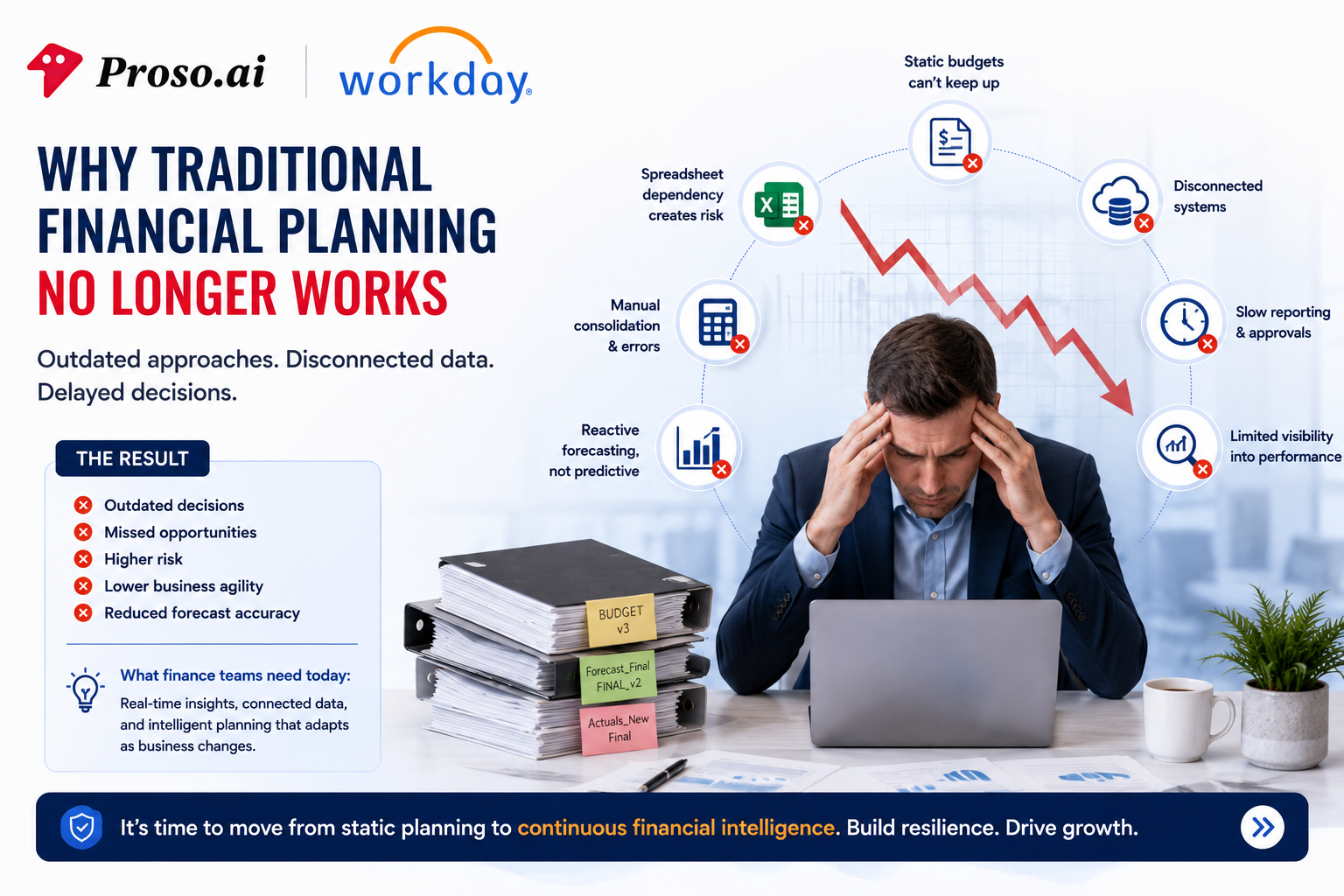
Most organizations still prepare annual budgets based on assumptions made months before the financial year begins.
The challenge is that business conditions rarely remain constant.
Unexpected economic shifts, changing customer behavior, workforce expansion, new competitors, and operational disruptions can significantly impact financial performance throughout the year. Yet finance teams often continue measuring performance against budgets that were created under entirely different market conditions.
Instead of enabling better decision-making, static budgets can limit an organization's ability to respond quickly when priorities change.
Business Impact
Despite advances in enterprise technology, spreadsheets remain one of the most widely used financial planning tools.
While spreadsheets offer flexibility, they become increasingly difficult to manage as organizations grow.
Multiple versions of the same file, manual data consolidation, broken formulas, inconsistent assumptions, and limited collaboration often result in reporting delays and forecasting errors.
Instead of spending time analyzing business performance, finance teams spend countless hours validating data and reconciling numbers across departments.
As organizations expand across multiple business units or geographies, spreadsheet-based planning becomes increasingly unsustainable.
Business Impact
Finance doesn't operate in isolation.
Revenue planning depends on sales performance.
Hiring plans influence operating expenses.
Procurement affects cash flow.
Project delivery impacts profitability.
Yet in many organizations, these functions operate across separate systems that rarely communicate with one another.
Finance teams often spend significant time collecting information from ERP systems, HR platforms, CRM applications, procurement tools, and business intelligence solutions before they can build a complete financial picture.
By the time the data is consolidated, the business may already be facing new challenges.
Without a unified view of enterprise operations, strategic decision-making becomes slower and less reliable.
Traditional forecasting relies heavily on historical performance.
While historical data provides valuable context, it cannot fully prepare organizations for rapidly changing market conditions.
Today's CFOs need to evaluate multiple "what-if" scenarios before making critical business decisions.
Questions like:
Unfortunately, many organizations lack the tools to model these scenarios quickly.
Instead of proactively preparing for uncertainty, they often respond only after financial risks begin affecting the business.
Business leaders depend on finance teams for timely insights.
However, when reporting cycles take weeks to complete, executive decisions are based on historical information rather than current business conditions.
Without real-time visibility into revenue performance, operating costs, workforce expenses, cash flow, and financial risks, leadership teams struggle to respond confidently to changing market dynamics.
In today's competitive environment, delayed financial insights can lead to delayed business decisions.
And delayed decisions often become missed opportunities.
The role of the CFO has evolved far beyond financial reporting and compliance.
Today's finance leaders are expected to balance profitability with growth, manage risk while enabling innovation, support strategic investments, and provide real-time guidance to executive leadership.
Accomplishing this with disconnected spreadsheets and static planning models is becoming increasingly difficult.
Modern finance requires continuous planning, connected enterprise data, intelligent forecasting, and the agility to respond to change as it happens—not weeks or months later.
Business uncertainty is no longer an occasional disruption—it's a constant reality.
Over the past few years, organizations across every industry have faced unprecedented challenges. Inflation has reshaped cost structures, supply chain disruptions have delayed production, changing customer behaviors have altered revenue forecasts, and evolving regulations have increased compliance requirements. At the same time, rapid advances in artificial intelligence and digital transformation continue to redefine how businesses operate and compete.
For finance leaders, this means that planning based solely on historical performance is no longer enough.
Today's CFOs are expected to make strategic decisions in an environment where business conditions can change within days, not quarters. Financial resilience has become less about predicting the future and more about building the capability to respond quickly when the future changes.
Organizations that can adapt faster than their competitors are better positioned to protect profitability, seize new growth opportunities, and navigate uncertainty with confidence.
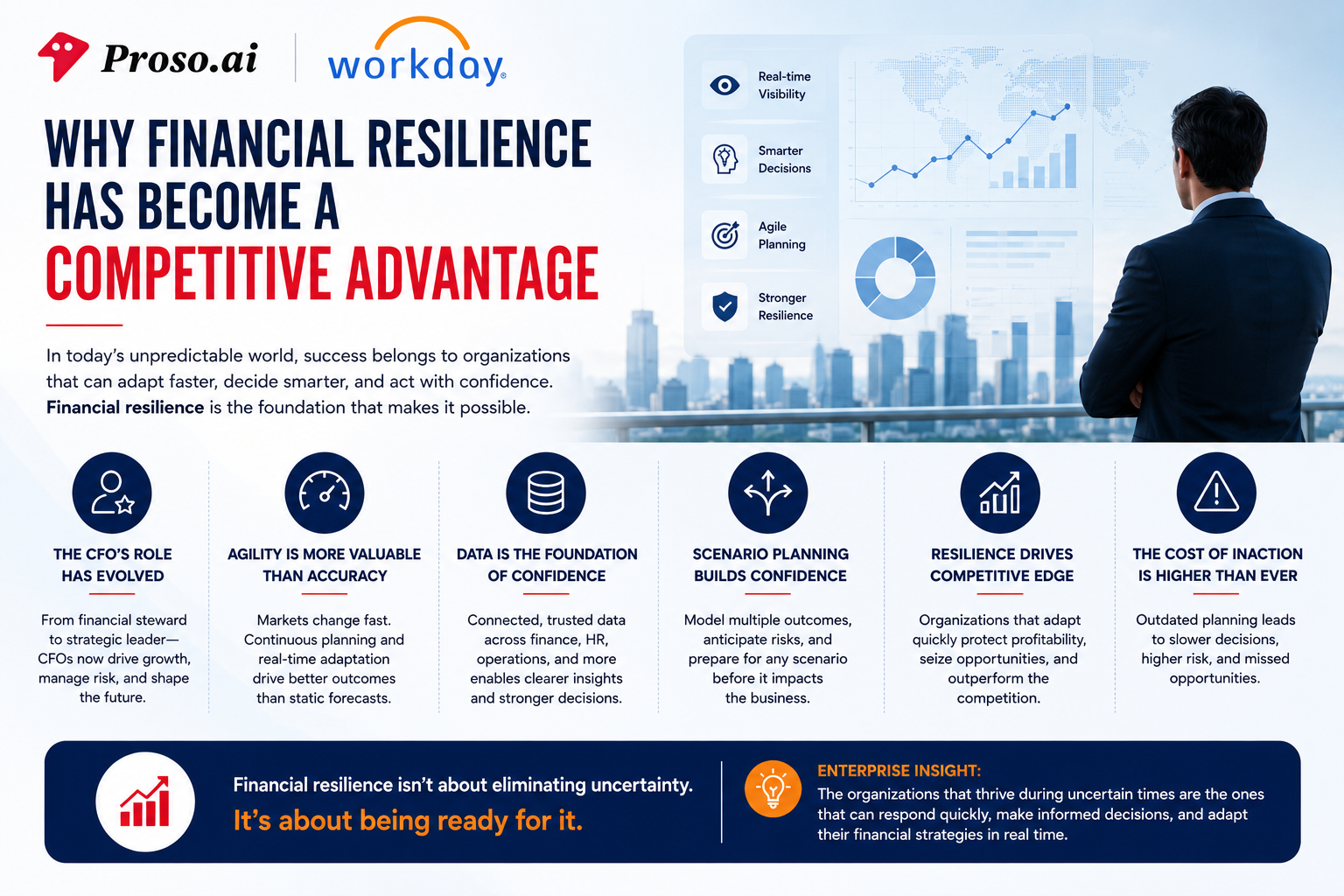
The responsibilities of the Chief Financial Officer have expanded significantly over the past decade.
Traditionally, CFOs focused on financial reporting, compliance, budgeting, and ensuring the organization's financial health. While these responsibilities remain essential, today's finance leaders are also expected to drive business strategy.
Modern CFOs help leadership answer questions such as:
The finance function has evolved from recording business performance to actively shaping business decisions.
This shift requires finance teams to move beyond retrospective reporting and adopt forward-looking planning capabilities that provide real-time visibility into business performance.
For years, organizations measured financial success by how accurately they could forecast annual budgets.
Today, the ability to adapt is often more valuable than the ability to predict.
Even the most accurate forecast can become obsolete when market conditions shift unexpectedly. Organizations that rely on static planning cycles often struggle to adjust investments, workforce strategies, and operational priorities quickly enough.
Financially resilient organizations, however, continuously evaluate changing conditions and update forecasts based on real-time business data.
This allows finance leaders to make informed decisions without waiting for the next budgeting cycle.
Agility transforms financial planning from a periodic exercise into an ongoing business capability.
Every strategic business decision depends on the quality of the data behind it.
Yet many organizations continue to manage financial, operational, workforce, and project data across multiple disconnected systems.
Without a unified view of enterprise performance, leadership teams often spend valuable time validating information rather than acting on it.
Financial resilience requires more than collecting data—it requires connecting it.
When finance, HR, operations, procurement, and project management share a common source of truth, organizations gain a more accurate understanding of how decisions in one area impact the entire business.
Connected enterprise data enables leaders to identify risks earlier, allocate resources more effectively, and respond with greater confidence.
Modern finance is no longer about preparing a single forecast.
Organizations must be prepared for multiple possible outcomes.
Questions that finance teams regularly face include:
Rather than reacting after these events occur, resilient organizations continuously evaluate multiple scenarios and adjust financial plans before risks impact business performance.
Scenario planning has become one of the most valuable capabilities for finance leaders navigating uncertainty.
Organizations that delay modernizing their financial planning processes often face more than operational inefficiencies.
Slow decision-making can lead to missed market opportunities. Limited visibility into cash flow can increase financial risk. Manual planning processes consume valuable time that finance teams could instead spend on strategic analysis.
As businesses grow, these inefficiencies compound, making it increasingly difficult to respond to market changes with speed and confidence.
In today's competitive landscape, financial resilience is no longer a luxury—it's a business necessity.
The expectations placed on finance teams have changed dramatically over the past decade.
Today's CFOs are no longer responsible solely for managing budgets and ensuring compliance. They are expected to provide strategic guidance, support business growth, optimize investments, manage financial risk, and help executive leadership make confident decisions in an increasingly unpredictable business environment.
Achieving these objectives requires more than faster reporting or better spreadsheets. It requires a financial planning platform that delivers continuous visibility, intelligent insights, and the flexibility to adapt as business conditions evolve.
Modern financial planning software should serve as the strategic foundation of the enterprise—connecting finance with operations, workforce planning, procurement, and executive decision-making through a single, trusted source of data.
Here are the capabilities today's finance leaders should expect from a modern financial management platform.
Annual budgets were designed for relatively stable business environments.
Today's markets require organizations to evaluate financial performance continuously rather than waiting for quarterly or yearly planning cycles.
Modern financial planning platforms enable finance teams to update forecasts as business conditions change, allowing organizations to respond proactively instead of reacting after financial performance has already been impacted.
Continuous planning helps businesses remain agile while improving forecast accuracy throughout the year.
Business Value
Finance leaders cannot make confident decisions without accurate and timely information.
Modern financial planning solutions provide real-time access to critical financial metrics, including revenue performance, operating expenses, cash flow, profitability, capital investments, and budget variances.
Rather than waiting for manually prepared reports, executives gain immediate visibility into the financial health of the business.
This enables faster decision-making while reducing dependence on historical reporting.
Business Value
No organization can accurately predict every market disruption.
What differentiates resilient organizations is their ability to prepare for multiple possible outcomes.
Modern financial planning software enables finance teams to model different business scenarios before making strategic decisions.
Organizations can evaluate questions such as:
Scenario planning enables organizations to evaluate risk before it becomes reality.
Business Value
Finance is influenced by every part of the business.
Hiring decisions affect labor costs.
Procurement impacts cash flow.
Sales influence revenue forecasts.
Projects determine profitability.
Modern financial planning platforms connect these business functions into a unified ecosystem, allowing finance teams to work with consistent, enterprise-wide data rather than disconnected reports from multiple systems.
A connected business enables connected decision-making.
Business Value
Historical reporting explains what happened.
Predictive analytics helps organizations understand what is likely to happen next.
Modern financial planning solutions leverage artificial intelligence and advanced analytics to identify trends, detect anomalies, improve forecasting accuracy, and surface potential financial risks before they impact business performance.
Rather than relying solely on historical data, finance leaders gain forward-looking insights that support better strategic decisions.
Business Value
Finance teams spend a significant amount of time performing repetitive administrative tasks.
Budget approvals, data consolidation, report generation, reconciliations, and manual validations often consume valuable time that could otherwise be dedicated to strategic analysis.
Modern financial planning platforms automate routine financial processes, enabling finance professionals to focus on higher-value activities such as business partnering, performance analysis, and long-term planning.
Automation improves efficiency while reducing the likelihood of manual errors.
Business Value
Leadership teams need more than financial reports—they need meaningful business insights.
Modern financial planning platforms provide interactive dashboards that consolidate key performance indicators into a clear, visual format.
Executives can monitor revenue trends, profitability, workforce costs, budget performance, cash flow, and strategic initiatives from a single interface, enabling faster and more informed decision-making.
Rather than searching for information across multiple reports, leaders gain immediate access to the metrics that matter most.
Business Value
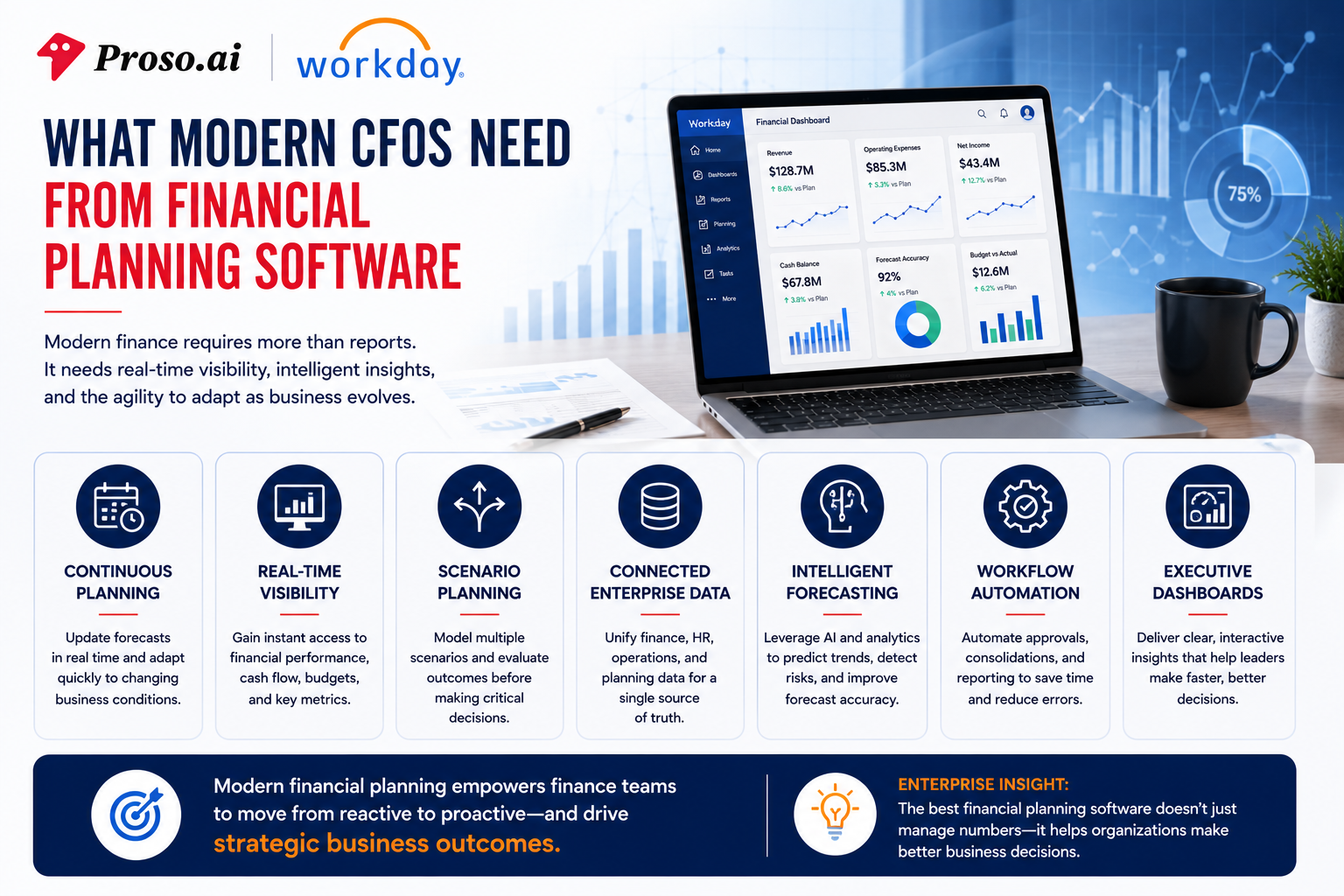
Financial planning has evolved from an annual budgeting exercise into a continuous business capability. Modern organizations need finance platforms that not only record financial performance but also help leaders anticipate change, evaluate risks, and make informed decisions with confidence.
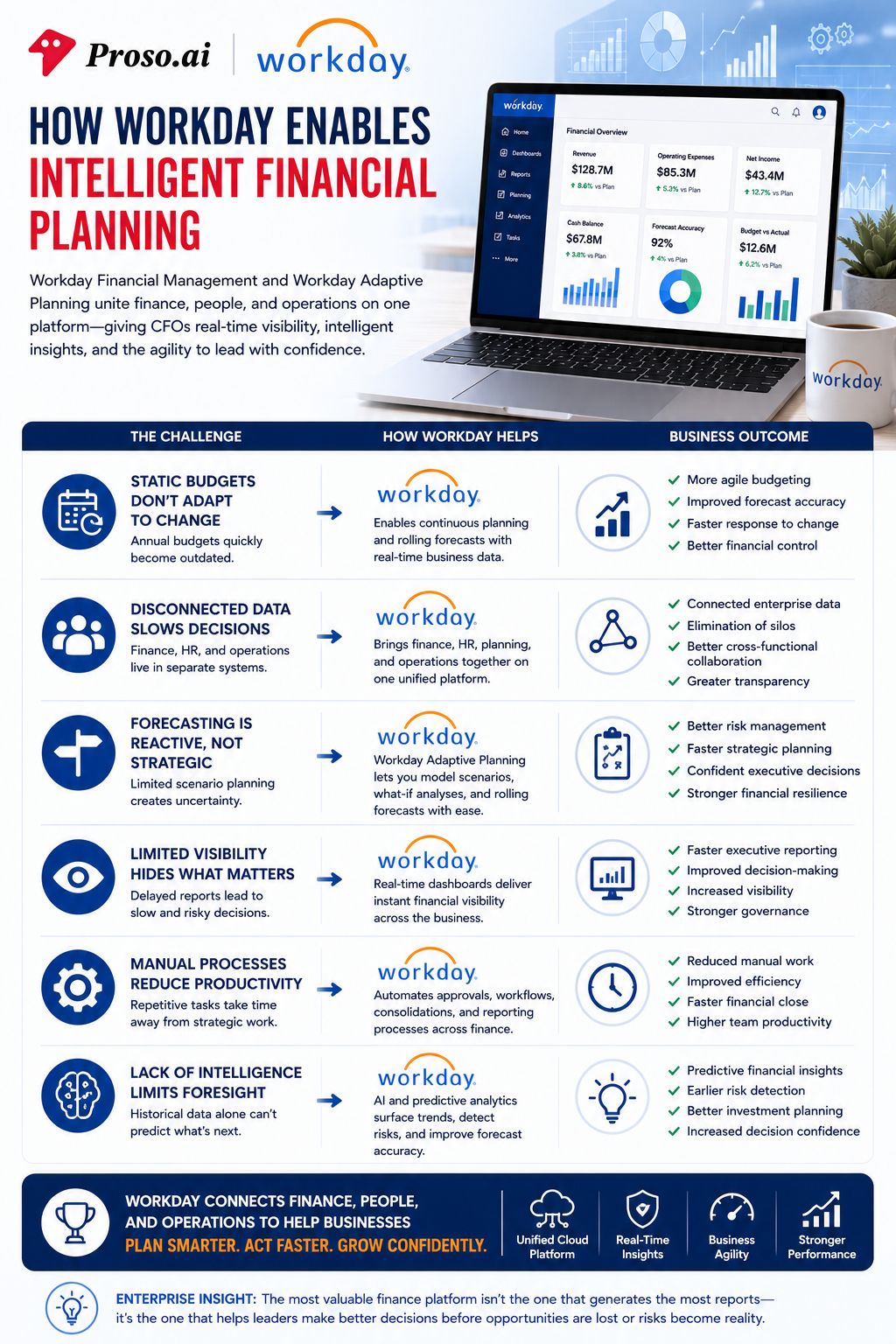
This is where Workday Financial Management and Workday Adaptive Planning redefine enterprise finance.
Unlike traditional financial systems that operate across disconnected applications and static reporting models, Workday brings financial management, workforce planning, operational data, and intelligent forecasting together on a unified cloud platform.
Instead of spending valuable time gathering information from multiple systems, finance teams gain real-time visibility into the entire business, enabling faster decisions, improved collaboration, and greater financial resilience.
Let's explore how Workday addresses the biggest challenges facing today's CFOs.
One of the biggest limitations of traditional financial planning is its reliance on annual budgets.
By the time many organizations complete their budgeting cycle, business priorities have already shifted.
Workday replaces static planning with continuous financial planning, allowing finance teams to update forecasts throughout the year based on real-time business performance.
Whether market demand changes, hiring plans evolve, or operational costs increase, organizations can adjust financial strategies without waiting for the next planning cycle.
Financial decisions are influenced by far more than accounting data.
Hiring plans affect payroll expenses.
Project delivery influences profitability.
Sales forecasts impact revenue planning.
Procurement affects cash flow.
Workday connects these business functions within a single enterprise platform, allowing finance leaders to understand how operational decisions influence financial performance in real time.
Rather than relying on disconnected reports from multiple systems, organizations gain a unified view of the business that supports faster and more informed decision-making.
Traditional forecasting explains what has already happened.
Modern finance requires visibility into what is likely to happen next.
Workday Adaptive Planning enables organizations to build rolling forecasts, evaluate multiple business scenarios, and model the financial impact of strategic decisions before they are implemented.
Finance teams can quickly answer questions such as:
Instead of reacting to uncertainty, organizations gain the ability to prepare for it.
Finance leaders cannot afford to wait until month-end to understand business performance.
Workday provides interactive dashboards that consolidate financial metrics into a single, real-time view.
Executives can monitor:
With instant access to current business data, leadership teams can identify opportunities, respond to emerging risks, and make strategic decisions with greater confidence.
Finance professionals should spend their time analyzing business performance—not manually consolidating spreadsheets or preparing repetitive reports.
Workday automates many routine financial processes, including approvals, reporting workflows, reconciliations, and planning activities.
Automation reduces manual effort, improves consistency, and allows finance teams to focus on higher-value initiatives such as business strategy, investment planning, and performance optimization.
The future of financial planning is not just automation—it's intelligent decision support.
Workday incorporates AI and machine learning capabilities to help organizations identify trends, improve forecast accuracy, detect anomalies, and surface potential financial risks before they escalate.
Rather than relying solely on historical reports, finance leaders gain predictive insights that enable proactive planning and smarter business decisions.
This helps organizations move from reactive financial management to forward-looking strategic planning.
Many financial platforms focus primarily on accounting transactions or reporting.
Workday takes a broader approach by connecting finance, people, operations, and planning within a unified cloud ecosystem.
This enables organizations to move beyond isolated financial management and create a connected enterprise where every strategic decision is supported by trusted, real-time data.
For today's CFOs, this means less time managing systems and more time driving business growth.
Technology alone doesn't create financial resilience—it enables it.
The true value of Workday lies in its ability to transform finance from a reporting function into a strategic partner that supports continuous planning, enterprise-wide collaboration, and data-driven decision-making.
Organizations that embrace this approach are better equipped to respond to uncertainty, optimize resources, and build a stronger competitive advantage.
Enterprise Insight:
The most valuable finance platform isn't the one that generates the most reports—it's the one that helps leaders make better decisions before opportunities are lost or risks become reality.
Technology creates value only when people use it effectively.
One of Workday's biggest strengths is that it isn't designed solely for accountants or finance professionals. It provides role-based experiences that give every stakeholder access to the information they need while ensuring all teams work from the same trusted source of financial and operational data.
Instead of relying on separate systems for budgeting, reporting, workforce planning, approvals, and analytics, Workday brings everything together into a unified experience tailored to each user's responsibilities.
Let's explore how different finance leaders interact with the platform.
For Chief Financial Officers, every decision impacts the organization's financial health.
Rather than reviewing static reports generated at the end of each month, Workday provides CFOs with a real-time executive dashboard that delivers a comprehensive view of business performance.
From a single interface, finance leaders can monitor:
Interactive visualizations allow executives to drill down into performance metrics, identify emerging trends, and respond quickly when business conditions change.
Instead of spending valuable time requesting reports from multiple departments, CFOs gain immediate access to the insights needed for strategic decision-making.
Financial Planning & Analysis (FP&A) teams are responsible for turning business data into strategic direction.
Workday Adaptive Planning provides FP&A professionals with powerful tools to build rolling forecasts, create driver-based models, and evaluate multiple financial scenarios.
Instead of maintaining dozens of spreadsheet versions, analysts can collaborate within a centralized planning environment where assumptions, forecasts, and financial models remain consistent across the organization.
Whether evaluating expansion opportunities, workforce investments, or cost optimization initiatives, finance teams can quickly model different scenarios and understand their financial impact before decisions are made.
Finance managers need continuous visibility into departmental performance.
Within Workday, managers can monitor:
Instead of waiting for periodic reports, managers receive real-time insights that help them identify overspending, optimize budgets, and maintain financial discipline throughout the year.
Financial performance cannot be separated from operational performance.
Department heads across sales, operations, procurement, HR, and project management use Workday to understand how day-to-day business decisions influence financial outcomes.
Business leaders can evaluate:
Because every department works from the same connected data, leadership teams collaborate more effectively while making decisions that align with organizational goals.
Senior executives require more than financial reports—they need a clear understanding of how the business is performing overall.
Workday's executive dashboards consolidate financial, workforce, and operational data into intuitive visual reports that highlight trends, opportunities, and potential risks.
Leadership teams can quickly assess:
This unified view enables executives to align financial strategy with broader business objectives while making informed decisions faster.
One of the biggest barriers to effective financial planning is fragmented information.
When every department uses different tools and different data sources, collaboration becomes slower, reporting becomes inconsistent, and strategic decisions take longer.
Workday eliminates these barriers through a unified, role-based platform where CFOs, finance teams, managers, and executives all work from the same trusted source of truth.
The result is not simply better reporting—it is faster collaboration, stronger governance, and more confident decision-making across the enterprise.
Modern finance is no longer about producing reports—it's about empowering every stakeholder with the right insights at the right time. By delivering personalized, role-based experiences built on connected enterprise data, Workday helps organizations move beyond siloed decision-making and create a finance function that actively drives business performance.
Enterprise Insight:
The most effective finance teams aren't those with the most reports—they're the ones where every decision-maker has immediate access to trusted, actionable insights.
Financial planning doesn't happen in isolation.
Every budget, forecast, investment decision, and financial strategy is influenced by people, projects, procurement, operations, and customer demand. Yet in many organizations, these functions continue to operate across disconnected systems, making it difficult for finance teams to gain a complete view of business performance.
The result is fragmented decision-making.
Finance teams spend valuable time reconciling data instead of analyzing it. Department leaders work with different versions of the truth. Strategic planning becomes slower because information must be gathered manually from multiple systems before decisions can be made.
Modern enterprises need something fundamentally different.
They need a connected business ecosystem where every financial decision is supported by real-time operational intelligence.
This is where Workday delivers one of its greatest advantages.
By bringing finance, HR, procurement, payroll, projects, and planning together on a unified cloud platform, Workday transforms financial management from a departmental function into an enterprise-wide strategic capability.
For many organizations, workforce costs represent the single largest business expense.
Yet finance and HR often operate on different platforms, making workforce planning unnecessarily complex.
Questions like:
...require finance and HR teams to exchange spreadsheets and manually reconcile workforce data.
With Workday, workforce planning and financial planning operate together.
Headcount forecasts, compensation planning, hiring strategies, and labor costs automatically align with financial forecasts, giving leaders a complete picture of future workforce investments.
Every purchasing decision influences profitability.
Procurement teams negotiate vendor contracts, manage purchase orders, and oversee operational spending. Finance teams, meanwhile, monitor budgets, cash flow, and financial performance.
When these processes exist in separate systems, organizations often struggle with delayed approvals, limited spending visibility, and budget overruns.
Workday connects procurement with finance, allowing organizations to monitor purchasing activity, manage approvals, track supplier spending, and understand the financial impact of procurement decisions in real time.
This creates greater financial discipline while improving operational efficiency.
Projects consume resources, generate revenue, and influence long-term profitability.
Without connected project and financial data, organizations often struggle to answer critical questions:
Workday enables organizations to connect project planning with financial performance, providing real-time visibility into budgets, resource utilization, project costs, and expected returns.
This helps business leaders prioritize investments and optimize project execution based on financial impact.
Every operational decision has a financial consequence.
Changes in production, inventory, customer demand, workforce availability, or supplier performance ultimately affect revenue, costs, and profitability.
Because Workday connects operational and financial information within a single platform, finance leaders gain a broader understanding of how business activities influence overall performance.
Instead of analyzing historical financial statements alone, organizations can evaluate operational trends alongside financial outcomes, enabling more proactive and informed decision-making.
One of the biggest barriers to effective decision-making is inconsistent data.
When finance, HR, procurement, operations, and project teams rely on different systems, reports often conflict, creating uncertainty and delaying executive decisions.
Workday establishes a single source of truth where every department works from the same trusted enterprise data.
This not only improves reporting accuracy but also strengthens governance, compliance, collaboration, and executive confidence.
Instead of asking, "Which report is correct?", leadership teams can focus on "What action should we take next?"
Organizations that connect their business functions outperform those operating in silos.
When finance has immediate visibility into workforce planning, procurement activities, project performance, and operational trends, decisions become faster, forecasts become more accurate, and strategic planning becomes significantly more effective.
The value of Workday extends far beyond financial management.
It creates an intelligent enterprise where every department contributes to a unified strategy for growth, resilience, and operational excellence.
The future of enterprise finance isn't defined by better spreadsheets or faster reporting—it's defined by connected decision-making. Organizations that unify finance with HR, procurement, operations, and project management gain a significant competitive advantage through improved visibility, stronger collaboration, and faster execution.
Enterprise Insight:
The strongest financial decisions are never made in isolation. They're powered by connected data, connected teams, and a connected enterprise.
Selecting the right financial planning platform is only the beginning of the transformation journey.
The real business value comes from how effectively the platform is implemented, integrated, and aligned with an organization's financial processes, operational goals, and long-term strategy.
Many organizations invest in modern enterprise software expecting immediate improvements in planning, reporting, and decision-making. However, without the right implementation approach, businesses often face challenges such as fragmented workflows, inconsistent data, low user adoption, disconnected enterprise applications, and underutilized platform capabilities.
As a result, they achieve only a fraction of the value their technology is capable of delivering.
This is where Proso AI becomes a strategic partner.
As an enterprise consulting and digital transformation organization, Proso AI helps businesses move beyond software implementation by designing connected financial ecosystems that align technology with measurable business outcomes.
Whether you're deploying Workday for the first time, modernizing legacy financial systems, or expanding your enterprise planning capabilities, Proso AI ensures every phase of the transformation delivers lasting business value.
Every organization has unique financial processes, governance requirements, and operational priorities.
Rather than adopting a one-size-fits-all approach, Proso AI works closely with finance leaders to understand existing workflows, identify process gaps, and develop a Workday strategy aligned with business objectives.
Our consultants help organizations define implementation roadmaps, optimize financial processes, and establish governance models that support long-term growth.
Modern enterprises depend on multiple business applications to manage finance, HR, procurement, payroll, CRM, analytics, and operations.
Without seamless integration, data remains fragmented and decision-making becomes slower.
Proso AI helps organizations integrate Workday with their broader enterprise technology ecosystem, enabling information to flow securely and consistently across departments.
By connecting finance with the rest of the business, organizations eliminate manual reconciliation, improve reporting accuracy, and gain a unified view of enterprise performance.
Technology alone doesn't improve performance.
Efficient business processes are equally important.
Proso AI evaluates existing finance operations to identify opportunities for automation, workflow optimization, and process standardization.
From budgeting and forecasting to approvals and reporting, we help organizations redesign finance processes that improve efficiency while supporting stronger governance.
Modern finance requires more than static reports.
Leadership teams need meaningful insights that support confident decision-making.
Proso AI develops customized dashboards, executive scorecards, KPI frameworks, and financial reporting models that provide real-time visibility into business performance.
By combining Workday's reporting capabilities with our enterprise consulting expertise, organizations gain actionable insights that drive strategic growth.
Successful digital transformation depends on people as much as technology.
Even the most advanced platform cannot deliver value if employees, managers, and finance teams struggle to adopt new ways of working.
Proso AI supports organizations through structured change management, role-based training, user enablement, and adoption programs that help teams confidently embrace Workday's capabilities.
Our focus is on ensuring that technology becomes an integral part of daily business operations rather than another disconnected enterprise system.
Enterprise transformation doesn't end when implementation is complete.
Business priorities evolve, regulatory requirements change, and organizations continue to grow.
Proso AI provides ongoing optimization, platform enhancements, managed support, and continuous improvement services to help organizations maximize the long-term value of their Workday investment.
As business needs evolve, we ensure your financial management platform evolves with them.
Organizations partner with Proso AI because we combine enterprise consulting expertise with deep implementation experience.
Our approach goes beyond deploying software—we focus on helping businesses transform the way they plan, operate, and make financial decisions.
With Proso AI, organizations gain:
A successful Workday implementation is measured not by how quickly the software goes live, but by how effectively it improves planning, collaboration, and business outcomes. With the right implementation strategy and a trusted consulting partner, organizations can transform financial management into a competitive advantage that supports sustainable growth.
Enterprise Insight:
Technology creates potential. The right implementation partner transforms that potential into measurable business value.
Financial uncertainty has become a defining characteristic of modern business. Market conditions shift rapidly, workforce dynamics continue to evolve, and business leaders are expected to make faster, more informed decisions than ever before.
In this environment, traditional financial planning methods built on static budgets and disconnected spreadsheets are no longer sufficient.
Modern finance requires continuous planning, connected enterprise data, intelligent forecasting, and real-time visibility across every part of the organization.
Workday provides that foundation by bringing finance, workforce planning, operations, and analytics together on a unified cloud platform that empowers organizations to plan with confidence and adapt with agility.
When paired with the right implementation partner, its value extends far beyond software. It becomes the engine for better collaboration, smarter investments, stronger governance, and long-term financial resilience.
At Proso AI, we help organizations unlock the full potential of Workday through strategic consulting, seamless implementation, enterprise integration, and continuous optimization. Together, we enable finance leaders to move beyond reactive reporting and build agile, data-driven enterprises that are ready for whatever comes next.
Whether you're evaluating Workday Financial Management, looking to implement Workday Adaptive Planning, or planning to modernize your finance operations, Proso AI can help you turn your technology investment into measurable business outcomes.
Connect with Proso AI today and discover how intelligent financial planning can become your organization's next competitive advantage.
.jpg)

.png)
.png)