.png)
Every day, we send thousands of messages, emails, photos, videos, financial transactions, and confidential business documents across the internet. Whether you're chatting on WhatsApp, making an online payment, accessing cloud applications, or collaborating with your team, your data travels through multiple networks before reaching its destination.
But here's the question:
How can you be sure that no one is reading, copying, or modifying your data while it's in transit?
Without proper protection, sensitive information can be intercepted by cybercriminals, compromised through network attacks, or exposed during transmission. As businesses continue their digital transformation and individuals rely more heavily on online communication, safeguarding information has become more important than ever.
This is where End-to-End Encryption (E2EE) plays a critical role.
Unlike traditional security methods, End-to-End Encryption ensures that your information is encrypted before it leaves your device and remains unreadable throughout its journey. It is decrypted only when it reaches the intended recipient, meaning that no intermediary—including internet service providers, cloud platforms, hackers, or even the application provider—can access the contents of your communication.
In a world where data breaches, ransomware attacks, and identity theft are becoming increasingly common, End-to-End Encryption is no longer just a security feature—it's a fundamental requirement for protecting digital privacy and maintaining trust.
Whether you're an individual protecting personal conversations or an enterprise securing confidential business data, End-to-End Encryption provides the assurance that your information remains private, authentic, and secure from start to finish.
The need for End-to-End Encryption is driven by the rapid growth of digital communication and increasingly sophisticated cyber threats. Today, it protects a wide range of sensitive information, including:
Without strong encryption, this information could be vulnerable to unauthorized access, manipulation, or theft.
1. Protects sensitive data from cyberattacks and interception.
2. Ensures that only the intended recipient can read the information.
3. Prevents unauthorized access by service providers or third parties.
4. Supports compliance with privacy regulations such as GDPR and HIPAA.
5. Builds trust by safeguarding personal and business communications.

End-to-End Encryption (E2EE) is a security method that protects data by encrypting it before it leaves the sender's device and decrypting it only on the recipient's device.
Unlike traditional encryption, where data may be decrypted on intermediary servers, E2EE ensures that only the sender and the intended recipient can read the information.
Even the service provider transmitting the data cannot access its contents.
Imagine sending a letter inside a locked box. Only the person who has the matching key can open it. Everyone else—including the courier transporting the box—can see that a package exists but cannot view what's inside.
That's essentially how End-to-End Encryption works.
As businesses and individuals rely more on digital communication, cyber threats continue to grow.
Without strong encryption, sensitive information such as:
could be exposed to hackers, cybercriminals, or unauthorized third parties.
End-to-End Encryption protects data against:
For organizations, it also helps maintain customer trust and supports compliance with privacy regulations such as GDPR, HIPAA, and other data protection standards.
The encryption process happens automatically in the background.
A user sends a message, uploads a file, or shares sensitive information.
The device converts the original information into unreadable encrypted text using complex mathematical algorithms.
The encrypted data travels across networks and servers.
Even if intercepted, the information appears as meaningless characters.
Only the recipient's device possesses the correct cryptographic key needed to convert the encrypted data back into its original form.
The entire process happens within seconds without requiring any action from the user.
Encryption has existed for thousands of years.
Early civilizations relied on simple substitution ciphers to protect military and diplomatic communications.
As computers emerged, encryption evolved into two primary approaches:
These two methods continue to form the foundation of modern cybersecurity.
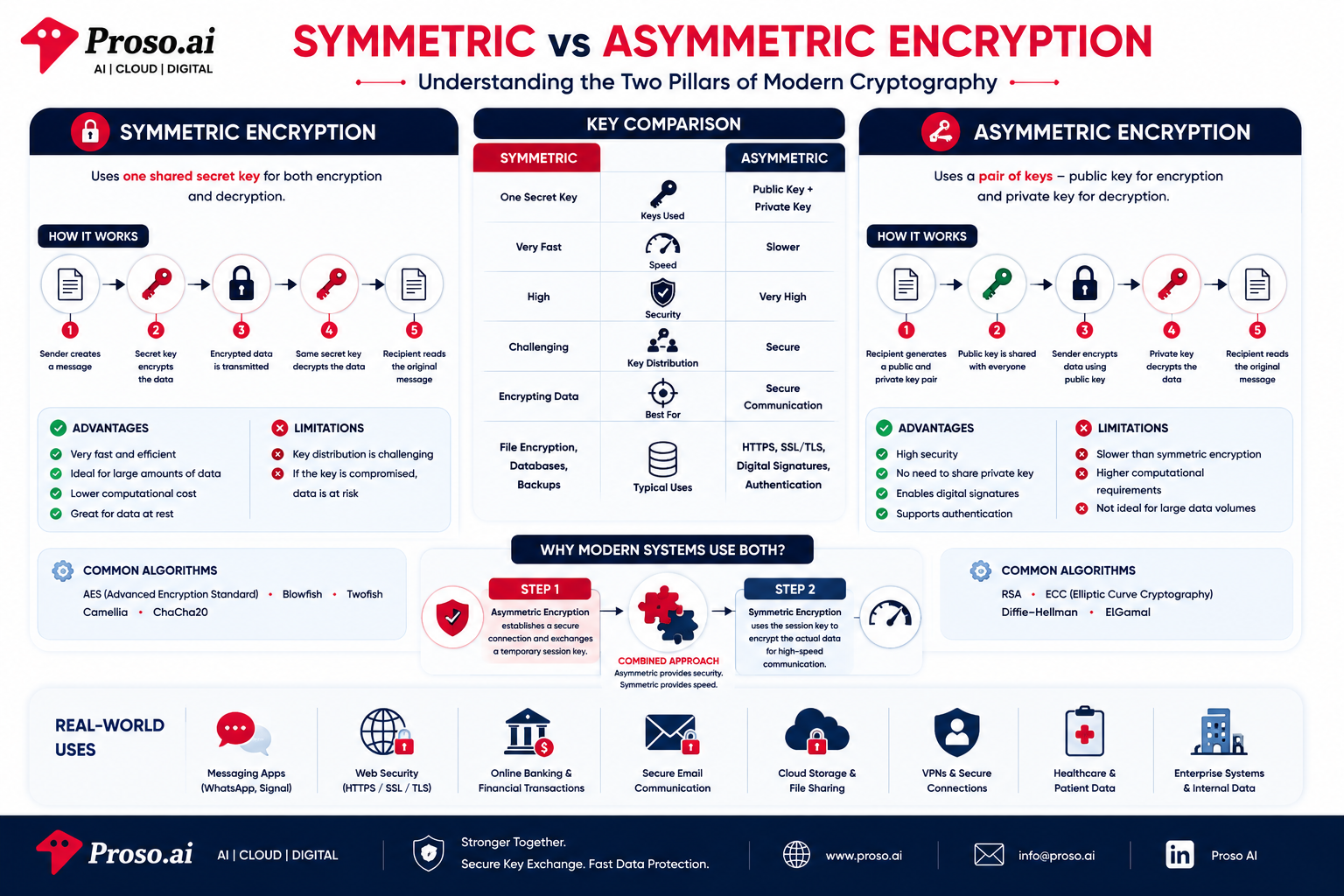
Symmetric encryption uses a single secret key for both encryption and decryption.
Both the sender and recipient must possess the same key before secure communication can begin.
The biggest challenge lies in securely sharing the secret key. If the key is intercepted, all encrypted information becomes vulnerable.
Asymmetric encryption, also known as Public Key Cryptography, solves the key-sharing problem.
Instead of one key, it uses two mathematically related keys:
A message encrypted with a public key can only be decrypted using the corresponding private key.
This approach provides significantly stronger security for internet communications.
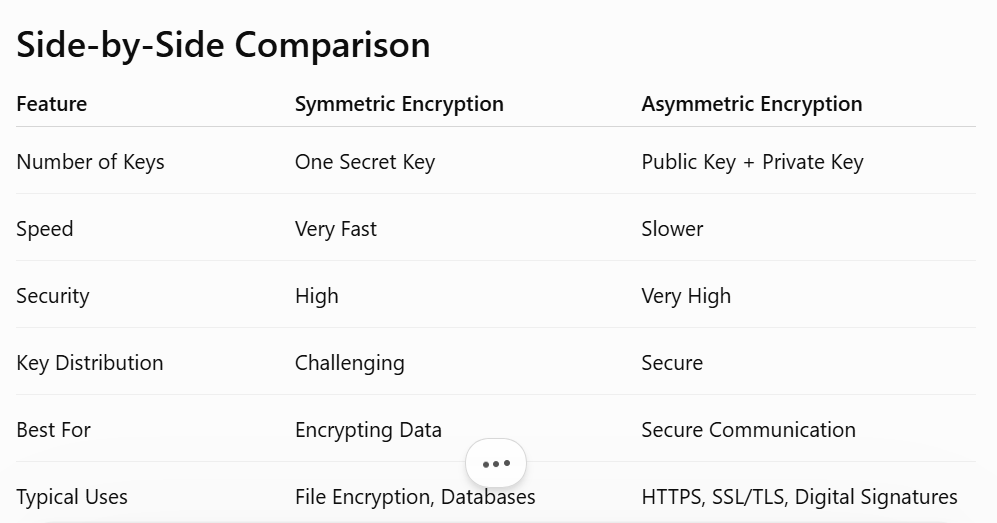
FeatureSymmetric EncryptionAsymmetric EncryptionKeys UsedOne Secret KeyPublic & Private KeysSpeedFasterSlowerSecurityGoodHigherBest ForLarge data encryptionSecure communication & authenticationCommon UsageFile encryption, databasesHTTPS, SSL/TLS, digital certificates
In practice, modern systems often combine both methods. Asymmetric encryption securely exchanges a session key, while symmetric encryption handles the bulk of data transfer for better performance.
Encryption is often associated with smartphones, online banking, and secure messaging apps. However, the concept of protecting information is far older than the internet itself. For thousands of years, civilizations have relied on encryption to safeguard military strategies, diplomatic communications, and confidential information.
While the techniques have evolved dramatically, the objective has remained unchanged: ensuring that only the intended recipient can understand the information being shared.
Today, encryption forms the backbone of digital trust, securing everything from personal conversations and financial transactions to cloud computing and enterprise communications.
The earliest forms of encryption were surprisingly simple.
Ancient civilizations used handwritten symbols, coded alphabets, and substitution ciphers to conceal sensitive information. One of the most well-known examples is the Caesar Cipher, developed by Julius Caesar around 58 BC.
In this method, each letter in a message was shifted by a fixed number of positions in the alphabet.
For example:
HELLO
became
KHOOR
Anyone who knew the shift could easily decode the message.
Although revolutionary for its time, these methods offered very little protection against determined attackers.
As computers became more powerful during the 20th century, organizations needed stronger methods to protect digital information.
Governments, banks, and enterprises began developing mathematical encryption algorithms capable of securing electronic communications.
This marked the birth of modern cryptography, replacing manual ciphers with sophisticated algorithms capable of encrypting enormous amounts of data within milliseconds.
The focus shifted from hiding messages to protecting digital identities, financial systems, and internet communications.
The first major advancement in modern cryptography was Symmetric Encryption.
Instead of replacing letters, computers used complex mathematical algorithms together with a single secret key to encrypt and decrypt data.
Both the sender and recipient needed access to the same key.
This approach dramatically increased encryption speed and remains one of the fastest methods for protecting large amounts of information.
However, it introduced a significant challenge:
How do you securely share the secret key without exposing it to attackers?
This limitation became increasingly problematic as the internet connected millions of users worldwide.
In the 1970s, researchers introduced one of the most significant breakthroughs in cybersecurity:
Asymmetric Encryption, also known as Public-Key Cryptography.
Instead of relying on one shared secret key, this method introduced two mathematically related keys:
This innovation solved the long-standing problem of secure key distribution and paved the way for secure online communication.
Today, public-key cryptography powers technologies such as:
Without this breakthrough, secure internet banking, e-commerce, and cloud computing would not exist in their current form.
Today's digital world generates unprecedented amounts of data.
Organizations exchange sensitive information across cloud platforms, remote workplaces, mobile devices, and AI-powered applications every second.
To keep this information secure, modern systems combine multiple encryption techniques rather than relying on a single approach.
For example:
This hybrid approach delivers both high security and high performance, making it suitable for everything from messaging apps to enterprise cloud platforms.
Cyber threats continue to grow in complexity.
Attackers now use artificial intelligence, automated malware, phishing campaigns, and sophisticated ransomware to target sensitive information.
To stay ahead, encryption technologies continue to evolve with innovations such as:
These advancements are shaping the future of cybersecurity and preparing organizations for emerging threats, including quantum computing.
1. Encryption has protected confidential information for thousands of years.
2. Ancient ciphers evolved into sophisticated mathematical cryptography.
3. Symmetric Encryption introduced speed but faced key-sharing challenges.
4. Asymmetric Encryption solved secure key distribution using public and private keys.
5. Modern security combines multiple encryption methods to protect digital communications at scale.
Every secure digital interaction—from logging into your bank account to sending a message on WhatsApp—depends on encryption. But not all encryption works the same way.
Modern cybersecurity relies on two primary encryption methods:
While both are designed to protect sensitive information, they solve different security challenges and are often used together to create a fast, secure, and scalable communication system.
Understanding the difference between these two approaches is essential for appreciating how modern applications, websites, and enterprise systems protect data.
Symmetric Encryption is the oldest and one of the fastest forms of encryption.
It uses one shared secret key for both encrypting and decrypting information.
This means that the sender and recipient must both possess the same key before communication begins.
Think of it like a locked safe.
You lock the safe using one key, and the recipient must use that exact same key to unlock it.
If someone else obtains the key, they can also access everything inside.
Although this approach sounds simple, it remains one of the most efficient methods for encrypting large volumes of data.
Because only one key is involved, encryption and decryption happen extremely quickly.
This makes symmetric encryption ideal for protecting:
1. Extremely fast
2. Efficient for encrypting large amounts of data
3. Lower computational requirements
4. Ideal for real-time applications
5. Excellent for data stored at rest
Despite its speed, symmetric encryption introduces one major challenge:
How do you securely share the secret key?
If the key is intercepted while being exchanged, an attacker gains complete access to the encrypted information.
This "key distribution problem" limited the use of symmetric encryption for internet communications.
To solve the key-sharing problem, cryptographers developed Asymmetric Encryption, also known as Public-Key Cryptography.
Instead of relying on one shared key, it uses two mathematically related keys:
Available to everyone.
Used only for encrypting information.
Known only to the recipient.
Used exclusively for decrypting information.
Even though the keys are mathematically connected, it is practically impossible to derive the private key from the public key.
This makes asymmetric encryption significantly more secure for communication over untrusted networks such as the internet.
Even if attackers intercept both the encrypted data and the public key, they still cannot read the original message without the private key.
1. Highly secure
2. Eliminates secure key-sharing challenges
3. Enables digital signatures
4. Supports user authentication
5. Forms the foundation of internet security
Greater security comes with one trade-off.
Because asymmetric encryption performs more complex mathematical operations, it is significantly slower than symmetric encryption.
For encrypting massive files or streaming large amounts of data, using only asymmetric encryption would be inefficient.
One of the biggest misconceptions is that organizations must choose between symmetric and asymmetric encryption.
In reality, they work together.
When you visit a secure website or use a messaging app, here's what happens:
Step 1: Asymmetric Encryption establishes a secure connection and safely exchanges a temporary session key.
Step 2: Symmetric Encryption uses that session key to encrypt the actual communication because it is much faster.
This hybrid approach combines the strengths of both methods:
Together, they create the secure digital experiences we rely on every day.
These algorithms secure billions of online transactions every day.
End-to-End Encryption isn't limited to cybersecurity professionals or enterprise IT systems. In today's digital world, it quietly protects billions of interactions every single day.
Whether you're sending a message to a friend, transferring money online, attending a virtual meeting, or sharing confidential business documents, encryption is working behind the scenes to ensure your data remains private and secure.
As organizations increasingly embrace cloud computing, hybrid work, AI-powered collaboration, and digital transformation, End-to-End Encryption has become a foundational technology for protecting both personal privacy and enterprise data.
Let's explore where it makes the biggest impact.
Messaging platforms are among the most common examples of End-to-End Encryption.
Whenever you exchange personal conversations, photos, voice notes, or documents, encryption ensures that only you and the intended recipient can read the content.
Even the platform itself cannot access the encrypted messages.
Without encryption, sensitive conversations could be intercepted during transmission, exposing private information to unauthorized users.
Every time you log into your banking application or authorize an online payment, encryption safeguards your financial information.
Sensitive data such as account numbers, passwords, payment credentials, and transaction details travel securely across networks, reducing the risk of fraud and cyberattacks.
Encryption helps financial institutions maintain customer trust while meeting strict regulatory and compliance requirements.
Healthcare organizations manage some of the most sensitive personal information in existence.
Patient records, laboratory reports, diagnostic images, prescriptions, insurance information, and telemedicine consultations all require strong protection against unauthorized access.
End-to-End Encryption helps healthcare providers maintain patient confidentiality while supporting secure collaboration between hospitals, clinics, laboratories, and healthcare professionals.
Strong encryption supports compliance with healthcare privacy regulations while protecting patient trust.
Modern businesses rely heavily on cloud platforms to store and exchange confidential information.
Documents often pass through multiple devices, networks, and cloud services before reaching collaborators.
End-to-End Encryption ensures that files remain protected throughout the entire sharing process.
Without encryption, confidential corporate information could become vulnerable to unauthorized access or accidental exposure.
Remote work has transformed how organizations communicate.
Teams now collaborate through messaging platforms, video conferences, shared workspaces, and cloud applications spread across multiple locations.
End-to-End Encryption enables organizations to protect confidential conversations while maintaining secure collaboration between employees, partners, and clients.
For enterprises, secure communication is no longer optional—it is a business necessity.
When customers purchase products online, they share payment information, delivery addresses, and personal details with retailers.
Encryption protects these transactions from cybercriminals attempting to intercept payment information or steal customer identities.
It also helps online businesses build confidence by assuring customers that their personal information remains secure.
Governments process enormous amounts of confidential information, including citizen records, tax information, legal documents, and national security communications.
Encryption protects this sensitive information while enabling secure digital public services.
Examples include:
As organizations adopt AI, cloud computing, and enterprise automation, data moves continuously between applications, APIs, and cloud environments.
Encryption ensures that sensitive business information remains protected throughout these complex digital ecosystems.
Industries using enterprise-grade encryption include:
This enables organizations to innovate confidently while maintaining compliance and protecting valuable business assets.
Although the applications vary, the objective remains the same:
As cyber threats continue to evolve, organizations can no longer rely solely on traditional perimeter security. Encryption has become a core component of modern cybersecurity strategies.
Whether protecting a private conversation or securing enterprise-scale cloud infrastructure, End-to-End Encryption ensures that information remains confidential throughout its journey.
1. End-to-End Encryption is used across consumer apps, financial systems, healthcare, cloud storage, enterprise collaboration, and government platforms.
2. It protects sensitive information during transmission, reducing the risk of interception and unauthorized access.
3. For businesses, encryption is not just a technical safeguard—it supports compliance, customer trust, and secure digital transformation.
For many organizations, cybersecurity is often viewed as an IT responsibility. However, in today's digital economy, protecting sensitive information has become a business imperative.
Every organization—regardless of its size or industry—handles valuable data. Customer information, financial records, employee details, intellectual property, contracts, and strategic business plans are constantly shared across emails, cloud platforms, collaboration tools, and enterprise applications.
Without adequate protection, this information becomes a prime target for cybercriminals.
End-to-End Encryption ensures that confidential data remains accessible only to authorized users, significantly reducing the risk of interception, unauthorized access, and data breaches.
More importantly, it helps businesses operate with confidence in an increasingly connected and regulated digital landscape.
Data is one of an organization's most valuable assets.
From customer databases and financial reports to product designs and legal agreements, businesses exchange critical information every day.
If this information falls into the wrong hands, the consequences can include financial losses, reputational damage, legal liabilities, and operational disruption.
End-to-End Encryption safeguards sensitive business communications by ensuring that only authorized recipients can access the information.
Organizations that prioritize encryption significantly reduce the likelihood of unauthorized access and data exposure.
Customers expect businesses to handle their information responsibly.
Every online purchase, digital payment, support request, or account registration involves sharing personal information.
If customers believe their information is not adequately protected, trust can disappear overnight.
Strong encryption demonstrates that an organization takes data security seriously.
By safeguarding customer information throughout its lifecycle, businesses strengthen relationships, enhance brand reputation, and improve customer confidence.
In today's competitive market, trust has become one of the strongest differentiators.
Governments worldwide continue introducing stricter data privacy regulations.
Organizations must demonstrate that sensitive information is collected, processed, transmitted, and stored securely.
Encryption plays a significant role in helping businesses comply with regulations such as:
Although encryption alone does not guarantee compliance, it is widely recognized as one of the most effective technical safeguards for protecting regulated data.
Cyber threats have become increasingly sophisticated.
Modern attackers use ransomware, phishing, credential theft, malware, and network interception techniques to gain unauthorized access to sensitive information.
Even when attackers successfully intercept encrypted data, End-to-End Encryption ensures that the information remains unreadable without the correct decryption keys.
This dramatically limits the value of stolen data and reduces the overall impact of many cyberattacks.
Encryption serves as one of the strongest defensive layers in a comprehensive cybersecurity strategy.
Organizations continue adopting cloud computing, artificial intelligence, remote work, and enterprise collaboration platforms.
These technologies improve efficiency but also increase the volume of sensitive information moving across networks and devices.
End-to-End Encryption enables businesses to embrace digital innovation without compromising security.
Whether employees are working remotely, collaborating globally, or accessing cloud applications, encryption ensures that sensitive information remains protected throughout its journey.
As digital ecosystems become more interconnected, encryption becomes an essential foundation for secure transformation.
A single data breach can have long-term consequences.
Beyond financial penalties, organizations often face:
Recovering from a breach can take years.
By implementing strong encryption practices, businesses demonstrate their commitment to protecting customer information and maintaining operational integrity.
Security is no longer just about preventing attacks—it's about preserving trust and protecting the organization's reputation.
Many organizations view encryption as a technical requirement.
In reality, it is a business enabler.
It allows organizations to:
In an era where data drives every business decision, encryption has become a critical component of resilience and long-term success.
✔ End-to-End Encryption protects sensitive business information throughout its lifecycle.
✔ It strengthens customer trust by ensuring that confidential data remains private.
✔ Encryption supports compliance with global data protection regulations.
✔ It reduces the impact of cyberattacks by making intercepted data unreadable.
✔ Most importantly, encryption enables organizations to innovate securely in an increasingly digital world.
End-to-End Encryption has evolved from a technical security measure into a cornerstone of modern digital trust. Whether protecting personal conversations, financial transactions, healthcare records, or enterprise communications, it ensures that sensitive information remains confidential from sender to recipient.
As organizations continue accelerating their digital transformation journeys, encryption is no longer optional—it's a strategic investment in resilience, compliance, customer trust, and long-term business success.
At Proso AI, we help organizations build secure, intelligent, and future-ready digital ecosystems. Through cybersecurity, cloud modernization, enterprise integration, AI, and digital transformation services, we empower businesses to innovate confidently while keeping their most valuable asset—their data—protected at every step.

.jpg)

.png)
.png)