.png)
Salesforce has evolved far beyond a customer relationship management (CRM) platform. Today, it serves as the digital backbone of many organizations, powering sales, marketing, customer service, finance, and business operations. Every customer interaction, contract, support case, sales opportunity, and business decision generates data that fuels enterprise growth.
As organizations expand, so does the volume of information stored within Salesforce. New business units, custom objects, third-party integrations, automation workflows, and AI-driven processes continuously add to the complexity of enterprise data. While this enables greater collaboration and operational efficiency, it also introduces a critical challenge that many businesses underestimate.
Not all data carries the same level of risk.
A customer's name and email address require a different level of protection than payment information, healthcare records, confidential contracts, or personally identifiable information (PII). Yet many organizations continue to apply broad security policies without fully understanding which data is sensitive, who owns it, how it is used, or which regulatory requirements govern it.
This lack of visibility creates hidden risks across the enterprise. Compliance becomes more difficult to manage, audits become more time-consuming, and sensitive information is more likely to be exposed through inconsistent governance practices. Even organizations with strong access controls, role hierarchies, and authentication mechanisms can struggle to secure data effectively if they don't first understand the nature of the information they are protecting.
This is where Salesforce Data Classification becomes an essential component of enterprise data governance.
Rather than treating every field equally, Salesforce enables organizations to classify data based on its sensitivity, ownership, business purpose, and compliance requirements. By creating a structured data classification framework, businesses gain greater visibility into their information, strengthen security policies, simplify regulatory compliance, and establish a scalable foundation for future initiatives such as AI, automation, and advanced analytics.
In today's data-driven economy, protecting enterprise information begins long before security controls are applied.
It begins with understanding your data.
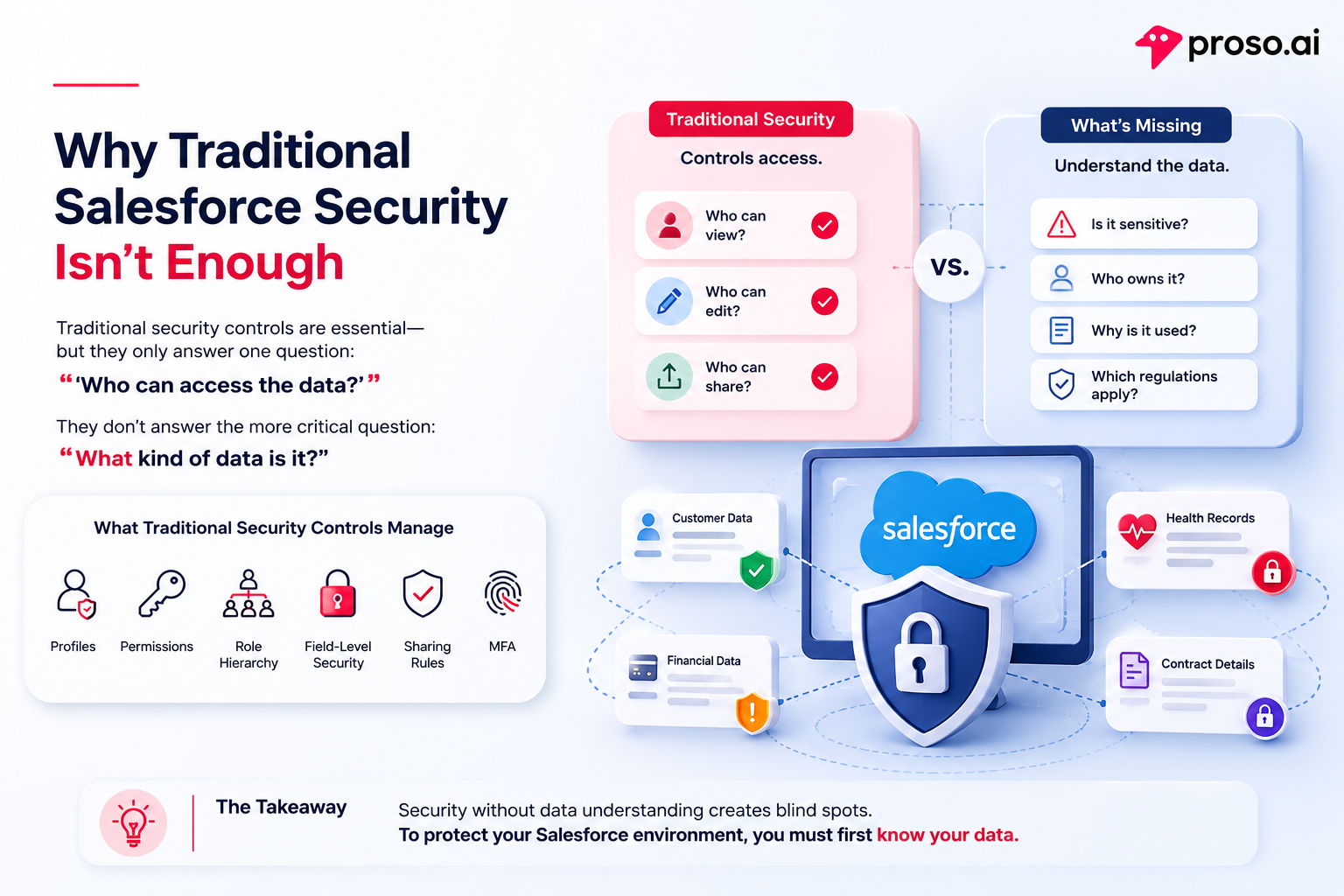
For years, organizations have relied on Salesforce's robust security model to protect their CRM environments. Profiles, Permission Sets, Role Hierarchies, Sharing Rules, Field-Level Security, Multi-Factor Authentication (MFA), and Shield Encryption have become essential components of every enterprise security strategy.
These controls are highly effective—but they solve only one part of the security equation.
They determine who can access data.
They don't determine what that data actually is.
This distinction is becoming increasingly important as enterprises manage millions of customer records across multiple departments, clouds, integrations, and AI-powered workflows.
Imagine two custom fields inside Salesforce.
One stores a customer's preferred communication channel.
The other stores passport information or medical records.
From a technical perspective, both are simply fields in the database. Yet from a business, legal, and compliance perspective, they represent completely different levels of risk.
Without identifying which information is public, internal, confidential, restricted, or mission-critical, organizations often apply inconsistent governance policies. Sensitive customer information may be overlooked, compliance efforts become reactive instead of proactive, and security teams spend valuable time trying to locate regulated data during audits or incident investigations.
As businesses continue to adopt AI, automation, and connected enterprise applications, this lack of visibility becomes even more challenging. AI models, integrations, analytics platforms, and third-party applications can only be governed effectively when the underlying data is properly understood and classified.
This is why modern enterprise security is no longer built on access controls alone.
It begins with understanding the business value, sensitivity, ownership, and compliance requirements of every piece of information stored within Salesforce.
Only then can organizations apply the right security controls to the right data.
Every piece of information stored in Salesforce has a different business value.
A customer's first name is not as sensitive as their banking information. A support ticket doesn't carry the same compliance requirements as a healthcare record. Likewise, an internal project identifier shouldn't be governed the same way as personally identifiable information (PII).
Yet, without a structured framework, Salesforce simply stores all of these as data fields.
This is where Salesforce Data Classification changes the conversation.
Instead of asking "Who should have access to this field?", organizations first ask a much more important question:
"What type of information is this?"
Once that question is answered, security policies become significantly easier to design, automate, and govern.
Salesforce Data Classification enables organizations to categorize data based on its sensitivity, ownership, business purpose, and regulatory obligations. Rather than treating every field equally, it provides context that helps IT teams, security leaders, compliance officers, and administrators understand which information requires additional protection and why.
This classification becomes the foundation for stronger governance across the Salesforce ecosystem. It supports everything from security policies and compliance reporting to AI governance, data retention strategies, and enterprise-wide risk management.
More importantly, it creates a common language between business teams and technical teams. Instead of relying on assumptions, everyone understands which data is public, which is confidential, who owns it, and how it should be handled throughout its lifecycle.
As organizations continue to embrace AI, automation, and connected cloud applications, this level of visibility is no longer optional—it has become essential for building secure, compliant, and scalable Salesforce environments.
.png)
Data security isn't built by simply restricting access. It begins with understanding what data exists, why it matters, who owns it, and how it should be protected.
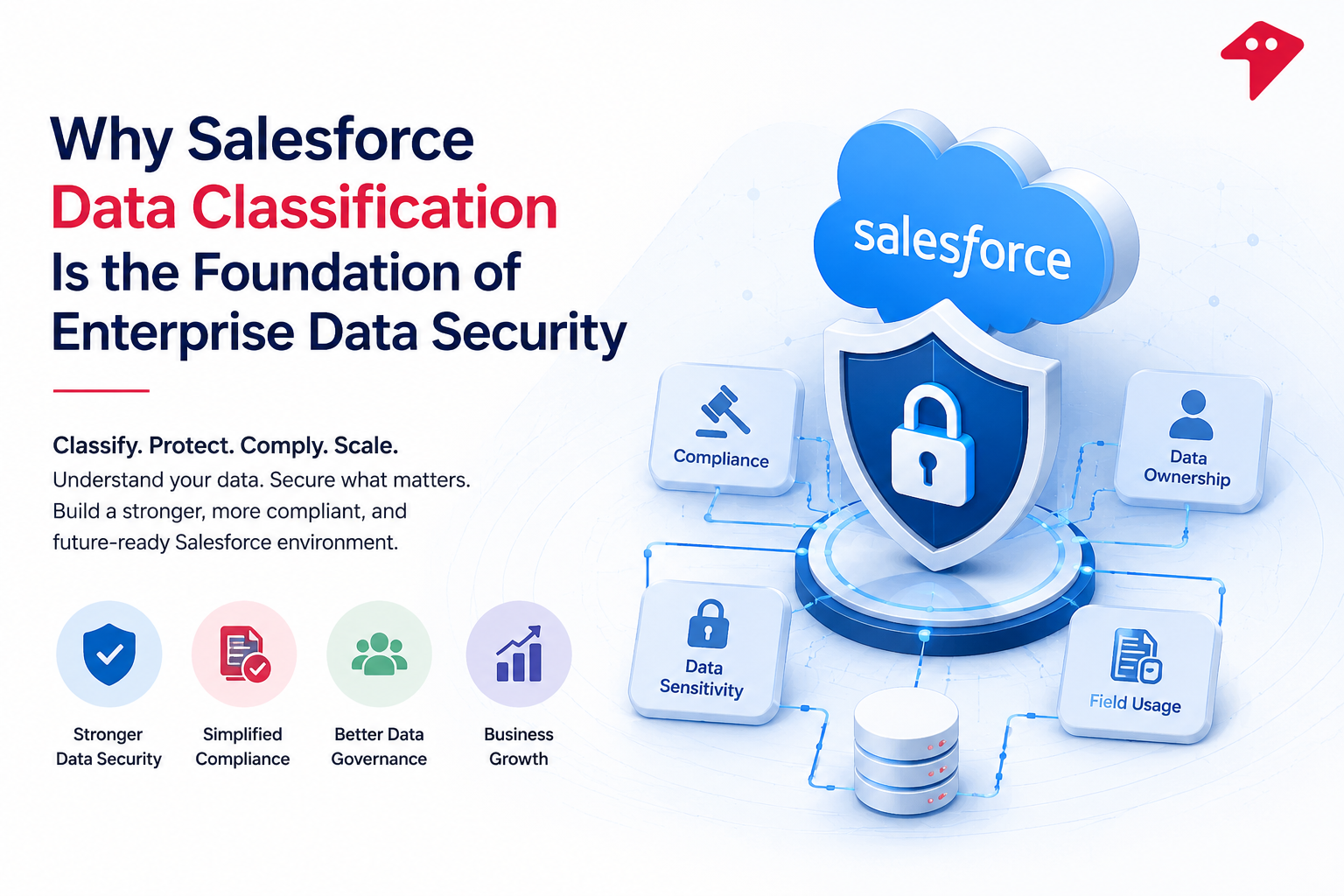
To help organizations create that foundation, Salesforce provides four built-in classification fields that work together to strengthen governance across the entire CRM ecosystem.
Instead of relying on spreadsheets or manual documentation, these metadata fields create a standardized framework that helps administrators, security teams, compliance officers, and business leaders make informed decisions about enterprise data.
Let's explore how each classification contributes to a stronger security strategy.
Not every data field is governed by the same regulations.
Some information falls under GDPR, while other fields may be subject to HIPAA, PCI DSS, CCPA, or industry-specific compliance standards.
Compliance Categorization allows organizations to identify which data requires additional regulatory protection, making audits, reporting, and governance significantly more efficient.
Rather than searching through thousands of fields during a compliance review, teams can instantly identify sensitive information and demonstrate how it is being managed.
Security becomes difficult when nobody owns the data.
The Data Owner field identifies the individual or department responsible for a particular data asset, ensuring clear accountability throughout its lifecycle.
When ownership is clearly defined, organizations improve data quality, accelerate governance decisions, and eliminate confusion over who is responsible for maintaining sensitive information.
Over time, Salesforce environments accumulate hundreds—or even thousands—of custom fields.
Many are no longer used, while others continue storing sensitive information without serving any business purpose.
Field Usage helps administrators identify active fields, hidden fields, and potential deprecation candidates.
This creates a cleaner Salesforce environment, reduces unnecessary security risks, and simplifies long-term platform management.
Not all enterprise data requires the same level of protection.
Salesforce enables organizations to classify information into sensitivity levels such as Public, Internal, Confidential, Restricted, and Mission Critical.
This classification allows security controls to match the actual value of the data.
Highly sensitive information can receive stronger access controls, encryption policies, monitoring, and governance, while less critical information remains accessible to support productivity.
The result is a security strategy that balances protection with business efficiency.
When these four classification pillars work together, organizations gain far more than organized metadata.
They establish a trusted framework for governance, compliance, risk management, AI readiness, and enterprise security—making Salesforce data easier to understand, manage, and protect as the business grows.
Modern enterprises don't struggle because they lack security tools—they struggle because they lack visibility into their data.
As organizations scale across departments, regions, and cloud applications, Salesforce becomes home to millions of records containing customer information, financial details, contracts, healthcare data, intellectual property, and operational insights. Protecting this information requires more than access controls. It requires understanding the sensitivity and business value of every piece of data.
This is where Salesforce Data Classification becomes a critical part of an enterprise security strategy.
By classifying data before applying security controls, organizations create a governance framework that is proactive rather than reactive. Security teams know exactly where sensitive information resides, compliance teams can prepare for audits with confidence, and administrators can implement consistent policies without relying on manual documentation.
Data Classification also strengthens collaboration between business users and IT teams. Instead of treating every Salesforce field equally, organizations establish a common understanding of which information is public, internal, confidential, restricted, or mission-critical. This shared context improves decision-making and reduces the likelihood of sensitive data being exposed unintentionally.
As enterprises adopt AI-powered analytics, automation, and third-party integrations, classified data becomes even more valuable. AI systems can only deliver trustworthy insights when they operate on well-governed, accurately classified information. Without that foundation, organizations increase the risk of exposing regulated or confidential data to automated workflows.
Ultimately, Salesforce Data Classification transforms security from a collection of isolated controls into a connected governance strategy—one that protects sensitive information, simplifies compliance, and enables organizations to innovate with confidence.
Improve enterprise-wide data governance
Accelerate GDPR, HIPAA, CCPA, and PCI compliance
Reduce security and privacy risks
Support responsible AI and automation initiatives
Simplify audits and regulatory reporting
Strengthen trust across customers, employees, and partners
Data Classification delivers the greatest value when it becomes part of everyday business operations. Across industries, organizations rely on Salesforce to manage their most valuable asset—data. Whether it's customer records, financial information, healthcare data, or intellectual property, understanding the sensitivity of that information is the first step toward protecting it.
Here are some examples of how enterprises use Salesforce Data Classification to strengthen security, simplify compliance, and improve governance.
Banks, insurance providers, and financial institutions process large volumes of confidential customer information every day. Account numbers, transaction histories, tax documents, and identity records all require strict protection.
By classifying sensitive financial data, organizations can apply stronger security controls, support regulatory compliance, and ensure only authorized users can access business-critical information. This reduces operational risk while improving customer trust.
Healthcare organizations manage highly regulated patient information that must comply with standards such as HIPAA and regional privacy regulations.
Salesforce Data Classification helps administrators identify protected health information (PHI), establish appropriate governance policies, and simplify compliance reporting. This allows healthcare providers to improve patient experiences while maintaining data privacy and security.
Manufacturers store supplier contracts, production schedules, engineering specifications, and product development information inside Salesforce.
Classifying these records helps organizations protect confidential operational data, limit unauthorized access, and ensure critical business information remains secure throughout the product lifecycle.
Retailers collect customer profiles, purchase histories, loyalty information, and marketing preferences across multiple channels.
With Salesforce Data Classification, organizations can identify personally identifiable information (PII), manage customer consent more effectively, and maintain compliance with evolving privacy regulations while delivering personalized customer experiences.
As AI becomes part of everyday business operations, technology companies need confidence that sensitive information is governed before it reaches AI-powered workflows.
Data Classification provides the visibility needed to determine which datasets can be safely used for analytics, automation, and AI initiatives while protecting confidential business information and customer data.
Although every industry faces different regulatory and operational challenges, the objective remains the same:
Organizations need to understand their data before they can protect it.
Salesforce Data Classification provides that visibility, enabling enterprises to reduce security risks, improve governance, simplify compliance, and build a trusted foundation for AI, automation, and future digital transformation initiatives.
Implementing Salesforce Data Classification is not simply about assigning labels to fields. The real value lies in creating a governance strategy that aligns with business objectives, regulatory requirements, and long-term digital transformation goals.
At Proso AI, we help organizations move beyond basic Salesforce configuration to establish secure, scalable, and intelligent data governance frameworks.
Our approach begins with understanding your existing Salesforce environment. We assess how data is collected, stored, accessed, and shared across departments, identifying sensitive information that requires stronger governance and protection. This provides organizations with a clear picture of their data landscape before implementing classification policies.
Once critical data has been identified, we help define meaningful classification standards that align with your industry regulations and internal security policies. Rather than applying generic controls, we build governance models tailored to your organization's operational needs, ensuring sensitive information receives the appropriate level of protection without creating unnecessary complexity for end users.
Our Salesforce experts also help organizations strengthen the broader security ecosystem by aligning Data Classification with Field-Level Security, Permission Sets, Sharing Rules, Shield Encryption, audit capabilities, and enterprise compliance initiatives. The result is a unified governance model that improves visibility while reducing operational risk.
As businesses continue to invest in AI, analytics, and enterprise automation, well-classified data becomes even more valuable. Proso AI helps organizations prepare Salesforce environments for responsible AI adoption by ensuring that trusted, governed data forms the foundation for intelligent business processes.
Whether you're beginning your Salesforce governance journey or modernizing an existing CRM environment, our focus is to help you build a platform that is secure, compliant, scalable, and ready for the future.
Salesforce consulting and implementation expertise
Enterprise data governance strategy
Compliance-focused CRM architecture
Security and access control optimization
AI-ready Salesforce environments
Scalable solutions designed for long-term growth
As organizations continue to accelerate their digital transformation initiatives, Salesforce has evolved into far more than a CRM platform. It has become the central repository for customer relationships, operational intelligence, financial information, and business-critical data. Protecting this information requires more than robust authentication, access controls, or encryption—it requires a clear understanding of the data itself.
Salesforce Data Classification provides that foundation. By identifying the sensitivity, ownership, business purpose, and compliance requirements of enterprise data, organizations can build governance strategies that are proactive, scalable, and aligned with today's regulatory landscape. The result is stronger security, simplified compliance, improved operational visibility, and greater confidence in every business decision.
As AI, automation, and connected enterprise applications become integral to modern business, the importance of trusted and well-governed data will only continue to grow. Organizations that invest in understanding their data today will be better positioned to innovate securely tomorrow.
At Proso AI, we help businesses transform Salesforce into a secure, compliant, and future-ready platform by combining deep Salesforce expertise with practical data governance strategies. Whether your goal is to strengthen compliance, improve security, or prepare your CRM for AI-driven innovation, our team helps you build a Salesforce environment that supports long-term business growth.
Because in today's digital enterprise, security doesn't begin with restricting access—it begins with understanding your data.
A strong Salesforce security strategy starts with knowing what data you have, how sensitive it is, and how it should be governed.
Connect with Proso AI to assess your Salesforce environment, implement an effective data classification strategy, and build a governance framework that supports security, compliance, and future AI initiatives.

.jpg)

.png)
.png)