.png)
And What Leaders Must Know to Transform Their Operations in 2026
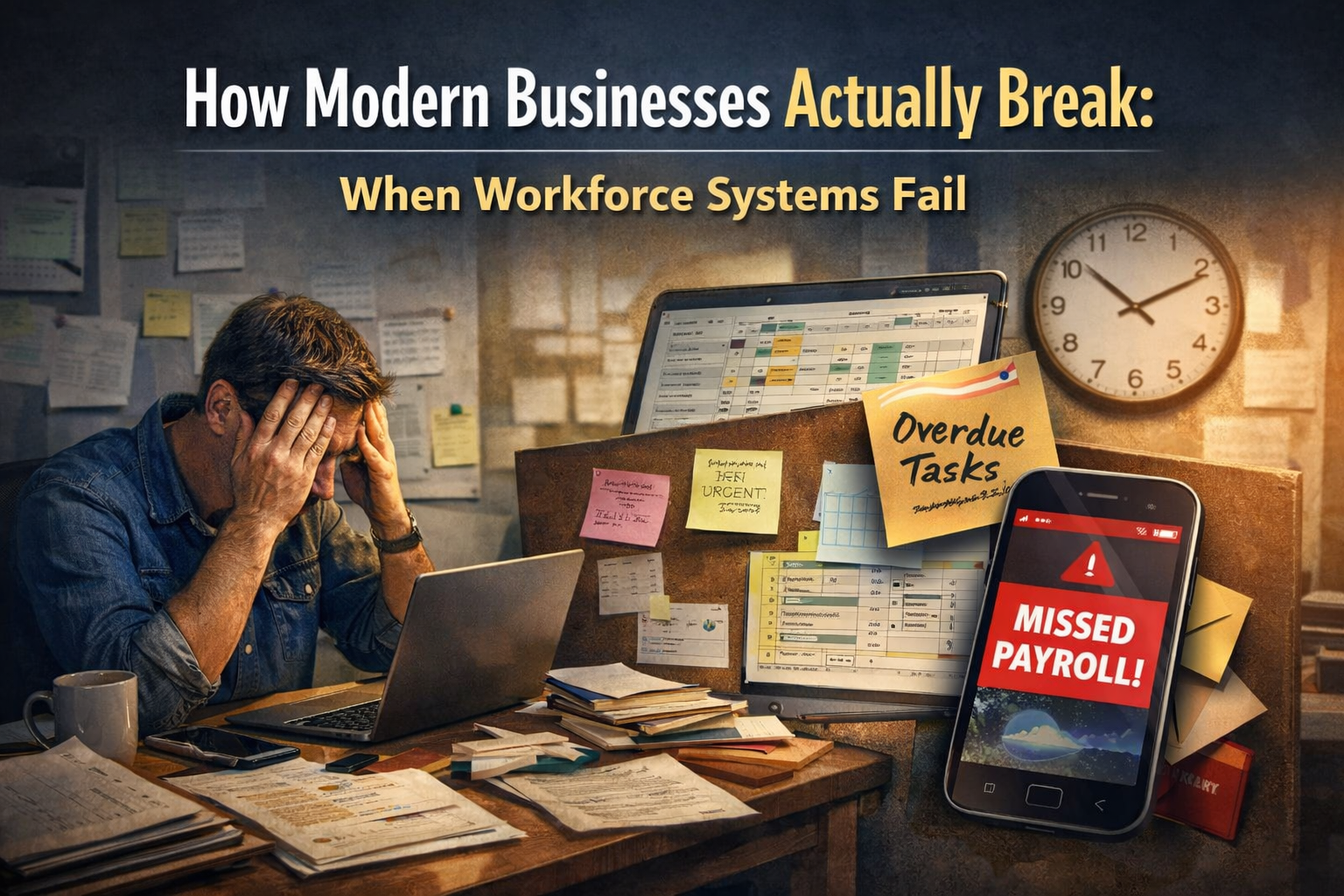
Technology should make small businesses stronger, not more complicated. Yet most leaders tell me the opposite — their tools feel disconnected, their teams are overwhelmed, and growth feels slower than it should.
When Priya launched her logistics startup, she used WhatsApp, a shared spreadsheet, and a Gmail account. Six months later she had 35 people, three contractors across two states, and a dozen SaaS subscriptions. People were busy — but deadlines slipped. The finance lead discovered payroll errors. A key contract went unsigned because the right document was in someone’s private folder. Priya couldn’t point to a single disaster; she only felt the constant friction. That slow, quiet version of “breaking” is the one most leaders don’t recognize until it costs them time, money, and trust.
Most leaders come to this problem with a list of symptoms, not a diagnosis:
Those symptoms feel operational — but their root cause is systemic. Leaders interpret them as people problems (“we need more discipline”) or budget problems (“we need better software”), when the actual failure is a lack of repeatable systems and governance.
A few factors make this invisible failure especially hard to diagnose:
When founders type "why is my team slow with tools" or "how to stop payroll errors," what they’re actually asking is deeper:
“Why is running this business harder now than when we were smaller?”
That question points to a single answer: systems didn’t scale with the organization. The work changed (more people, more rules, more jurisdictions), but the processes didn’t.
Before buying another app or hiring an expert, check these five things this week:
If you answered “no” to two or more, you’re experiencing system drift — and that’s the real cause of the friction.
Over the past decade, small businesses have adopted some of the most advanced productivity tools ever built. Email, document collaboration, chat, video meetings, cloud storage, and now AI-assisted workflows are readily available—even to very small teams.
And yet, complexity continues to rise.
Leaders often express this frustration in simple terms: “We have good tools, but things still feel messy.” This isn’t a contradiction. It’s a predictable outcome of how tools are introduced into growing organizations.
Modern productivity platforms are designed to accelerate work. They make it easier to communicate, share files, and collaborate in real time. What they do not do—by default—is define how work should flow through an organization.
When teams grow without shared operating rules:
The tools are working as intended. The system around them is not.
As a result, businesses experience activity without alignment. Work moves quickly, but not always in the same direction.
When friction appears, the instinctive response is to look for additional features or applications. Leaders add:
Each addition solves a local problem. None address the underlying issue: there is no agreed-upon operational backbone.
Instead of simplifying work, tools begin to overlap. Teams spend time deciding where to do work rather than doing it. Information duplicates, and accountability blurs.
This is when productivity tools start to feel heavy instead of helpful.
Many leaders attempt to standardize processes—only to face resistance. Teams argue that:
What’s often missing is context. Standardization isn’t about control; it’s about reducing decision fatigue. When every team chooses its own method, leaders are forced to reconcile differences continuously.
Over time, this creates a hidden cost:
The business becomes fragile—not because people are unwilling, but because the system relies too heavily on memory and effort.
One of the most common complaints among growing businesses is that collaboration feels disjointed.
Documents live in multiple places. Conversations are split between chat and email. Decisions are discussed but not captured. When someone is absent, progress stalls.
This isn’t a collaboration problem. It’s a coordination problem.
Coordination requires:
Without these, collaboration tools simply surface confusion faster.
As complexity grows, leadership involvement increases. Founders and senior managers become the default point of escalation. They approve exceptions, resolve conflicts, and interpret ambiguous information.
Initially, this feels manageable. Over time, it becomes a bottleneck.
The organization’s pace slows—not because people aren’t working, but because decisions cannot move independently of leadership. Productivity tools, in this context, amplify dependence rather than autonomy.
Many modern platforms now include AI features designed to summarize, suggest, and automate work. These capabilities are powerful—but only when they operate within clear systems.
AI can:
What it cannot do is:
When workflows are unclear, AI accelerates noise. It makes the business faster at being confused.
This is why many leaders feel underwhelmed by AI adoption. The problem isn’t the technology—it’s the absence of structure for the technology to work within.
The solution is not to abandon modern tools. It’s to change how they are introduced and governed.
Before adding new capabilities, leaders need to ask:
When productivity tools are anchored to clear processes, they reduce effort. When they aren’t, they multiply decisions.
When Microsoft announced new capabilities across Microsoft 365—expanding AI-powered assistance, strengthening security, and enhancing management tools—it wasn’t simply shipping features. It was responding to a broader shift in how work now happens, especially for smaller and mid-sized organizations.
At a glance, these announcements may look incremental. But taken together, they point to a clear message: work has become more complex, and businesses need stronger operational foundations to keep up.
Microsoft’s updates focus on three areas:
These aren’t isolated improvements. They are responses to challenges businesses of all sizes now face: distributed teams, growing data volumes, increasing security threats, and rising expectations for speed and accuracy.
For large enterprises, these capabilities are managed by dedicated IT teams. For small businesses, they surface a more uncomfortable truth: the tools are ready, but many organizations are not.
Small businesses often adopt enterprise-grade tools without enterprise-grade practices. As a result, the same features that enable scale can expose gaps in how work is structured.
For example:
When those assumptions don’t hold, new capabilities feel overwhelming rather than empowering.
This is why some leaders experience technology updates as disruption instead of progress.
Alongside new capabilities, Microsoft announced pricing updates scheduled for mid-2026. While pricing changes often attract the most attention, they serve a deeper purpose: they signal a shift from basic productivity software to integrated operational platforms.
In other words, productivity suites are no longer just tools for writing emails or documents. They are becoming:
This evolution raises an important question for leaders:
Are we using these platforms intentionally, or are we simply paying for capabilities we don’t fully leverage?
The challenge for many small businesses is not access—it’s adoption.
Modern platforms offer:
But without clear workflows and governance, these capabilities remain underused or misused. Teams revert to old habits. Leaders hesitate to enforce standards. Over time, complexity returns.
This is not a failure of technology. It’s a failure of alignment between tools and operations.
Microsoft’s announcement reflects a broader industry consensus: the future of work depends on connected systems, not standalone tools.
For small business leaders, this moment is an opportunity to pause and reassess:
Ignoring these questions means paying more for tools without realizing their value.
The takeaway is not that every business needs more technology. It’s that businesses need intentional structure around the technology they already have.
Modern platforms, including Microsoft 365, are designed to scale. But they scale best when paired with:
Without those, even the most advanced tools cannot reduce complexity.
Most small businesses don’t fail because they choose the wrong tools. They struggle because critical operational gaps remain invisible as long as the business is small enough to “power through”.
Growth doesn’t create these gaps. It reveals them.
By the time leaders notice persistent friction, these gaps are already embedded in daily work. They are rarely written down, rarely owned, and rarely discussed — yet they shape how every decision is made.
In many growing organizations, work gets done — but responsibility remains vague.
Tasks are completed because someone remembers to do them, not because a system ensures they happen. When something goes wrong, leaders ask who dropped the ball, only to discover no one clearly owned it in the first place.
This shows up in:
Without explicit ownership, work becomes fragile. It succeeds through effort, not design.
Small teams move fast by being informal. Decisions happen in conversations, not documents. Changes are shared verbally, not recorded.
At scale, this becomes a liability.
As teams grow:
Eventually, leaders are forced to intervene more often — not because people aren’t capable, but because the system provides no guardrails.
This is where businesses begin to feel “busy” without making proportional progress.
Governance sounds bureaucratic, so many small businesses avoid it. Instead, they operate on assumptions:
These assumptions work — until they don’t.
When access isn’t reviewed, former employees retain permissions. When data isn’t standardized, reports conflict. When policies aren’t explicit, enforcement becomes inconsistent.
The absence of governance doesn’t remove rules; it creates unspoken rules that vary by person and situation.
Data exists in almost every modern business. The problem is trust.
Leaders often receive:
Over time, leaders stop relying on data altogether and default to instinct.
This undermines decision quality and makes AI adoption especially risky, since automated insights are only as reliable as the data feeding them.
When problems surface, technology decisions are made quickly:
Each decision solves a narrow issue. Few are evaluated for how they fit into the broader system.
Over time, the tech stack becomes a patchwork — functional but brittle. Integration becomes harder. Costs rise quietly. And every change requires more coordination than the last.
These gaps don’t exist because leaders ignore them. They persist because:
But as complexity grows, these gaps compound. What once felt manageable becomes exhausting.
The cost of these gaps isn’t just inefficiency. It’s:
Leaders sense that the business could run better — but lack a clear starting point.
For many small business leaders, AI represents both opportunity and pressure. It promises faster execution, better insights, and competitive advantage — yet in practice, AI initiatives often stall, disappoint, or quietly fade away.
This isn’t because AI lacks capability. It’s because AI magnifies the quality of the systems it operates within.
AI tools are designed to work with existing information. They summarize conversations, analyze documents, and generate recommendations based on available inputs.
When those inputs are fragmented or inconsistent, AI produces outputs that are:
Leaders quickly learn that while AI can move fast, it cannot resolve ambiguity on its own.
In organizations where workflows, ownership, and data standards are unclear, AI accelerates noise rather than clarity.
Many businesses adopt AI expecting it to:
In reality, AI performs best when:
When these conditions don’t exist, AI becomes an experiment rather than an operational asset.
This gap between expectation and readiness is why leaders often conclude that “AI isn’t ready for us” — when the truth is the organization wasn’t ready for AI.
Across small and mid-sized businesses, AI adoption struggles tend to follow a pattern:
Without addressing these factors, AI becomes another layer of work rather than a source of leverage.
One of the most common mistakes leaders make is automating unstable processes.
If approvals are inconsistent, automating them doesn’t create clarity — it codifies confusion. If data is unreliable, automating analysis spreads errors faster.
AI should be applied after workflows are stabilized, not before.
This sequencing matters. Businesses that reverse it often spend more time fixing AI outputs than saving time.
Organizations that benefit from AI share a few traits:
In these environments, AI enhances focus instead of distracting it. Leaders trust outputs because they understand the system behind them.
AI becomes a multiplier — not a substitute.
The most important shift leaders must make is moving from tool-first thinking to system-first thinking.
Instead of asking:
They ask:
This reframing transforms AI from a trend into a capability.
By the time leaders reach this point, they’re no longer looking for inspiration. They’re looking for relief.
Their searches aren’t framed around platforms, features, or trends. They’re framed around pain, confusion, and time pressure. What they’re really trying to understand is not what to buy, but what’s wrong.
On the surface, leaders search for questions like:
These questions appear tactical, but they point to something deeper.
Behind each query is a broader concern:
Leaders aren’t searching for perfection. They’re searching for stability and predictability.
Many resources available to small businesses focus on tools:
While useful in isolation, these resources rarely address the real issue: how tools fit into a coherent operating model.
As a result, leaders may adopt recommended tools only to experience the same problems in a new interface.
This is why many feel stuck in a cycle of adoption without improvement.
The most important question often goes unspoken:
“How do we design the way work flows through our business?”
This question sits at the intersection of operations, technology, and leadership — and it’s rarely answered by software alone.
Leaders need guidance that helps them:
Without this clarity, even well-intentioned investments fail to deliver value.
For many businesses, this realization comes after:
At this point, leaders recognize that they don’t need more information — they need a partner who understands systems, not just software.
This is where the role of experienced partners becomes relevant.
Not as vendors pushing tools, but as guides who can translate complexity into clarity.
At this stage, many business leaders arrive at the same conclusion: the challenge they’re facing isn’t a lack of technology, but a lack of clarity, structure, and sustained execution.
Tools can be purchased quickly. Systems take time to design, implement, and maintain. This is where the role of a partner becomes essential.
Modern platforms are powerful, but they assume that someone is responsible for:
In large organizations, this responsibility is distributed across operations, IT, and leadership teams. In small businesses, it often falls to founders or senior leaders — on top of their existing responsibilities.
Without dedicated ownership, systems drift. And when systems drift, tools lose their impact.
A vendor provides software.
A partner helps design how the business operates.
This distinction matters.
Vendors are measured by adoption. Partners are measured by outcomes.
A true partner focuses on:
These outcomes require understanding the business, not just the technology.
Proso AI works with businesses that feel stuck between ambition and execution. Our approach starts by diagnosing how work actually happens, not how it’s supposed to happen.
We focus on:
This ensures that every tool introduced serves a purpose within a broader system.
One of the most common failures in small businesses is treating transformation as a one-time event. In reality, systems must evolve alongside the organization.
Proso AI helps businesses:
This ongoing alignment prevents the gradual return of complexity.
AI introduces new capability — but also new responsibility.
Proso AI helps businesses adopt AI in a way that:
This ensures AI becomes a sustainable advantage, not an unmanaged experiment.
Small business leaders are understandably skeptical. They’ve seen tools oversold and under-delivered.
Trust is earned by:
That’s why Proso AI’s role is not to sell technology, but to help businesses regain control of how work flows.
By now, one thing should be clear: most modern businesses don’t struggle because they lack technology. They struggle because their systems haven’t kept pace with their growth.
This is not a failure of leadership. It’s a natural outcome of moving fast in an environment where tools evolve faster than operating models.
The way forward doesn’t require sweeping transformation or disruptive change. It requires intentional, sequenced progress.
Before introducing new tools, AI features, or automation, leaders must stabilize the fundamentals:
Stability creates the conditions for improvement. Without it, optimization efforts increase noise.
Effective systems reflect reality, not ideals. That means:
When systems align with day-to-day behavior, adoption follows naturally.
Technology should be introduced to remove friction, not add features.
Every tool or capability should answer a clear question:
This approach ensures that technology investments translate into measurable value.
AI delivers its greatest impact when layered onto stable processes. Leaders should view AI as:
When introduced thoughtfully, AI amplifies clarity rather than confusion.
Operational systems are not static. As teams grow, markets shift, and tools evolve, systems must adapt.
Leaders who succeed create feedback loops:
This ongoing discipline prevents complexity from quietly rebuilding.
The most important shift leaders can make is moving from firefighting to system stewardship.
This doesn’t mean doing more work. It means ensuring that:
When systems are strong, leadership effort moves from coordination to strategy.
Modern tools, AI capabilities, and advanced platforms are transforming how work gets done. But technology alone cannot create clarity.
Clarity comes from systems that make work visible, ownership explicit, and decisions repeatable.
For leaders who feel overwhelmed despite having the “right tools,” this realization is empowering. It reframes the problem — and reveals a path forward that is practical, achievable, and sustainable.
The goal is not to do more.
It’s to make the business easier to run.

.jpg)

.png)
.png)