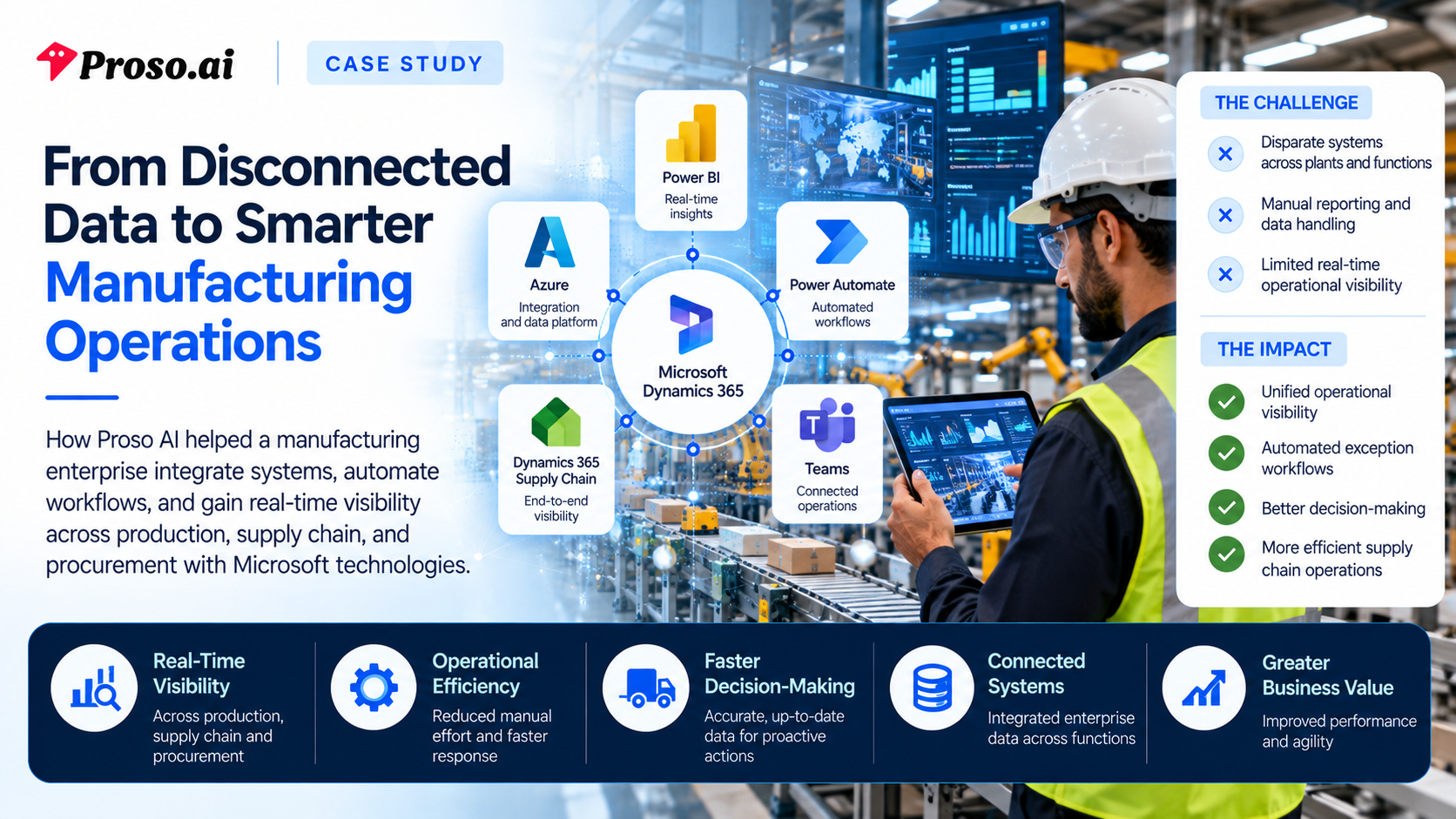
Connecting operational data to support faster, more informed decisions.
Manufacturers depend on coordination across production, procurement, inventory, logistics, finance, and sales. When these functions rely on disconnected systems and manually updated spreadsheets, even a small disruption can be difficult to identify and resolve quickly.
A delayed supplier delivery may affect production schedules. An inventory discrepancy may go unnoticed until an order is at risk. Operations teams may spend hours consolidating reports before leadership can understand what is happening across facilities.
Proso AI's proposed solution uses Microsoft enterprise technologies to improve data visibility, automate selected operational workflows, and give teams a more consistent view of business performance.
Improve Operational Visibility
Bring relevant production, inventory, procurement, and delivery information into more accessible reporting views.
Dynamics 365 Integration
Where Dynamics 365 is part of the customer's environment, connect relevant ERP and supply-chain data to support consistent access to information across business functions. The precise integration design depends on the customer's existing applications and architecture.
Identify Exceptions Earlier
Help teams identify potential delays, inventory discrepancies, and process bottlenecks using timely data and clearly defined business rules.
Power BI Operational Dashboards
Develop role-based dashboards for relevant indicators such as inventory status, procurement progress, order fulfillment, and production performance, using validated source data and agreed definitions.
Reduce Spreadsheet-Driven Work
Automate recurring reporting, notifications, approvals, and data-handling tasks where suitable integrations are available.
Power Automate Exception Workflows
Configure alerts, approval routing, and escalation workflows for selected operational exceptions—for example, overdue approvals, delayed order updates, or inventory thresholds.
The intended outcomes should be established during discovery and measured after implementation.
Recommended measures: Reporting preparation time, exception detection and resolution time, inventory discrepancy rates, approval cycle time, order fulfillment performance, and manual data-handling effort.
Manufacturing efficiency depends on more than production capacity. It also depends on the quality, availability, and timeliness of information used to coordinate operations.
Microsoft's business applications, analytics, integration, and automation capabilities can help manufacturers connect operational information and respond more effectively to disruptions—provided the underlying data, integrations, and workflows are designed around actual business needs.
Proso AI helps organizations align enterprise applications, integration architecture, automation, and analytics with business objectives. For manufacturers, this means focusing on operational bottlenecks first and selecting technology capabilities that address them.
Explore how Microsoft enterprise technologies can help connect your systems, improve visibility, and support more responsive manufacturing and supply-chain operations.


.png)
.png)